

TL;DR:
- Immediate documentation, remaining silent, and consulting a lawyer are crucial after arrest in New Hampshire.
- Defense strategies involve case review, motions, negotiations, trial prep, and sentencing, tailored to NH laws.
- Private attorneys generally lead to better outcomes than public defenders, but choices depend on resources and case specifics.
Facing a criminal charge in New Hampshire is overwhelming. The risk to your freedom, finances, and reputation is real, and every decision you make from the first moment matters. Many people feel paralyzed by the legal process, unsure of what to do or who to trust. This guide breaks down a clear, step-by-step approach to building a defense strategy tailored to your situation, so that a confusing system becomes something you can actually navigate with confidence.
Table of Contents
- What you need before starting your defense
- Step-by-step defense strategy: Core mechanics in NH
- Choosing your approach: Plea or trial?
- Who represents you: Public defender or private counsel?
- Why ‘tailoring’ your defense is more important than ever
- Need strategic criminal defense in New Hampshire?
- Frequently asked questions
Key Takeaways
| Point | Details |
|---|---|
| Act fast, protect rights | Time is critical—document everything and invoke your right to silence immediately. |
| Know New Hampshire’s process | Each defense step—review, motions, negotiation, possible trial—is shaped by NH laws and local practice. |
| Choose legal counsel wisely | Private counsel usually leads to better outcomes but always weigh your options. |
| Personalize your strategy | Every case is unique—local facts and court tendencies matter as much as the law. |
What you need before starting your defense
Once you’ve recognized the seriousness of your situation, the first step is preparation. What you do in the hours and days immediately after an arrest can shape your entire case.
The most important action you can take right away is to document arrest details and invoke your rights immediately. Write down the time, location, officers involved, and anything said during the arrest. Accuracy matters because memories fade quickly.
Your Miranda rights give you the right to remain silent and the right to an attorney. Use both. Do not answer questions without a lawyer present, even if officers suggest it will help your case. It rarely does.
Here is a checklist of what to gather as early as possible:
- Arrest documentation and booking paperwork
- Bail terms and conditions
- Names and contact information of potential witnesses
- Any police reports you are entitled to receive
- Personal identification and financial records for your attorney
Pro Tip: Contact a private criminal defense attorney for an initial consultation even if you expect to qualify for a public defender. Early legal advice can prevent costly mistakes before formal representation begins.
New Hampshire also has local resources that can support you or assist your attorney. The NH defense resources available through organizations like MCLE provide continuing legal education and guidance relevant to NH criminal proceedings.
“The single most protective thing you can do after an arrest is stay quiet and get a lawyer. Everything else flows from those two decisions.”
Understanding the defense attorney role early in the process helps you set realistic expectations and work more effectively with your legal team.

Step-by-step defense strategy: Core mechanics in NH
With preparation in place, you’re ready to map out an actionable defense plan. New Hampshire’s criminal process has specific procedural rules, and working within them strategically can make a significant difference in your outcome.
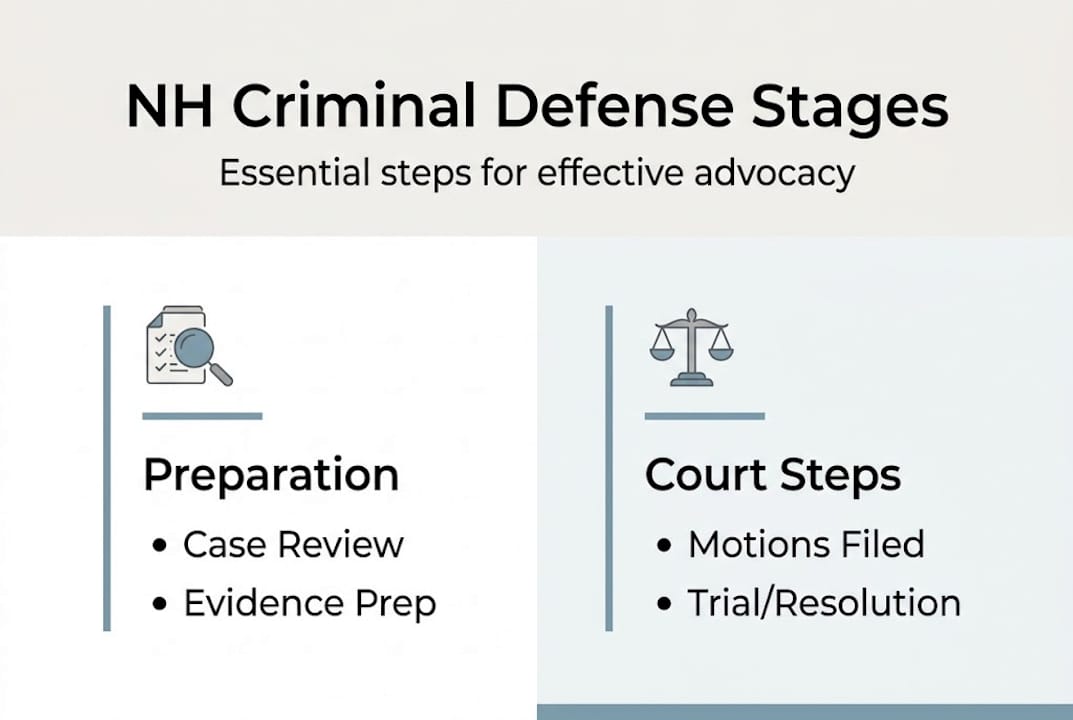
Here are the five core stages of an NH defense process:
- Case review: Understand the exact charges, what evidence exists, and the potential penalties you face.
- Motion to suppress: If police obtained evidence illegally, your attorney can file a motion to have it excluded from trial.
- Plea negotiations: Your attorney works with prosecutors to seek reduced charges or alternative sentencing.
- Trial preparation: If negotiations fail, build a strategy based on the facts, weaknesses in the prosecution’s case, and jury considerations.
- Sentencing advocacy: If convicted, prepare a mitigation argument to reduce the severity of your sentence.
Pro Tip: New Hampshire courts reward attention to procedural detail. Filing motions on time and correctly can suppress key evidence or even lead to dismissed charges.
The table below summarizes each stage with its NH-specific focus:
| Stage | NH-specific focus |
|---|---|
| Case review | Charges under NH RSA titles, bail conditions |
| Motion to suppress | 4th Amendment violations, unlawful stops |
| Plea negotiations | Prosecutor tendencies, charge severity |
| Trial preparation | Jury selection, local court rules |
| Sentencing advocacy | Mitigating factors, alternative programs |
For more detail on hiring a criminal attorney in New Hampshire, it helps to understand how attorneys approach each stage and what questions to ask during your consultation.
Choosing your approach: Plea or trial?
As you move through the process, a critical decision point is choosing whether to accept a plea or fight in court. This choice depends on several factors specific to your case.
Plea bargaining is a negotiated agreement where you plead guilty to a lesser charge in exchange for a reduced sentence or dropped counts. A trial means presenting your case before a judge or jury with the goal of acquittal.
Key decision points to consider:
- Strength of the evidence against you
- Severity of the charges and associated penalties
- Your personal risk tolerance regarding a possible conviction
- Local court tendencies and the prosecutor’s track record
Plea bargaining resolves approximately 90% of NH cases, often reducing sentences by 30 to 40%. That is a significant outcome for many defendants. On the other hand, trials in NH carry roughly a 70% conviction risk, though they offer the possibility of full acquittal when evidence is weak.
| Factor | Plea bargain | Trial |
|---|---|---|
| Certainty of outcome | High | Low |
| Potential sentence | Reduced | Full range possible |
| Typical timeline | Weeks to months | Months to over a year |
| Risk level | Lower | Higher |
| Acquittal possible | No | Yes |
For a deeper look at plea versus trial considerations in New Hampshire, reviewing local conviction data with your attorney helps frame the decision clearly.
Who represents you: Public defender or private counsel?
After choosing your core approach, the next pivotal factor is the quality of your legal representation. In New Hampshire, public defenders are assigned based on financial eligibility under RSA 604-A:2. If your income qualifies, the court will appoint one at no cost.
However, public defenders in New Hampshire face serious caseload pressures. Private counsel improves outcomes by up to 75% compared to public defenders, partly because NH faces significant public defender shortages that limit the time each client receives.
Here is a direct comparison:
- Cost: Public defenders are free; private attorneys require fees, though payment plans are common.
- Caseload: Public defenders often carry 80 to 100 cases at once; private attorneys typically manage far fewer.
- Resources: Private firms can invest in investigators, expert witnesses, and thorough document review.
- Personal attention: Private counsel typically offers more frequent communication and proactive strategy.
NH data shows that hiring counsel can drop conviction rates from the 75 to 85% range down to 45 to 60%, a meaningful shift in likely outcomes.
Pro Tip: Even if you qualify for a public defender, schedule a consultation with a private attorney before making your decision. Many offer free or low-cost initial meetings, and the comparison is worth your time.
Understanding your options around private versus public representation is one of the most impactful choices you will make in your case.
Why ‘tailoring’ your defense is more important than ever
Beyond choosing the right advocate, effective defense also means personalizing your approach. The most overlooked truth in criminal defense is that strategy is not a checklist. It is a reflection of your specific circumstances.
For example, diversion programs and deferred prosecution work well for first-time or non-violent offenders in New Hampshire, but aggressive motion filing may be the right move for someone with prior charges and strong constitutional arguments. What works in one case can backfire in another.
Local knowledge of New Hampshire judges and prosecutors often matters more than general legal strategy. An attorney who has appeared regularly in your county’s courthouse understands how specific prosecutors negotiate, which judges respond to which arguments, and where procedural leverage exists. That insight cannot be replicated by strategy alone.
Proactive, individualized preparation shifts negotiations before they even begin. Treat your case as unique because it is.
Need strategic criminal defense in New Hampshire?
The strategies outlined here reflect what it actually takes to navigate criminal charges in New Hampshire effectively. At Naro Law, we understand the pressure you’re under, and we focus on building defense strategies that fit your unique circumstances, not generic templates.
Whether you’re in Concord, need Manchester defense attorneys, or are searching for a trusted Nashua defense team, our consultations are confidential and focused on real, practical outcomes. Contact us today to take a proactive step toward protecting your future.
Frequently asked questions
What are the first steps to take after being arrested in New Hampshire?
Immediately document your arrest details, stay silent, and ask to speak with a lawyer before answering any questions from law enforcement.
How do I know if a plea bargain is my best option?
Review your evidence carefully with an attorney, keeping in mind that 90% of NH cases resolve through plea deals, often with sentence reductions of 30 to 40%.
Is it better to hire a private attorney than use a public defender?
Private counsel improves outcomes by up to 75% compared to public defenders in NH, though public defenders remain a viable option for those who financially qualify.
Are diversion programs or alternative sentences available in New Hampshire?
Yes, for first-time and some low-level offenses, diversion or rehabilitation programs may apply. Ask your defense attorney whether you qualify based on your charge and history.


