

TL;DR:
- Police can search a vehicle without a warrant only under specific legal conditions such as voluntary consent, probable cause, or recognized exceptions. Drivers in New Hampshire can lawfully refuse a search by clearly stating their refusal and without physically resisting, which protects their rights. Knowing and asserting these rights can prevent unlawful searches and preserve evidence suppression options in court.
A police officer can search your car without a warrant only when specific legal conditions are met, such as your voluntary consent, probable cause, or a recognized exception to the Fourth Amendment. New Hampshire drivers who understand these conditions are far better positioned to protect their rights during a traffic stop. Knowing the difference between a lawful warrantless search and an unlawful one is not just useful knowledge. It can determine whether evidence gets thrown out in court.
What legal exceptions allow police to search your car without a warrant?
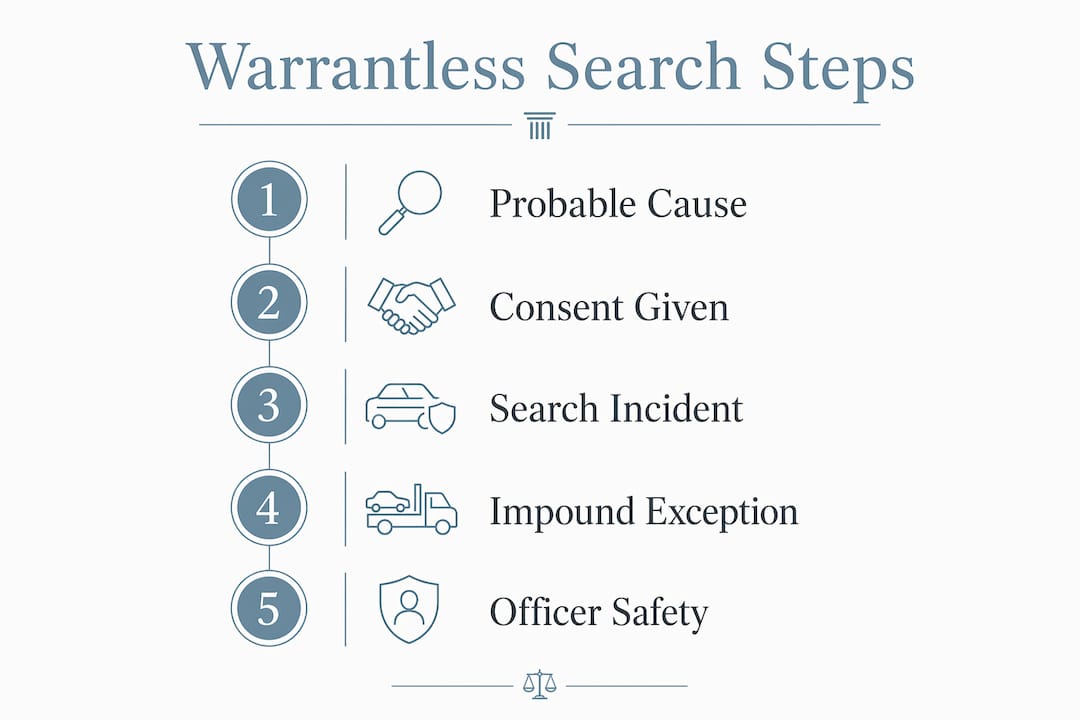
A warrantless car search is legal under several well-defined exceptions, not as a general rule. Courts have recognized these exceptions because vehicles are mobile and carry lower privacy expectations than homes. Each exception has firm boundaries that officers must respect.
The main exceptions include:
- Probable cause (the automobile exception). Police may search your vehicle if they have specific, articulable facts suggesting it contains evidence or contraband. A vague hunch does not qualify.
- Consent. If you agree to a search, officers do not need a warrant. Voluntary consent waives your Fourth Amendment protections, and any evidence found becomes admissible.
- Search incident to arrest. After a lawful arrest, officers may search the vehicle. However, the U.S. Supreme Court’s ruling in Arizona v. Gant limits this search to areas within the suspect’s reach or to evidence related to the specific offense.
- Plain view doctrine. If an officer lawfully stops your vehicle and sees illegal items in plain sight, such as drugs, open alcohol containers, or weapons, that observation can establish probable cause for a broader search.
- Emergency circumstances. If officers reasonably believe evidence is about to be destroyed or someone is in danger, they may search without waiting for a warrant.
- Inventory searches. When a vehicle is impounded, police may conduct an inventory search. These require written departmental policies and cannot be used as a pretext for a criminal investigation.
Pro Tip: Being stopped for a minor traffic violation does not give police automatic search rights. A routine traffic stop alone requires additional legal justification before any vehicle search is lawful.
How do New Hampshire drivers legally refuse a vehicle search?
Drivers in New Hampshire have a clear constitutional right to refuse consent to a vehicle search. Exercising that right calmly and clearly is the most direct way to protect yourself during a traffic stop.
Follow these steps if an officer asks to search your car:
- Stay calm and comply with lawful orders. Pull over safely, keep your hands visible, and provide your license, registration, and proof of insurance when asked.
- State your refusal clearly. Say, “I do not consent to a search of my vehicle.” Saying this out loud matters. If you do not verbally refuse, courts may infer implied consent, which weakens any later motion to suppress evidence.
- Do not physically resist. Refusal is a legal act, not a physical one. If an officer searches your car anyway, do not interfere. Your remedy is in court, not at the roadside.
- Ask for an attorney. If you are arrested or believe a search was unlawful, request legal counsel immediately.
- Document everything afterward. Write down the officer’s name, badge number, patrol car number, and everything you remember about the stop as soon as possible.
New Hampshire drivers who clearly state refusal protect their ability to file suppression motions later if the search violated their Fourth Amendment rights. Refusal alone cannot be used as probable cause to justify a search.
Pro Tip: Consent requests often sound like commands. Phrases like “I need to take a look in your car” are requests, not orders. You are legally entitled to say no.

What is probable cause, and how do officers establish it?
Probable cause is the legal standard that allows police to search your vehicle without your permission and without a warrant. It requires objective, specific facts, not guesses or general suspicion.
Common examples that courts have accepted as probable cause include:
- The smell of marijuana or alcohol coming from the vehicle
- Visible contraband, such as drug paraphernalia or an open container
- Suspicious behavior combined with other observable facts
- A passenger or driver making furtive movements when approached
What does not qualify as probable cause is equally important. An officer’s vague feeling that something seems “off” is not enough. The facts must be specific and capable of being described to a judge.
“Probable cause requires more than a hunch. Officers must point to concrete, observable facts that would lead a reasonable person to believe a crime is occurring or evidence is present.” — Standard applied by U.S. courts under the Fourth Amendment
If an officer conducts a warrantless search and cannot later articulate those specific facts, the search may be ruled unlawful. Evidence obtained during an unlawful search can be suppressed, meaning it cannot be used against you in court.
How does New Hampshire law affect warrantless car searches?
New Hampshire courts apply Fourth Amendment protections alongside state constitutional provisions, which in some cases offer drivers broader protections than federal law alone.
| Legal Framework | Key Rule | Impact on NH Drivers |
|---|---|---|
| Fourth Amendment | Prohibits unreasonable searches without warrant | Core protection for all drivers |
| Automobile exception | Probable cause allows warrantless search | Officers must articulate specific facts |
| Arizona v. Gant (2009) | Limits search after arrest to offense-related evidence | Restricts invasive post-arrest searches |
| Inventory search rules | Must follow written departmental policy | Prevents pretextual impound searches |
| NH Part I, Article 19 | State constitutional search protections | May provide stronger rights than federal floor |
New Hampshire’s state constitution, specifically Part I, Article 19, mirrors the Fourth Amendment but has been interpreted by state courts to reinforce individual privacy rights. Local police departments must also follow their own written inventory search procedures. Courts scrutinize those procedures closely to prevent officers from using impound searches as a workaround for lacking probable cause.
What practical steps protect you from unlawful vehicle searches?
Knowing your rights matters most when you are actually pulled over. These steps keep you protected without escalating the situation:
- Remain calm. Anxiety can lead to statements or actions that officers may interpret as suspicious.
- Do not volunteer information. Answer basic identification questions, but do not explain where you are going or what is in your car unless legally required.
- Clearly refuse consent if you do not agree to a search. Silence or ambiguity can be interpreted as agreement.
- Do not lie. Lying to an officer can create additional legal problems. Silence is always a safer option.
- Request an attorney if searched. If police search your vehicle over your objection, state clearly that you want to speak with a lawyer before answering any further questions.
- Review your rights before your next stop. Narolaw’s guide on your rights when pulled over in New Hampshire covers this in detail.
If police search your car for drugs specifically, Narolaw also provides guidance on what to do after a drug search, including how to protect your defense from the moment the stop ends.
Key Takeaways
A cop can legally search your car without a warrant only under specific exceptions, including probable cause, consent, plain view, search incident to arrest, emergency circumstances, or a lawful inventory search.
| Point | Details |
|---|---|
| Warrant exceptions are limited | Police need probable cause, consent, or another recognized exception to search without a warrant. |
| Consent is always voluntary | You have the right to refuse a search request; refusal alone cannot create probable cause. |
| State your refusal out loud | Saying “I do not consent” protects your ability to challenge the search in court later. |
| Arizona v. Gant limits post-arrest searches | Officers cannot search your car freely after arrest; the search must relate to the specific offense. |
| Document everything after the stop | Write down officer details and the sequence of events as soon as possible to support any legal challenge. |
Why most drivers give up rights they never had to surrender
The single most common mistake I see is drivers who consent to a search because the request sounded like an order. Officers are trained to ask in a confident, authoritative tone. Most people comply because they assume refusal will make things worse. It rarely does, and it almost always makes things better legally.
Refusal does not make you look guilty. Courts have confirmed that repeatedly. What refusal does is preserve your options. If an officer had no real probable cause and you said yes anyway, that evidence is almost certainly coming in against you. If you said no and the officer searched anyway, a skilled defense attorney can move to suppress that evidence entirely.
The other misconception worth addressing is that a traffic stop grants broad search authority. It does not. A lawful stop for speeding gives an officer the right to check your license and registration. Nothing more. Any search beyond that requires independent justification.
Knowing this does not make you confrontational. It makes you prepared.
— Rich
Narolaw is ready to defend your rights in New Hampshire
If you believe your vehicle was searched unlawfully during a traffic stop, the outcome of your case may depend on acting quickly. Narolaw’s New Hampshire criminal defense attorneys have experience handling unlawful search and seizure cases, including motions to suppress evidence obtained without proper legal justification. A free consultation can clarify whether your Fourth Amendment rights were violated and what options you have. Narolaw serves clients across Manchester, Concord, Nashua, Portsmouth, and surrounding communities. Contact Narolaw to speak with an attorney who understands New Hampshire car search laws and can build a defense tailored to your situation.
FAQ
Can a cop search my car without a warrant during a routine stop?
A routine traffic stop alone does not justify a vehicle search. Officers need additional legal grounds, such as probable cause or your consent, before searching your car.
Does refusing a car search make me look guilty?
Refusing consent to a search is a constitutional right and cannot be used as probable cause on its own. Courts have consistently upheld the right to refuse without that refusal implying guilt.
What happens if police search my car illegally?
Evidence obtained through an unlawful search can be challenged through a suppression motion. If the court agrees the search violated your Fourth Amendment rights, that evidence may be excluded from your case.
Can police search my car after arresting me?
Yes, but with limits. Under Arizona v. Gant, officers can only search areas within your reach or look for evidence directly related to the offense for which you were arrested.
Do I have to answer questions during a traffic stop in New Hampshire?
You must provide your license, registration, and proof of insurance. Beyond that, you have the right to remain silent and to request an attorney before answering further questions.


