

TL;DR:
- Police cannot search the digital contents of your phone after arrest without a warrant because it violates your constitutional rights. Seizing your phone is legal, but searching or opening it requires specific judicial permission. Refusing consent and requesting an attorney protect your privacy rights during an arrest.
Police cannot search the digital contents of your phone after an arrest without a warrant. This protection is not a technicality. It is a constitutional right established by the U.S. Supreme Court in Riley v. California (2014), which recognized that smartphones hold an extraordinary amount of private information. Officers may take your phone from you at the scene, but accessing your texts, photos, emails, or apps requires judicial approval. Knowing the difference between physical seizure and a digital search is the first step toward protecting your privacy rights during arrest.
Can police search my phone after an arrest?
The short answer is no, not without a warrant. The Supreme Court unanimously ruled in Riley v. California that police cannot search the digital contents of a cell phone seized during a lawful arrest without first obtaining a warrant. That ruling changed the legal standard for phone search law after arrest across the entire country.
The Court’s reasoning was direct: a smartphone is not a wallet or a cigarette pack. It contains years of personal communications, financial records, location history, and private photographs. Treating it like ordinary physical evidence would expose far more private data than the Fourth Amendment permits.
Key protections the Riley ruling established:
- Police may seize your phone to prevent tampering, but they cannot open it.
- Any deliberate interaction with your phone’s screen, including scrolling, constitutes a search requiring a warrant.
- Warrants must be specific about the device and the items sought, satisfying the Fourth Amendment’s particularity requirement.
Pro Tip: The “plain view” doctrine does not apply to phone screens. An officer who glances at your unlocked screen and sees a notification has not legally searched your phone. But an officer who scrolls through your messages has.
What exceptions allow a warrantless phone search?
Two legal exceptions permit police to access your phone without a warrant: voluntary consent and exigent circumstances. Both are narrow, but both are real risks.
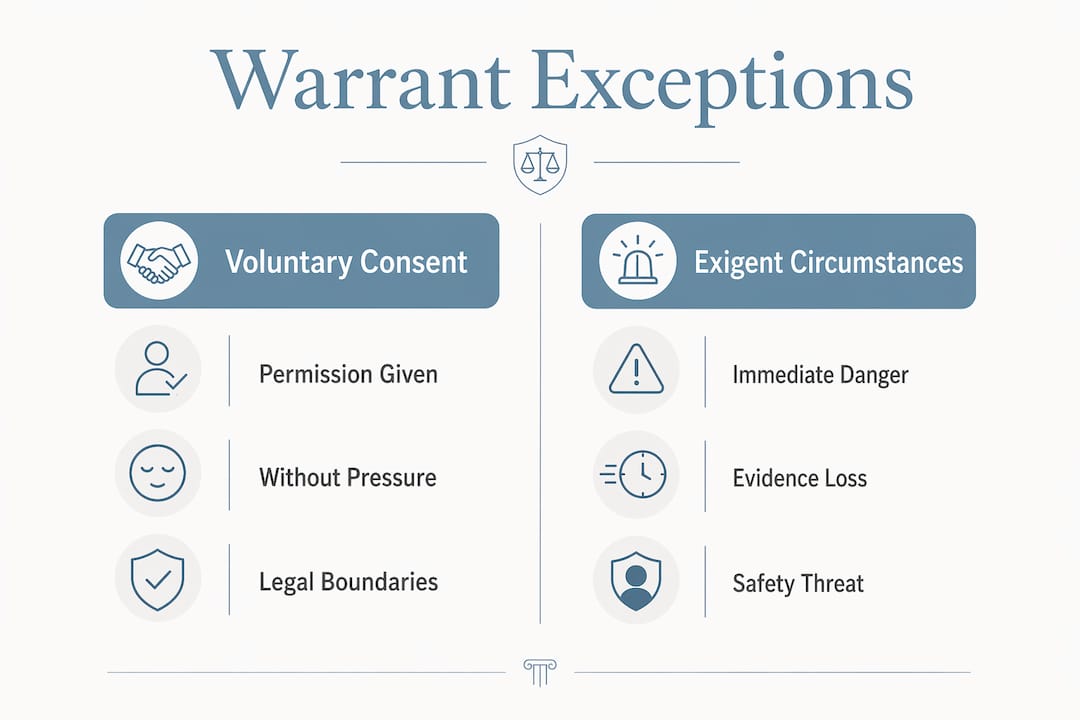
Consent is the most common reason warrantless phone searches happen. Consent is the most frequent cause of warrantless searches, and it is legally binding once given. Many people hand over their phones out of politeness or because they believe refusing looks suspicious. Neither assumption is correct. You have the right to refuse, and refusal cannot be used as evidence of guilt.
Exigent circumstances cover situations where waiting for a warrant would cause immediate harm or allow evidence to be destroyed. Examples include:
- A credible, immediate threat to someone’s physical safety that requires accessing the phone.
- Concrete evidence that data is being remotely wiped in real time.
- A situation where a co-conspirator is actively communicating through the device.
The burden falls on law enforcement to justify the exception after the fact. Courts examine these claims closely, and a judge can suppress evidence obtained through an unjustified warrantless search. Knowing your rights when pulled over or arrested applies equally to your phone.
Pro Tip: Never try to explain or “help” officers by showing them content you think is harmless. Pointing out innocent data can inadvertently create probable cause for a warrant covering far more of your device.
What happens to your phone physically when police arrest you?
Physical seizure of your phone is routine and legal. It does not mean police are searching it. Officers confiscate phones primarily to prevent remote wiping, encryption activation, or any other action that could destroy potential evidence.
Once seized, police use specific procedures to preserve the device:
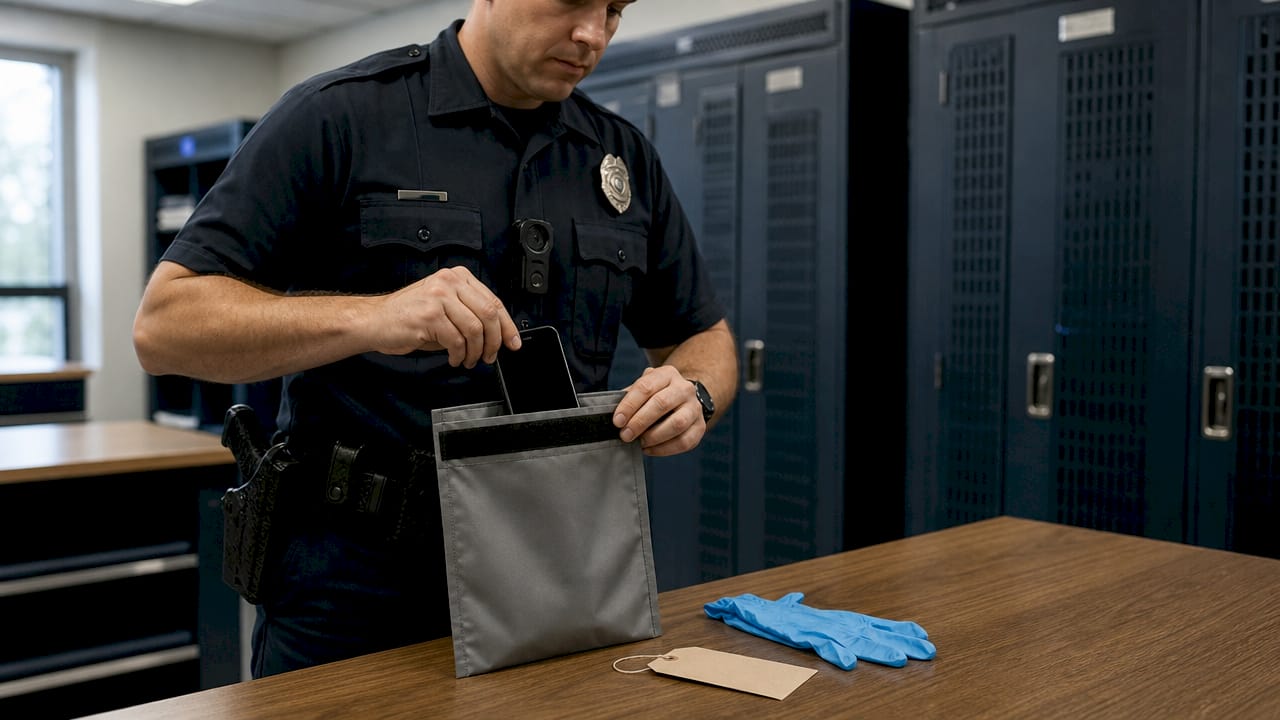
- Faraday bag isolation. Officers place phones in Faraday bags to block wireless signals, preventing remote wipe commands or new data from reaching the device.
- Evidence logging. The phone is cataloged as physical evidence with a chain of custody record.
- Warrant application. Investigators then apply for a search warrant, describing the specific device and the categories of data they seek.
- Forensic extraction. Once a warrant is granted, trained forensic examiners extract data using specialized tools. The scope of extraction must match the warrant’s terms.
The critical distinction is this: physical control of your phone is not the same as legal access to your data. Police holding your phone in a Faraday bag have not searched it. Understanding digital evidence in court helps clarify why these procedural steps matter so much for your defense.
How should you respond if police want to search your phone?
Your response at the moment of arrest shapes your legal position for everything that follows. The arrest scene is not the place for negotiation or explanation.
Follow these steps clearly and calmly:
- Refuse consent explicitly. Say: “I do not consent to a search of my phone.” Simple, direct refusal is both legal and effective.
- Request an attorney immediately. Say: “I want a lawyer.” Stop speaking after that.
- Do not unlock your phone voluntarily. Handing over your passcode waives your Fourth Amendment protections for that search.
- Do not attempt to delete data. Tampering with phone data during an arrest can result in obstruction charges, which compound your legal problems significantly.
The question of whether you must unlock your phone is legally unsettled in one specific area. Police cannot compel you to reveal a passcode because the Fifth Amendment protects against self-incrimination. However, courts remain divided on whether police can compel biometric unlocking, such as a fingerprint or face scan. The safest approach is to refuse any form of unlocking and request counsel immediately.
Pro Tip: Silence is not suspicious. Remaining quiet and requesting a lawyer is the single most protective action you can take. Anything you say or do at the arrest scene can be used against you.
Protecting your digital privacy during a criminal investigation starts with knowing these boundaries before you ever need them.
Key Takeaways
Police cannot search your phone’s digital contents after an arrest without a warrant, and the Riley v. California ruling makes that protection one of the strongest in modern Fourth Amendment law.
| Point | Details |
|---|---|
| Warrant required for digital search | Police must obtain a specific, probable-cause warrant before accessing any phone data. |
| Physical seizure is legal and routine | Officers can confiscate your phone to prevent data destruction without searching it. |
| Consent waives your protections | Voluntarily handing over your phone or passcode removes your Fourth Amendment shield. |
| Refusal is your right | Clearly stating “I do not consent” and requesting a lawyer is both legal and protective. |
| Biometric unlocking is legally unsettled | Passcode refusal is protected by the Fifth Amendment; biometric compulsion remains contested in courts. |
What I’ve seen when people don’t know these rules
I’ve worked with clients who handed over their phones within seconds of being asked, genuinely believing that cooperating would make things easier. It rarely does. In most of those cases, the data recovered from the phone became the centerpiece of the prosecution’s case, and the defense had almost nothing to work with because the client had consented freely.
The pattern I see most often is this: people confuse politeness with legal obligation. An officer asking to see your phone sounds like a reasonable request. Saying no feels confrontational. But the law does not require you to be accommodating with your private data, and no judge will penalize you for asserting a constitutional right.
The other mistake I see is people trying to manage the situation by talking. Explaining that there is “nothing bad” on the phone, or offering to show officers specific messages to prove innocence, almost always backfires. That kind of voluntary disclosure can create the probable cause needed for a full warrant. The arrest scene is not a negotiation. Your attorney’s office is.
My consistent advice: say nothing beyond your name, refuse consent clearly, and ask for a lawyer. Every time. The law is on your side when you know how to use it.
— Rich
Narolaw’s criminal defense team can protect your phone search rights
Facing an arrest is stressful, and the decisions you make in the first few minutes can affect your entire case. Narolaw’s criminal defense attorneys in New Hampshire understand the legal standards governing phone searches and know how to challenge unlawful access to your data. Whether police searched your phone without a warrant or pressured you into consent, there are legal remedies available. Narolaw handles cases across the state, including in Manchester, Concord, and Nashua, and offers free consultations so you can understand your options without delay. Reach out to Narolaw’s Concord criminal defense team to get started.
FAQ
Can police search my phone without a warrant after arresting me?
No. The Supreme Court’s Riley v. California ruling requires police to obtain a warrant before searching the digital contents of any phone seized during an arrest.
Do I have to unlock my phone for police?
You cannot be compelled to reveal your passcode under the Fifth Amendment. Whether police can force biometric unlocking remains legally unsettled, so the safest response is to refuse and request an attorney.
What happens to my phone when I am arrested?
Police can legally seize your phone to prevent data destruction. They typically place it in a Faraday bag to block wireless signals while they apply for a search warrant.
Can I refuse a police request to search my phone?
Yes. Clearly stating “I do not consent to a search of my phone” is a legal and protected response. Refusal cannot be treated as evidence of guilt.
What if I already consented to a phone search?
Consenting to a search waives your Fourth Amendment protections for that interaction, but an attorney can still examine whether the search exceeded the scope of your consent or whether other violations occurred.


