

TL;DR:
- Child custody involves legal decision-making authority and physical living arrangements, which are evaluated separately.
- Using precise, state-specific legal terminology in petitions and parenting plans is essential to avoid delays, misunderstandings, and costly amendments.
Child custody terminology is the legal language that defines who makes decisions for a child and where that child lives after a separation or divorce. Understanding these terms is not optional. The words you use in a petition, parenting plan, or court filing directly affect your rights, your child’s stability, and whether your case moves forward without costly delays. This guide breaks down the core child custody definitions, explains how divorce custody terms vary by state, and gives you the practical knowledge to protect your position from the start.
What does child custody terminology actually mean?
Child custody consists of two independent components: legal custody and physical custody. Courts evaluate each one separately, which means a parent can hold joint legal custody while the other parent holds primary physical custody. These are not the same thing, and confusing them is one of the most common and costly mistakes parents make.

Legal custody refers to the authority to make major decisions about a child’s life, including education, healthcare, and religious upbringing. Physical custody refers to where the child lives on a day-to-day basis and how parenting time is divided. A parent can have one without the other, and courts design arrangements based on what serves the child’s best interests rather than what feels fair to either parent.
Common custody arrangements include:
- Joint legal custody with primary physical custody: Both parents share decision-making, but the child lives mainly with one parent.
- Sole legal and physical custody: One parent holds all decision-making authority and the child lives with them full time.
- Joint physical custody: The child splits time between both homes, sometimes equally, sometimes on a structured schedule.
- Split custody: Each parent has primary physical custody of at least one child when there are multiple children.
Pro Tip: Always specify in your parenting plan which decisions require joint consent and which a parent can make independently. Vague language like “major decisions” without examples creates disputes that send families back to court.
How does custody language vary from state to state?
The phrase “child custody” is not universal in American law. Many states have replaced traditional custody terms with modern alternatives designed to reduce the adversarial tone of family court proceedings. The shift reflects a deliberate effort to discourage a winner-loser approach and encourage cooperative co-parenting from the start.
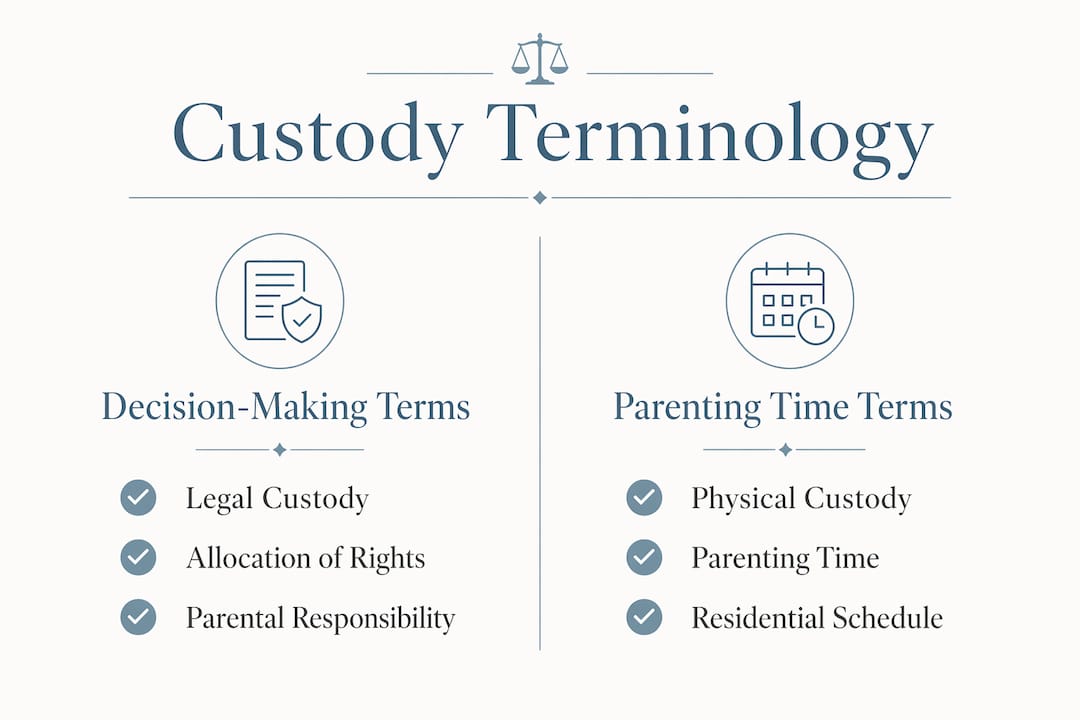
Here is how terminology differs across key states:
| State | Term for decision-making | Term for parenting time |
|---|---|---|
| Illinois | Allocation of parental responsibilities | Parenting time |
| Texas | Conservatorship (managing/possessory) | Possession and access |
| Arizona | Legal decision-making | Parenting time |
| Colorado | Parental responsibilities | Parenting time |
| Florida | Parental responsibility | Time-sharing |
| Washington | Parenting functions | Residential schedule |
These are not interchangeable labels. Illinois courts will not recognize a petition that uses “custody” where the statute requires “allocation of parental responsibilities.” Texas uses “joint managing conservatorship” where other states say “joint legal custody.” Using incorrect terminology in legal filings can cause procedural delays or require costly amendments. That means more time, more money, and more stress for your family.
One additional complexity: default presumptions differ by state. In Wisconsin, for example, unmarried parents start with different custody presumptions, which directly affects who must petition for shared rights. Knowing your state’s specific rules matters more than memorizing general definitions.
Pro Tip: Before filing any custody petition, look up your state’s current family law statutes or ask an attorney to confirm the exact terminology required. One wrong word can stall your case.
What is a parenting plan and why does its language matter?
A parenting plan is a court-enforceable document that formalizes every aspect of a custody arrangement. Parenting plans detail parenting time schedules, decision-making authority, communication protocols, and financial responsibilities, with at least 24 specific provisions that must be addressed, including holidays, relocation restrictions, and tax entitlements. That level of detail is not bureaucratic excess. It is protection.
Clear, specific language in a parenting plan prevents disputes before they start. A schedule that says “alternating weekends” leaves room for conflict. A schedule that specifies pickup times, school holiday splits, and a defined process for schedule changes does not. Modern parenting plans commonly incorporate mandatory mediation clauses and structured communication protocols to reduce costly court returns.
Key terms you will encounter in custody agreement language include:
- Parenting time: The scheduled periods each parent spends with the child.
- Decision-making authority: The right to make choices about education, healthcare, religion, and extracurricular activities.
- Right of first refusal: A requirement that a parent offer the other parent childcare before using a third party.
- Relocation clause: A provision restricting a parent from moving beyond a defined distance without court approval or the other parent’s consent.
- Dispute resolution process: The agreed method, often mediation, for resolving disagreements before returning to court.
Each of these terms carries legal weight. Omitting any one of them from your agreement creates a gap that a future dispute can fall into.
How do joint legal and physical custody interact?
Parents often misunderstand joint legal custody as granting equal parenting time. It does not. Joint legal custody means shared decision-making authority. The child’s physical schedule is a separate determination entirely.
Courts assess the best interests of the child standard independently for legal and physical custody. A judge may grant joint legal custody because both parents are capable decision-makers, while awarding primary physical custody to one parent because of school proximity, work schedules, or the child’s established routine. All custody decisions are governed by the best interests standard, which considers relationships, stability, and history of abuse, among other factors.
The scope of joint legal custody has also expanded. Courts increasingly expect detailed decision-sharing arrangements beyond traditional health, education, and religion, now including extracurriculars, therapy, daycare, and summer camp. This expansion means parents need to explicitly detail which decisions require joint consent in their parenting plans to avoid ongoing disputes.
To protect yourself under a joint legal custody arrangement, consider these steps:
- List every category of decision in your parenting plan, not just the traditional three.
- Specify a response timeline for joint decisions so one parent cannot stall indefinitely.
- Define what happens when parents disagree, including whether a mediator or the court decides.
- Clarify which routine decisions each parent can make independently during their parenting time.
What practical steps protect parents during custody proceedings?
Knowing your state’s custody terminology and default presumptions is more critical than memorizing general definitions. Use the exact statutory language your state requires in every filing, every motion, and every agreement. Ask your attorney to review all documents before submission, specifically to check that terminology matches current statutes.
When negotiating custody agreement language, ask for specificity on every provision. Request that your parenting plan define “major decisions” with concrete examples. Confirm whether your state uses “parenting time” or “visitation,” and use the correct term consistently. If you are an unmarried parent, understand your state’s default presumptions before assuming you have equal rights. For parents in complex family situations, resources like children from two relationships can offer useful comparative context on how custody terms apply across different family structures.
Pro Tip: If you are filing in New Hampshire, review the state’s specific parenting plan requirements before drafting any agreement. New Hampshire courts expect detailed schedules and defined decision-making protocols. You can find guidance on custody types in New Hampshire to understand what the courts expect.
Key takeaways
Understanding child custody terminology is the foundation of every effective custody arrangement, because the words in your legal documents define your rights, your child’s stability, and your ability to co-parent without returning to court.
| Point | Details |
|---|---|
| Legal vs. physical custody | These are separate rights evaluated independently; you can share one without sharing the other. |
| State-specific language | Terms like “conservatorship” and “allocation of parental responsibilities” are legally required in certain states. |
| Parenting plan precision | Plans must address at least 24 provisions; vague language creates disputes and court returns. |
| Joint custody misconception | Joint legal custody means shared decisions, not equal time. Schedules are determined separately. |
| Default presumptions matter | Unmarried parents in some states start with unequal rights and must petition for shared custody. |
Why terminology is the first battle in any custody case
From working with families through custody disputes, the confusion I see most often is not about the law itself. It is about the words. A parent comes in believing they have “joint custody” because they agreed to it verbally, only to discover their state uses “parenting time” and “allocation of parental responsibilities,” and nothing they agreed to is enforceable without a court order using the right language.
The shift toward modern terminology in states like Illinois and Colorado was well-intentioned. Removing “winner” and “loser” framing from custody language genuinely does reduce conflict in some cases. But it also created a gap between what parents think they agreed to and what the court will actually enforce. I have seen cases delayed by months because a petition used “custody” in a state that requires “parenting time.” That delay costs money, creates stress, and harms children.
My honest advice: treat terminology as your first priority, not an afterthought. Before you negotiate anything, learn the exact words your state uses. Before you sign anything, have an attorney confirm that every term in your agreement matches current statutory language. Precision at the start prevents years of ambiguity.
— Rich
How Narolaw helps parents get custody right from the start
Narolaw is a New Hampshire-based family law practice that guides parents through every stage of custody disputes, from understanding state-specific terminology to drafting enforceable parenting plans. The team at Narolaw works with parents to use precise, court-ready language in every filing, reducing the risk of procedural delays and protecting your parental rights. Whether you are negotiating a first-time custody arrangement or modifying an existing order, Narolaw provides the legal knowledge and personalized strategy your situation requires. Explore the 2026 custody guide for parents for practical strategies, or contact Narolaw directly to schedule a free consultation with an experienced Manchester custody attorney.
FAQ
What is the difference between legal and physical custody?
Legal custody is the right to make major decisions about a child’s education, healthcare, and religion. Physical custody refers to where the child lives and how parenting time is divided between parents.
Why do custody terms differ between states?
States use different terminology because family law is governed at the state level. Illinois uses “allocation of parental responsibilities,” Texas uses “conservatorship,” and Florida uses “parental responsibility,” all referring to similar concepts but requiring state-specific language in legal filings.
Does joint legal custody mean equal parenting time?
No. Joint legal custody means both parents share decision-making authority. The child’s physical schedule is determined separately and does not need to be equal to reflect joint legal custody.
What happens if I use the wrong custody terms in my filing?
Using incorrect terminology can cause procedural delays, require costly amendments, or result in petition rejections. States like Illinois and Texas require exact statutory language, and errors force parents to refile, adding time and expense to the process.
What should a parenting plan include?
A parenting plan should cover parenting time schedules, decision-making authority, communication protocols, holiday arrangements, relocation restrictions, financial responsibilities, and a dispute resolution process such as mandatory mediation.


