

TL;DR:
- Uncontested divorce in New Hampshire occurs when both spouses agree on all key issues before court involvement, while contested divorce involves unresolved disputes requiring judicial decision. The uncontested process is faster, typically lasting 2–3 months, and less costly, whereas contested cases can take over a year and cost significantly more. Mediation and thorough legal review can help convert disputes into uncontested agreements, saving time, money, and emotional strain.
The difference between contested and uncontested divorce in NH is defined by one factor: whether both spouses agree on all key divorce terms before a judge gets involved. An uncontested divorce means both parties have resolved property division, child custody, visitation, and support in a signed written agreement. A contested divorce means at least one of those issues remains unresolved, requiring a New Hampshire court to decide. New Hampshire is a no-fault divorce state, with irreconcilable differences cited in over 90% of cases. Understanding which process applies to your situation shapes your timeline, your costs, and your level of control over the outcome.
What is the difference between contested and uncontested divorce in NH?
The core legal distinction is straightforward. In an uncontested divorce, spouses submit a complete marital settlement agreement to the court. In a contested divorce, most disputes involve property division, child custody, visitation, and support obligations. That gap between agreement and dispute determines nearly everything else about how your case proceeds.
Uncontested divorce does not require spouses to be friendly or even amicable. It requires a full written and signed agreement on every issue before the court finalizes the decree. Many couples reach that point through mediation, even after starting from a high-conflict position. Contested divorce, by contrast, hands decision-making authority to a judge, who resolves each disputed issue based on New Hampshire law and the evidence presented.
How does each divorce type move through the NH court system?
Both divorce types begin with filing a petition at the New Hampshire Family Division court. From there, the procedures diverge significantly.
For an uncontested divorce, the typical steps are:
- One spouse files the petition, or both file jointly.
- Both parties complete mandatory financial disclosures within 45 days of filing.
- The court reviews the signed marital settlement agreement.
- A brief hearing confirms the agreement is voluntary and fair.
- The judge issues a decree nisi, followed by a 30-day waiting period before the divorce is final.
For a contested divorce, the process expands considerably:
- One spouse files and serves the other with divorce papers.
- Financial disclosures are due within 45 days; temporary order hearings typically occur 30–60 days after filing.
- If children are involved, both parents must attend the mandatory Child Impact Program.
- The court orders mediation, which is generally required when children are part of the case.
- If mediation fails, the case proceeds to discovery, pretrial hearings, and potentially a full trial.
Uncontested divorces in New Hampshire typically take 2–3 months. Contested divorces routinely take 8–18 months or longer, depending on case complexity and court scheduling. That difference in time is not just an inconvenience. It translates directly into attorney hours, court fees, and emotional strain.
Pro Tip: Even in an uncontested case, have an attorney review your marital settlement agreement before you sign. Courts do not rewrite agreements, but they do scrutinize them for fairness, and a gap in your paperwork can delay your final decree.

How do costs compare between contested and uncontested divorces?
Filing fees in New Hampshire run approximately $250–$252 regardless of divorce type. The real cost difference comes from legal fees and the complexity of the proceedings.
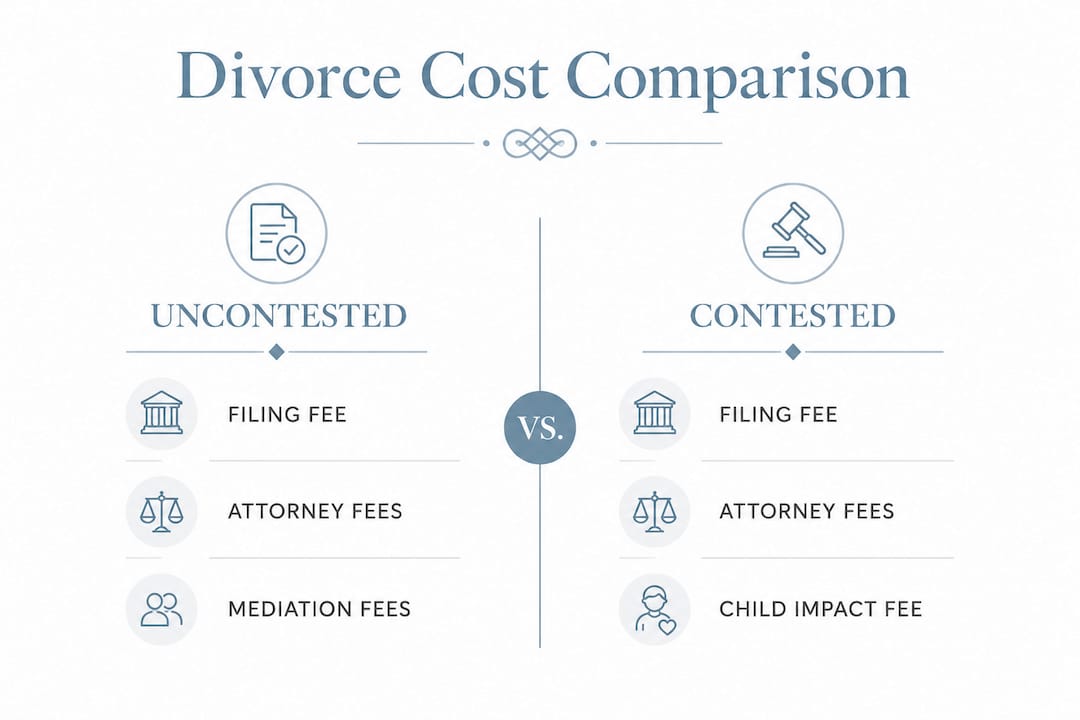
Uncontested divorces typically cost between $1,500 and $5,000 in attorney fees. Contested divorces can reach $15,000 to $30,000 or more. That gap reflects the reality that contested cases can require 40–80 additional attorney hours at rates exceeding $250–$400 per hour.
| Cost Element | Uncontested Divorce | Contested Divorce |
|---|---|---|
| Court filing fee | ~$252 | ~$252 |
| Attorney fees | $1,500–$5,000 | $15,000–$30,000+ |
| Mediation fees | Minimal or none | ~$450 (split between parties) |
| Child Impact Program | Not required | $50–$100 per parent |
| Discovery and expert witnesses | Not required | Can add thousands |
Hidden costs in contested divorces include the mandatory Child Impact Program fees and court-ordered mediation fees that appear early in proceedings. These costs are separate from attorney fees and must be budgeted from the start. Reaching a negotiated settlement before trial is the single most effective way to reduce total divorce costs in New Hampshire.
What are the pros and cons of each divorce type?
Choosing between the two processes means weighing practical tradeoffs against your specific circumstances.
Uncontested divorce advantages:
- Faster resolution, typically within 2–3 months
- Lower legal costs, often under $5,000
- Privacy benefits by keeping settlement details out of public court records
- Greater control over parenting plans and financial arrangements
- Less adversarial, which can preserve co-parenting relationships
Uncontested divorce disadvantages:
- Requires complete agreement on every issue before filing
- Not suitable for cases involving domestic violence or significant power imbalances
- Agreements must still meet court standards for fairness
Contested divorce advantages:
- Court protection ensures disputed rights are formally adjudicated
- Judges can order discovery to uncover hidden assets
- Appropriate when one spouse refuses to negotiate in good faith
Contested divorce disadvantages:
- Courtroom proceedings are public records, exposing personal and financial details
- Significantly higher costs and longer timelines
- Outcomes are decided by a judge, not the parties themselves
- Extensive discovery including depositions and expert witnesses can dramatically increase delays
Pro Tip: If your case starts as contested, mediation can shift it toward an uncontested resolution. New Hampshire courts require mediation in most cases involving children, and many couples reach full agreement through that process before ever going to trial.
How do you decide which divorce type fits your situation?
The right process depends on your level of agreement, the complexity of your assets, and whether children are involved. Use these guidelines to assess your situation honestly.
- Full agreement on all issues: You are a strong candidate for an uncontested divorce process and should consult an attorney to draft a proper settlement agreement.
- Partial disagreement: Consider mediation before assuming your case must be contested. Many disputes resolve through a few structured sessions.
- High conflict or safety concerns: A contested process with full legal representation is appropriate. Courts provide protective orders and formal procedures that safeguard both parties.
- Complex assets or business interests: Even if you agree in principle, contested-level discovery tools may be needed to ensure full financial disclosure.
- Children involved: Regardless of divorce type, New Hampshire courts prioritize the best interests of the child. A detailed parenting plan is required in either case.
Consulting an experienced New Hampshire family law attorney early gives you a realistic picture of which path is appropriate. The NH divorce process has specific procedural requirements that apply to both types, and missing a deadline or filing incorrectly can set your case back by months.
Key takeaways
The most cost-effective and private divorce in New Hampshire is an uncontested one, but it requires complete written agreement on every issue before the court will approve it.
| Point | Details |
|---|---|
| Core distinction | Uncontested requires full prior agreement; contested requires a judge to resolve disputes. |
| Timeline difference | Uncontested takes 2–3 months; contested cases run 8–18 months or longer. |
| Cost gap | Uncontested legal fees average $1,500–$5,000; contested cases can exceed $30,000. |
| Privacy factor | Uncontested settlements stay out of public court records; contested proceedings do not. |
| Mediation as a bridge | Court-ordered mediation in NH often converts contested cases into uncontested resolutions. |
What i’ve seen after years of NH divorce cases
Most people who walk into a contested divorce do not fully realize they are signing up for a year or more of legal proceedings. The financial and emotional costs are real, and they compound over time. What surprises many clients is that “uncontested” does not mean you and your spouse have to be on good terms. It means you have resolved the paperwork. Those are very different things.
The most common mistake I see is couples skipping legal review on an uncontested agreement because they assume it is simple. Courts in New Hampshire scrutinize agreements for fairness and will not approve one that appears coerced or fundamentally unfair. A poorly drafted agreement can be rejected, sending you back to square one. Spending a few hundred dollars on attorney review at the start is far less costly than fixing a flawed decree later.
If your case is contested, do not treat mediation as a formality. It is the most practical off-ramp available, and New Hampshire courts take it seriously. Couples who approach mediation with a genuine willingness to compromise often reach full agreement and avoid trial entirely. That outcome protects your finances, your privacy, and your ability to co-parent effectively after the divorce is final.
— Rich
How Narolaw supports NH divorce clients at every stage
Narolaw is a New Hampshire-based family law practice that works with clients navigating both uncontested and contested divorces. Whether you need help drafting a marital settlement agreement, preparing for mediation, or representing your interests at trial, Narolaw provides personalized legal guidance grounded in New Hampshire family law. The firm’s attorneys understand the procedural requirements, financial disclosures, and court standards that apply to every NH divorce case. To understand the full scope of NH family law services including divorce, custody, and support, visit Narolaw’s family law page. A free consultation is available to help you assess your situation and choose the right path forward.
FAQ
What makes a divorce uncontested in new hampshire?
A divorce is uncontested in New Hampshire when both spouses reach a full written agreement on all issues, including property, custody, and support, before the court finalizes the decree.
How long does a contested divorce take in NH?
Contested divorces in New Hampshire typically take 8–18 months or longer, depending on case complexity, discovery requirements, and court scheduling.
Can a contested divorce become uncontested in NH?
Yes. New Hampshire courts require mediation in most cases involving children, and many contested cases resolve into full agreements through that process before reaching trial.
What are the filing fees for divorce in new hampshire?
Court filing fees run approximately $250–$252 for both contested and uncontested divorces. Attorney fees and additional program costs create the significant cost difference between the two types.
Do i need a lawyer for an uncontested divorce in NH?
An attorney is not legally required, but legal professionals recommend hiring one to review your agreement and protect your rights, particularly regarding children and property division.


