

TL;DR:
- Understanding criminal defense terminology is essential for defendants to navigate court proceedings, from arraignment to trial, effectively. Knowing how terms like probable cause, burden of proof, and Miranda rights apply at specific stages helps in making informed decisions and safeguards legal rights. Accurate knowledge of jurisdiction-specific roles and procedural deadlines enhances the quality of legal representation and the overall defense strategy.
Criminal defense terminology is the set of legal words and phrases that define your rights, the charges against you, and every procedural step in a criminal case. Understanding these terms is not optional. When you or a family member faces criminal charges in New Hampshire or anywhere in the United States, knowing what arraignment, probable cause, and burden of proof actually mean can directly affect the decisions you make and the outcomes you reach. This guide explains the most critical criminal defense terms explained clearly, tied to the procedural stages where they matter most.
What are the most common criminal defense terms?
The vocabulary of criminal defense is built around a handful of foundational concepts. Knowing these before you set foot in a courtroom reduces confusion and helps you communicate more effectively with your attorney.
- Arraignment: The first formal court hearing where a defendant is told the charges and asked to enter a plea. Under Rule 10, arraignment is conducted in open court, and the defendant must confirm they have a copy of the charges before the judge asks for a plea.
- Plea types: A defendant may plead guilty (admitting the offense), not guilty (denying the charge), or nolo contendere (no contest, accepting punishment without admitting guilt). Each choice carries different legal consequences, so the decision should always be made with counsel.
- Burden of proof: In criminal cases, the prosecution must prove guilt beyond a reasonable doubt. This is the highest standard of proof in the American legal system, and the defendant is never required to prove innocence.
- Beyond a reasonable doubt: This phrase means the evidence must be so convincing that no reasonable person would question the defendant’s guilt. It cannot be replaced by the lower civil standard of “preponderance of the evidence.”
- Probable cause: A factual and legal standard used at multiple stages, including warrant applications and preliminary hearings, to establish a reasonable belief a crime occurred. Probable cause is not the same as proof of guilt.
- Acquittal: A formal finding that the defendant is not guilty. An acquittal bars retrial on the same charge under the Double Jeopardy Clause of the Fifth Amendment.
- Miranda rights: Before any custodial interrogation, law enforcement must deliver four warnings: you have the right to remain silent, anything you say can be used against you in court, you have the right to an attorney, and an attorney will be appointed if you cannot afford one. Miranda warnings are required only when both custody and interrogation are present, not automatically upon arrest.
Pro Tip: If you are unsure whether Miranda rights were properly given in your case, document exactly what was said and when. This detail can become significant during pretrial motions.
How do criminal procedure stages relate to legal terminology?
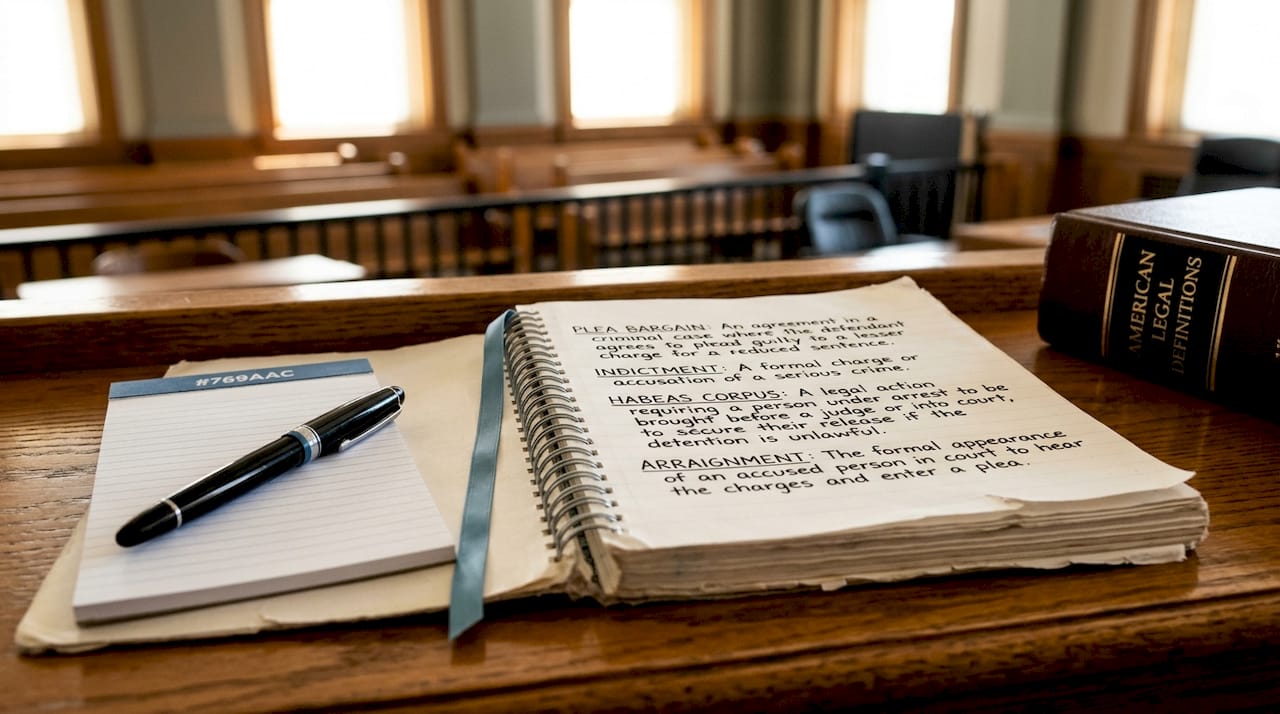
Legal terms do not exist in isolation. Each term connects to a specific stage of the criminal process, and misapplying a term to the wrong stage can lead to real misunderstandings about where a case stands.
The stages unfold in a defined sequence:
- Arrest and initial appearance: Law enforcement takes a person into custody based on probable cause. The defendant appears before a magistrate, is informed of the charges, and bail conditions are set.
- Preliminary hearing (Rule 5.1): A judge evaluates whether enough evidence exists to proceed. Under Rule 5.1, hearsay evidence is admissible at this stage, and the hearing must generally be held within 14 to 21 days of the initial appearance. The defendant may cross-examine witnesses, making this an early opportunity to test the prosecution’s case.
- Arraignment (Rule 10): The defendant formally enters a plea. Arraignment often sets procedural deadlines that affect the entire case timeline, including when pretrial motions must be filed.
- Pretrial motions (Rule 12): Defense attorneys file motions to suppress evidence, challenge charging defects, or raise other legal issues. Under Rule 12, these motions must be filed on time or the right to raise them may be permanently waived.
- Trial: The prosecution presents evidence, the defense responds, and the jury or judge applies the beyond a reasonable doubt standard to reach a verdict.
The table below shows how key terms map to specific stages:
| Procedure stage | Key term | What it means at that stage |
|---|---|---|
| Preliminary hearing | Probable cause | Judge decides if evidence is sufficient to proceed |
| Arraignment | Plea | Defendant formally responds to charges |
| Pretrial motions | Suppression motion | Request to exclude unlawfully obtained evidence |
| Trial | Burden of proof | Prosecution must prove guilt beyond a reasonable doubt |
| Verdict | Acquittal | Court finds defendant not guilty; bars retrial |
What distinctions should you know about courtroom roles across jurisdictions?
Courtroom roles and terminology are not uniform across all legal systems, even within common-law traditions. In U.S. federal courts, the person charged is the defendant, represented by defense counsel or a defense attorney. The government is represented by a prosecutor or Assistant U.S. Attorney.
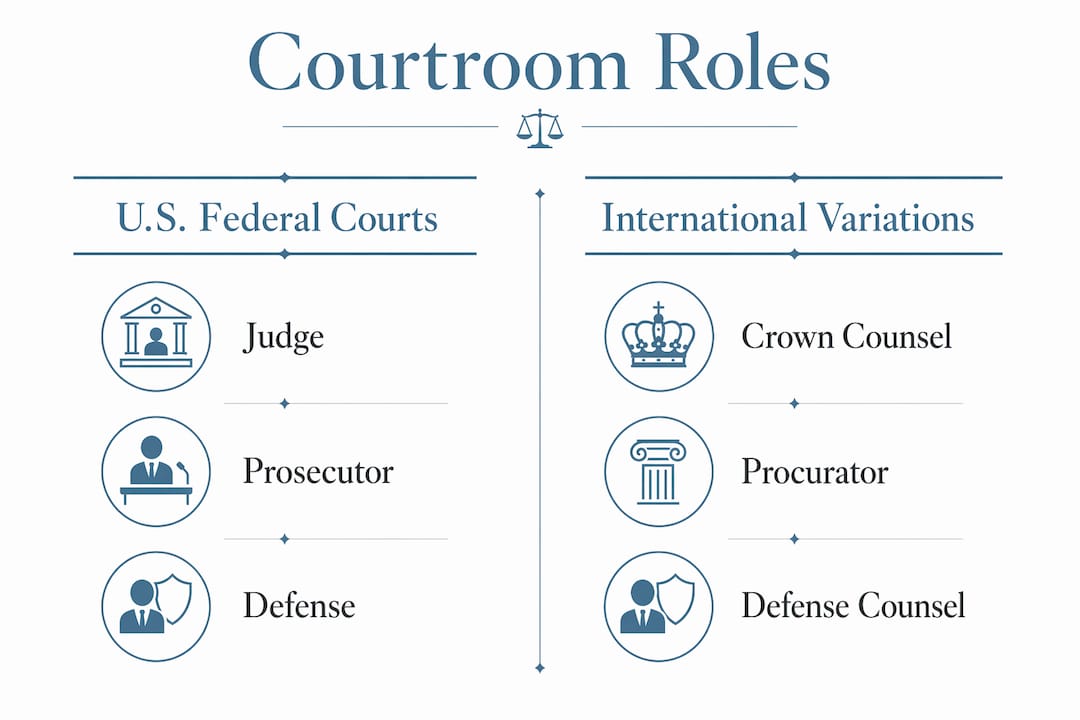
In Scotland, the equivalent prosecuting body is the Crown Office and Procurator Fiscal Service (COPFS), which uses terms like procurator fiscal instead of prosecutor. Roles and terminology differ between U.S. federal courts and systems like COPFS, though shared concepts such as “beyond a reasonable doubt” appear across common-law jurisdictions. This matters because families researching legal terms online may encounter definitions from other countries that do not apply directly to a New Hampshire case.
Even within the United States, state courts and federal courts use some terms differently. New Hampshire state courts follow their own procedural rules, which parallel but do not always mirror the Federal Rules of Criminal Procedure. The role of a defense attorney in New Hampshire carries specific obligations under state rules that a general glossary will not capture. Relying on a general lawyer terminology guide is a starting point, not a substitute for local legal advice.
What practical tips help you apply criminal defense knowledge?
Knowing the terms is only useful if you apply that knowledge at the right moment. These points address the situations where terminology gaps cause the most harm.
- Learn key terms before arraignment. Arraignment is often the first formal court event, and the plea you enter there shapes the entire case strategy. Going in without understanding your options puts you at a disadvantage from the start.
- Understand motion deadlines. Missing pretrial motion deadlines under Rule 12 can forfeit critical defense rights, including the right to suppress illegally obtained evidence. Courts may allow late motions only if good cause is shown, and that is never guaranteed.
- Know when Miranda rights apply. Miranda warnings are required only when a person is both in custody and being interrogated. A voluntary statement made before arrest may not be protected, which is why you should ask your attorney about any statements made before formal charges.
- Ask your attorney to define every term you do not recognize. No question is too basic. Misunderstanding a single term, such as confusing “nolo contendere” with a full guilty plea, can affect sentencing and future legal proceedings.
- Do not assume probable cause equals guilt. Probable cause is a threshold standard used to justify an arrest or search. It is far below the beyond a reasonable doubt standard required for conviction.
Pro Tip: Keep a personal glossary of terms your attorney uses during consultations. Writing them down in plain language reinforces your understanding and helps you track how the case is progressing.
Key takeaways
Mastering criminal defense terminology requires connecting each term to the specific procedural stage where it applies, because the same word can carry different weight at arraignment versus trial.
| Point | Details |
|---|---|
| Arraignment sets the timeline | The plea entered at arraignment triggers procedural deadlines for motions and hearings. |
| Burden of proof protects defendants | The prosecution must prove guilt beyond a reasonable doubt; defendants never bear this burden. |
| Miranda rights have conditions | Warnings are required only when both custody and interrogation are present simultaneously. |
| Motion deadlines are non-negotiable | Missing Rule 12 deadlines can permanently waive key defense rights without good cause shown. |
| Jurisdiction shapes terminology | Terms and roles vary between federal, state, and international courts; local counsel is necessary. |
Why terminology knowledge changes how you show up in court
From my experience working with clients facing criminal charges, the single most consistent source of anxiety is not the charges themselves. It is the feeling of being lost in a conversation happening around them, in a language they were never taught. A client who understands what a preliminary hearing is, and what probable cause means at that stage, asks sharper questions and makes more deliberate decisions. That shift in confidence is not cosmetic. It changes the quality of the attorney-client relationship and, in turn, the quality of the defense strategy built together.
The most common misunderstanding I encounter involves Miranda rights. Many people believe they were not properly “Mirandized” simply because an officer spoke to them before arrest. In reality, Miranda warnings are only required when custody and interrogation occur together. Knowing this distinction prevents wasted energy on arguments that will not hold up in court.
The second most common gap is around arraignment. Families often treat it as a formality. It is not. The plea entered there, and the deadlines it triggers, can define the entire arc of a case. Pairing a solid understanding of legal defense phrases with experienced local counsel is not redundant. It is the combination that actually protects you.
— Rich
How Naro Law helps you understand and apply criminal defense terms
Naro Law’s criminal defense attorneys in New Hampshire work with defendants, victims, and families who need both clear explanations and skilled representation. The firm handles DUI/DWI, drug crimes, assault, and a range of other criminal matters across New Hampshire, including Manchester and Merrimack. Every client receives a plain-language walkthrough of the charges, the process, and the terminology that applies to their specific case. If you are facing criminal charges and want guidance you can actually understand, contact Naro Law to schedule a free consultation and take the first concrete step toward a prepared defense.
FAQ
What is criminal defense terminology?
Criminal defense terminology is the set of legal terms used to describe rights, procedures, and roles in a criminal case, including words like arraignment, probable cause, and burden of proof. Understanding these terms helps defendants and families follow case proceedings and make informed decisions.
When are Miranda rights required?
Miranda rights are required before custodial interrogation, meaning law enforcement must deliver the four warnings only when a person is both in custody and being questioned. They are not automatically triggered by arrest alone.
What happens if you miss a pretrial motion deadline?
Under Rule 12, missing a pretrial motion deadline can result in permanently waiving that defense right unless the court finds good cause to allow a late filing. This makes timely action on motions one of the most consequential procedural steps in any criminal case.
What does “beyond a reasonable doubt” mean?
Beyond a reasonable doubt is the highest standard of proof in the American legal system, requiring the prosecution to present evidence so convincing that no reasonable person would question the defendant’s guilt. The defendant is never required to prove innocence.
Does criminal defense terminology differ by state?
Yes. While federal terms like arraignment and probable cause apply broadly, state courts including New Hampshire courts follow their own procedural rules, which can affect how and when terms apply. Local legal counsel is the most reliable source for jurisdiction-specific definitions.


