

TL;DR:
- Immediate legal and administrative processes run separately after a DUI arrest in New Hampshire.
- Request an ALS hearing within 30 days to prevent automatic license suspension.
- Acting quickly and consulting a DUI attorney is crucial for protecting your rights and future.
A DUI charge in New Hampshire can feel overwhelming. One moment you’re being pulled over, and the next you’re facing the prospect of lost driving privileges, court dates, and serious legal consequences. The good news is that the steps you take in the hours and days immediately after your arrest can significantly affect your outcome. This article walks you through exactly what happens after a DUI arrest in New Hampshire, what your rights are, how to meet critical deadlines, and how to put your life back on track.
Table of Contents
- What happens after a DUI arrest in New Hampshire
- Understanding your rights and implied consent laws
- Step-by-step guide: Navigating the legal process
- Restoring your license and moving forward
- Why speed and knowledge matter more than ever with DUI cases in NH
- Get help with your DUI case in New Hampshire
- Frequently asked questions
Key Takeaways
| Point | Details |
|---|---|
| Act quickly after arrest | Request an ALS hearing within 30 days to protect your license. |
| Understand implied consent | Refusing a chemical test brings automatic and increasingly harsh penalties. |
| Follow each step closely | Meeting deadlines and requirements helps you get your license back sooner. |
| Seek legal guidance | An experienced DUI attorney can help reduce mistakes and improve your outcome. |
What happens after a DUI arrest in New Hampshire
Having framed the urgency, let’s break down what actually occurs immediately after a DUI arrest. The process moves faster than most people expect, and missing even one step can make your situation considerably worse.
When police arrest you for DUI in New Hampshire, you are taken to a police station for booking. This includes fingerprinting, photographing, and the completion of paperwork. Officers will also seize your driver’s license and issue a temporary driving permit. From that moment, two separate legal processes begin simultaneously: the criminal case and the Administrative License Suspension (ALS) process.
The ALS process is completely independent of your criminal case. Even if your criminal charges are later reduced or dismissed, your license suspension under ALS can still stand. Understanding the DUI process steps in New Hampshire is essential for managing both tracks at once.
Here is a summary of the two processes:
| Process | Who handles it | Timeline | What’s at stake |
|---|---|---|---|
| Criminal case | Court system | Weeks to months | Fines, jail, record |
| ALS process | DMV/administrative | Immediate | Driver’s license |
The most critical deadline after your arrest is the 30-day window to request an ALS hearing. If you do not request this hearing in time, your license will be automatically suspended without any opportunity to contest it. The after a DWI arrest timeline is unforgiving, and many people lose their license simply because they did not know this deadline existed.
Your numbered checklist immediately after arrest:
- Secure your temporary driving permit and note the expiration date.
- Request an ALS hearing within 30 days.
- Document everything you remember about the stop, including officer conduct and test conditions.
- Contact a DUI defense attorney as soon as possible.
- Avoid discussing your case with anyone except your attorney.
One more critical point: if you refused a chemical test, you face a separate, automatic license suspension on top of the ALS process. Refusal penalties are increasing to nine months beginning January 2027, making early legal action even more important.
“The ALS process and criminal case run on separate tracks. Acting fast on the 30-day ALS hearing window is one of the most important decisions you will make after a DUI arrest.”
Understanding your rights and implied consent laws
Understanding the post-arrest landscape means you also need to know your legal rights and pitfalls, starting with New Hampshire’s implied consent rules.

New Hampshire, like every other state, operates under an implied consent law. This means that by simply driving on New Hampshire roads, you have already legally agreed to submit to a chemical test (breath, blood, or urine) if law enforcement has probable cause to believe you are impaired. You cannot withdraw this consent without consequences.
Many people believe that refusing a breathalyzer test is a smart move, reasoning that there will be less evidence against them. However, the data tells a different story. New Hampshire has the second highest DWI test refusal rate in the nation, at approximately 69%, compared to a national average of just 24%. This high refusal rate exists precisely because the penalties for refusing are so similar to those for failing the test. But new legislation is changing that equation.
Here is how the consequences compare:
| Scenario | License suspension (1st offense) | License suspension (subsequent) |
|---|---|---|
| Failed chemical test (BAC over 0.08) | 9 months | Up to 2 years |
| Refused chemical test (before Jan 2027) | 180 days | Up to 2 years |
| Refused chemical test (from Jan 2027) | 9 months | Up to 2 years |
Key points to understand about refusing tests in New Hampshire:
- Refusal triggers an automatic, immediate ALS suspension separate from your criminal case.
- The refusal itself can be used as evidence against you in court.
- Starting in January 2027, first-offense refusal suspensions increase from 180 days to 9 months, closing the gap between refusal and failure even further.
- You have 30 days from the date of arrest to request a hearing to contest your ALS suspension.
Pro Tip: Do not make any decisions about chemical tests, statements to officers, or legal strategy without first consulting a DUI defense attorney. A single uninformed decision in those first hours can follow you for years.
The implied consent law places you in a difficult position, but knowledge of your options and their real consequences is your best protection. Acting quickly and getting qualified legal advice is far more effective than any snap decision made at the roadside.
Step-by-step guide: Navigating the legal process
Once you’re clear about your rights, the next challenge is navigating each step of the legal process correctly. Here’s how to do it in a way that protects your interests at every stage.
The 30-day ALS hearing window is your first and most urgent deadline. Missing it means automatic suspension. Here is a practical roadmap:
- Request your ALS hearing immediately. Submit your request to the New Hampshire DMV within 30 days of your arrest. Your temporary permit buys you some driving time while the hearing is scheduled.
- Hire a DUI attorney before your arraignment. Your arraignment is your first court appearance where you enter a plea. Having an attorney present at this stage is critical.
- Gather all relevant documents. Collect the police report, your temporary permit, any field sobriety test results, and any witness contact information.
- Track every deadline on a calendar. Court dates, DMV deadlines, and attorney consultations all need to be recorded and prioritized.
- Prepare for arraignment. Your attorney will advise on whether to plead guilty, not guilty, or no contest, based on the specific facts of your case.
- Attend all hearings. Missing a court date can result in a warrant being issued for your arrest and may damage your case significantly.
What to bring to your first attorney consultation:
- A written timeline of events leading up to and during the arrest.
- Copies of all paperwork received from law enforcement.
- Your driving record, if you have access to it.
- Any questions about the DUI penalties overview that apply to your specific situation.
The consequences by DUI offense differ significantly in New Hampshire. A first offense carries lighter penalties than a second or third, so understanding exactly where you stand is essential for building the right defense strategy.
Pro Tip: Keep a dedicated folder, physical or digital, for every document related to your DUI case. Staying organized prevents costly mistakes and helps your attorney work more efficiently on your behalf.
Restoring your license and moving forward
After dealing with the legal process, it’s essential to understand how to get your life and license back on track.
License reinstatement in New Hampshire is not automatic. You must actively complete a series of steps before the state will return your driving privileges. According to NH DUI reinstatement requirements, the process for a first offense generally includes:
- Serving your full suspension period (or the conditional license waiting period of 45 days for first-time offenders).
- Completing an Impaired Driver Care Management Program (IDCMP) screening and any required treatment.
- Installing an Ignition Interlock Device (IID) if mandated by the court or DMV.
- Obtaining SR-22 insurance (high-risk auto insurance) and maintaining it for three years.
- Paying reinstatement fees of $100 or more.
| Reinstatement step | Who requires it | Timeline |
|---|---|---|
| Suspension period served | DMV | Varies by offense |
| IDCMP screening/treatment | Court/DMV | During suspension |
| IID installation | Court/DMV | Before reinstatement |
| SR-22 insurance | DMV | 3 years post-reinstatement |
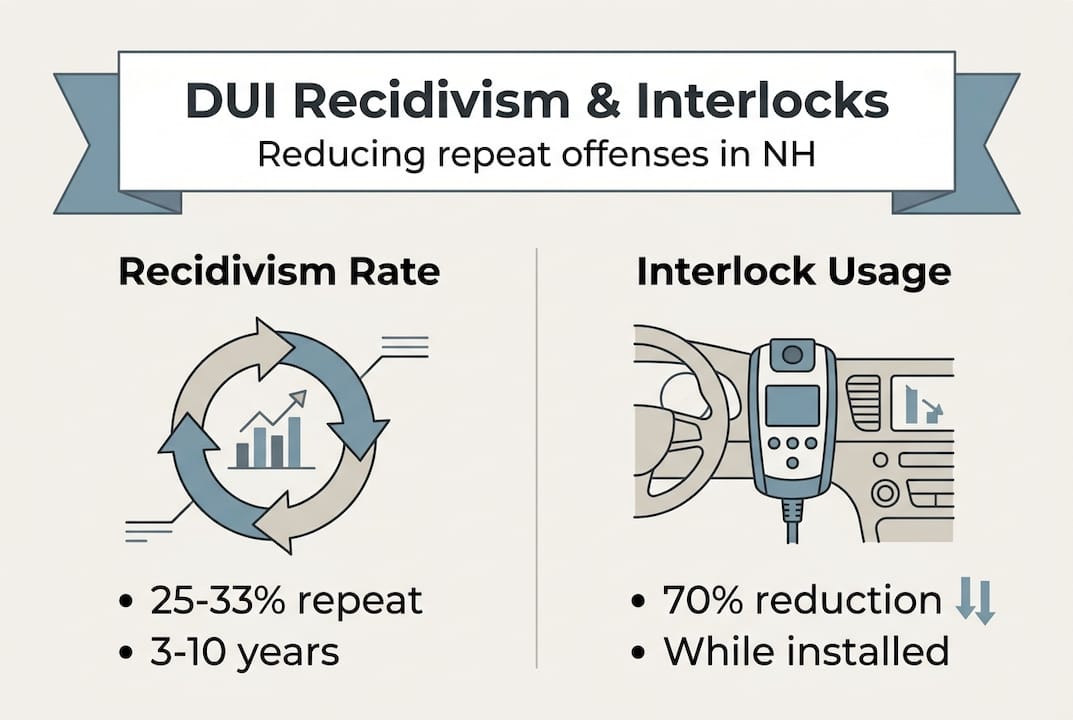
The data on IIDs is striking. Research shows that IIDs reduce recidivism by up to 70% while installed, making them one of the most effective tools for preventing repeat offenses. This matters because roughly 25 to 33% of DUI offenders in the U.S. are re-arrested within 3 to 10 years. Taking the reinstatement process seriously is not just a legal obligation; it’s a genuine investment in your future.
Understanding the long-term DWI consequences in New Hampshire helps frame why each of these steps is worth completing thoroughly and promptly.
Why speed and knowledge matter more than ever with DUI cases in NH
Most articles about DUI defense focus on the checklist. What they miss is the broader reality: New Hampshire’s DUI laws are actively evolving, and the window for effective action is shrinking.
The new refusal penalty increases set for January 2027 are a direct example. Legislators and law enforcement see tougher penalties as a bipartisan solution to reducing dangerous driving. Critics argue this approach infringes on personal liberty and may push unlicensed driving among those who cannot afford the suspension consequences. Both sides have valid points, but what is not debatable is that the understanding DUI process and acting quickly are now more consequential than ever. Delays don’t just cost you time. They cost you options.
Get help with your DUI case in New Hampshire
Facing a DUI charge is serious, but you don’t have to face it alone. Working with an experienced NH criminal defense attorney gives you a significant advantage in navigating both the criminal and administrative processes. At Naro Law, we provide personalized legal strategies tailored to your specific circumstances, helping you meet every deadline and understand every option available to you. Whether this is your first offense or a more complex situation, our DUI & DWI help services are designed to guide you through each step with clarity and support. Contact us today for a free consultation.
Frequently asked questions
How long will my license be suspended if I refuse a breathalyzer in NH?
Refusing a chemical test results in a minimum 180-day suspension for a first offense, rising to 9 months beginning January 2027.
Can I drive to work with a conditional license after a DUI in NH?
First-time offenders may be eligible for a conditional license after serving 45 days of their suspension, allowing limited driving privileges such as travel to work or medical appointments.
What is the recidivism rate for DUIs in New Hampshire?
Approximately 25 to 33% of DUI offenders in the U.S. are re-arrested within 3 to 10 years, and New Hampshire carries the second highest test refusal rate in the country at approximately 69%.
What are ignition interlock devices and do they work?
Ignition interlock devices require a clean breath sample before your vehicle will start, and research shows they reduce repeat DUI offenses by up to 70% while installed.


