

New Hampshire has one of the lowest divorce rates in the country, with marriages lasting a median of 22.6 years before ending. Yet many people believe divorce laws are too complex or identical nationwide. New Hampshire divorce law has unique features like equitable distribution and specific custody rules that set it apart. This guide explains divorce basics, custody, domestic violence protections, and practical steps to help you navigate your situation with confidence and clarity.
Table of Contents
- Key takeaways
- Understanding the basics of divorce law in New Hampshire
- Navigating child custody and parenting plans in New Hampshire
- Protective measures and domestic violence impact in divorce
- Uncontested vs. contested divorce: What to expect in New Hampshire
- Get expert help with your New Hampshire divorce and custody issues
- Frequently asked questions
Key Takeaways
| Point | Details |
|---|---|
| Equitable distribution | Property division uses fairness based on marriage length, contributions, earning capacity, and nonfinancial contributions. |
| No fault basis | Most divorces are no fault and require no proof of blame, which speeds the process. |
| Residency filing rules | Residency and filing rules require at least one year NH residence, filing in a county where either spouse resides, and allow joint petitions when both agree on all terms. |
| Contested versus uncontested | Uncontested divorces are faster and less expensive than contested ones. |
| Custody mediation and protections | Custody decisions follow the best interests of the child and require mandatory mediation, and protective orders can affect custody and property outcomes. |
Understanding the basics of divorce law in New Hampshire
New Hampshire’s approach to divorce balances legal structure with practical flexibility. The state’s divorce rate is relatively low with a crude rate of approximately 2.5 per 1,000 residents, and many marriages last over 20 years before divorce. This context shapes how courts handle cases and what you can expect during the process.
Most divorces in New Hampshire are no-fault, meaning you don’t need to prove specific blame to file. You simply cite irreconcilable differences that have caused the breakdown of your marriage. This approach reduces conflict and speeds up the process. Filing fees range from $250 to $282 depending on your county, making the initial step relatively affordable compared to other states.
Key filing requirements include:
- One spouse must have lived in New Hampshire for at least one year before filing
- You must file in the county where either spouse resides
- Joint petitions are available when both spouses agree on all terms
- Service of process is required unless filing jointly
Property division follows equitable distribution principles, which consider length of marriage, contributions, and earning capacity rather than enforcing equal division. The court examines what’s fair based on your specific circumstances. A marriage of 25 years will typically see different property splits than a three-year marriage. Courts also consider non-financial contributions like homemaking and child-rearing when dividing assets.
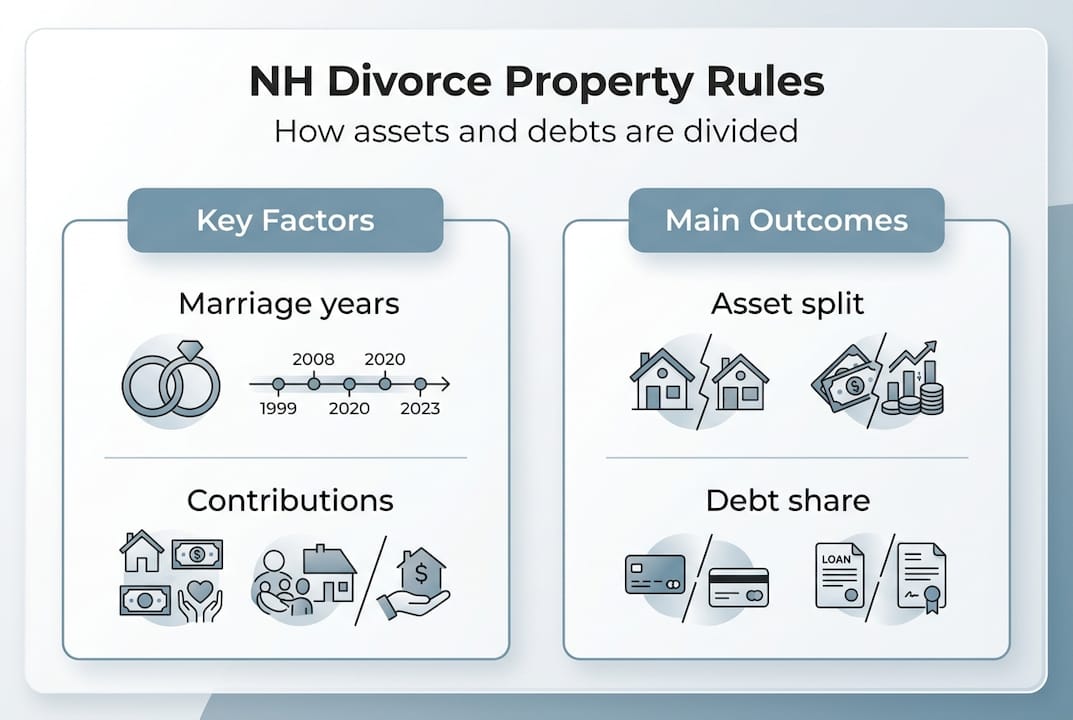
| Factor | How It Affects Property Division |
|---|---|
| Marriage duration | Longer marriages typically result in more equal splits |
| Income disparity | Higher-earning spouse may receive less property |
| Non-financial contributions | Homemaking and child-rearing count as valuable contributions |
| Property source | Inherited or pre-marital property may remain separate |
While fault is rare, it can influence alimony and property division when proven. Grounds like adultery, extreme cruelty, or abandonment require evidence and add complexity. Most couples avoid this route because it increases legal costs and emotional stress.
Choosing between contested vs uncontested divorce significantly impacts your timeline and expenses. Uncontested cases resolve faster because both parties agree on all major issues. Contested divorces require court intervention and often involve extensive negotiations.
Pro Tip: Gather financial documents early, including bank statements, tax returns, and property deeds. Complete documentation speeds up the process and helps your attorney build a stronger case for equitable distribution.
Navigating child custody and parenting plans in New Hampshire
Child custody decisions in New Hampshire center on parental rights and responsibilities, which divide into decision-making authority and residential time. The court prioritizes the best interests of the child under RSA 461-A:6. This framework ensures children maintain stability and healthy relationships with both parents whenever possible.

Decision-making authority covers major life choices like education, healthcare, and religious upbringing. Residential responsibility determines where the child lives and the parenting time schedule. Courts can award sole or shared arrangements for each category based on what serves the child best.
The custody process typically follows these steps:
- File a petition for parental rights and responsibilities with your divorce papers
- Attend mandatory child custody mediation to resolve disputes collaboratively
- Complete the required Child Impact Seminar to understand effects on children
- Submit a detailed parenting plan outlining schedules and responsibilities
- Attend court hearings if mediation doesn’t resolve all issues
Approximately 75% of custody cases are resolved through mandatory mediation, reducing court battles and preserving co-parenting relationships. Mediation provides a neutral space where you and your spouse work with a trained mediator to create solutions that work for your family. The process is less adversarial than litigation and gives you more control over the outcome.
Your parenting plan must address specific details including weekday and weekend schedules, holiday rotations, vacation time, transportation arrangements, and communication methods. Courts require comprehensive plans because clear expectations prevent future conflicts. The more detailed your plan, the fewer disputes you’ll face later.
Parents must attend a Child Impact Seminar, which educates about divorce effects on children and healthy co-parenting strategies. This requirement reflects New Hampshire’s commitment to protecting children during family transitions. The seminar covers age-appropriate communication, managing conflict, and maintaining consistency across households.
Shared parenting is encouraged unless domestic violence or abuse is present. Courts recognize that children benefit from meaningful relationships with both parents. However, safety always takes priority. If one parent poses a risk, the court will limit or supervise that parent’s time with the child.
Custody arrangements aren’t permanent. Life changes like relocation, remarriage, or changing child needs may require modifying parenting plans. You must demonstrate a substantial change in circumstances to justify modifications.
Pro Tip: Keep detailed records of your involvement in your child’s life, including school events, medical appointments, and daily care. Documentation supports your custody case and demonstrates your commitment to active parenting.
Protective measures and domestic violence impact in divorce
Domestic violence in New Hampshire is legally defined under RSA 173-B with clear criteria covering physical harm, threats, sexual assault, and other abusive behaviors between family or household members. The law provides comprehensive protections for victims navigating divorce while dealing with abuse.
Victims can obtain protective orders that restrict abuser’s contact, residence, and custody rights. These orders serve multiple purposes: ensuring immediate safety, establishing legal boundaries, and influencing divorce outcomes. Courts take domestic violence seriously, often limiting the abuser’s custody claims and property rights.
Protective orders may include provisions for:
- No contact with the victim and children
- Eviction from the shared residence
- Temporary custody arrangements
- Surrender of firearms
- Financial support during separation
- Counseling or treatment requirements
Protective orders can be filed ex parte, meaning the court can grant them quickly without the abuser present if immediate danger exists. This emergency protection gives victims time to secure safety and plan next steps. A full hearing follows within days to determine if the order should continue.
The presence of domestic violence significantly impacts custody decisions. Courts presume that awarding custody to an abusive parent is not in the child’s best interests. Even if the abuse was directed only at the other parent, courts recognize that witnessing violence harms children. Abusive parents may receive supervised visitation or no contact depending on severity.
Property division also reflects domestic violence considerations. Courts may award a larger share of marital property to victims, especially if abuse caused economic harm or prevented the victim from working. Financial abuse, where one partner controls all money and resources, is recognized as a form of domestic violence that affects equitable distribution.
“Victims are encouraged to seek protective orders immediately to safeguard themselves and influence custody outcomes. Early action establishes a legal record and demonstrates your commitment to safety.” Domestic violence legal remedies provide comprehensive support beyond just court orders.
Documenting abuse is crucial. Keep records of incidents, medical reports, police reports, threatening messages, and witness statements. This evidence supports your protective order petition and strengthens your position in divorce proceedings. Photographs of injuries, damaged property, and threatening communications provide powerful proof.
Understanding the difference between domestic violence charges and protection orders helps you navigate both the criminal and civil systems. Criminal charges punish the abuser, while protective orders focus on your safety and civil remedies. You can pursue both simultaneously.
Safety planning is essential. Work with domestic violence advocates to create an exit strategy, secure important documents, and identify safe places to stay. Legal assistance can guide you through the protection and divorce process while keeping your safety paramount.
Uncontested vs. contested divorce: What to expect in New Hampshire
The type of divorce you pursue dramatically affects your experience, timeline, and costs. Understanding the differences helps you make informed decisions about your case.
Uncontested divorces are faster (2-3 months), cheaper ($500-$2,500), and less stressful compared to contested divorces (8-14 months, $12,000-$44,000). These numbers reflect the reality that agreement saves time and money. When you and your spouse align on major issues, you avoid lengthy court battles and expensive attorney fees.
| Divorce Type | Timeline | Cost Range | Court Appearances | Stress Level |
|---|---|---|---|---|
| Uncontested | 2-3 months | $500-$2,500 | Minimal (1-2) | Low to moderate |
| Contested | 8-14 months | $12,000-$44,000 | Multiple (4+) | High |
Uncontested divorce requires agreement on all issues including property division, debt allocation, spousal support, and parenting arrangements if you have children. Both spouses sign a joint petition acknowledging they’ve resolved everything. This approach works best when communication remains civil and both parties prioritize efficiency over winning.
Contested divorce involves disputes requiring court intervention. You might agree on some issues but need a judge to decide others. Common contested issues include property valuation, business interests, retirement accounts, and spousal support amounts. Each disputed issue adds time and legal fees.
Benefits of choosing uncontested divorce:
- Faster resolution allows you to move forward sooner
- Lower costs preserve assets for your post-divorce life
- Less conflict protects children from parental disputes
- More control over outcomes versus judge’s decisions
- Privacy maintained without public court testimony
Mediation is mandatory for contested child custody disputes, while joint petitions can simplify uncontested cases. Even in contested divorces, mediation often resolves custody issues without trial. The mediator helps you find common ground and develop solutions that work for your family.
Joint petitions avoid complicated service requirements and speed up uncontested cases. Instead of one spouse serving papers on the other, you both sign and file together. This collaborative start sets a positive tone for the entire process.
Knowing your options saves time and emotional stress during divorce. Some couples start with contested divorces but reach agreements through negotiation or mediation, converting to uncontested cases. Others begin cooperatively but discover irreconcilable differences requiring court decisions.
Choosing uncontested divorce is ideal when spouses can communicate and compromise. You don’t need to be friends, but you must be willing to negotiate fairly. If domestic violence, substance abuse, or severe conflict exists, contested divorce with strong legal representation may be necessary.
Working with experienced Manchester family law attorneys helps you assess which path suits your situation. An attorney can evaluate whether your case is truly uncontested or if hidden issues need addressing.
Pro Tip: Consider divorce mediation even if you think your case is contested. Many couples discover they can agree on more than expected when working with a skilled mediator, potentially converting a contested case to uncontested and saving thousands of dollars.
Get expert help with your New Hampshire divorce and custody issues
Navigating divorce and custody challenges requires knowledge of New Hampshire’s specific laws and procedures. Experienced family law attorneys who specialize in New Hampshire cases provide personalized guidance that protects your rights and interests effectively. Early consultation helps you understand your options and avoid costly mistakes that could impact your future.
Whether you need support with protective orders, parenting plans, or property division, professional legal help reduces stress and improves outcomes. An attorney can evaluate your situation, explain realistic expectations, and develop a strategy tailored to your goals. Understanding the divorce process before you begin helps you make informed decisions at every step.
Preparing well for your consultation maximizes the benefit you receive. Gather relevant documents, write down questions, and be honest about your situation. Learn how to prepare for your divorce consultation to make the most of your time with an attorney and get clear answers to your most pressing concerns.
Frequently asked questions
What are the grounds for divorce in New Hampshire?
New Hampshire recognizes both fault and no-fault grounds for divorce, though approximately 90% of divorces are no-fault citing irreconcilable differences. Fault grounds include adultery, extreme cruelty, abandonment, and substance abuse, but proving fault adds time and expense. Most couples choose no-fault because it’s simpler and less adversarial.
How does New Hampshire handle child custody after divorce?
Custody decisions prioritize the child’s best interests under RSA 461-A:6, requiring a detailed parenting plan and often going through mandatory mediation. The child custody process divides responsibilities into decision-making authority and residential time. Shared parenting is encouraged unless safety concerns like domestic violence exist, and approximately 75% of cases resolve through mediation rather than trial.
What protections are available for domestic violence victims during divorce?
Victims can obtain protective orders under RSA 173-B that include no-contact provisions, residence restrictions, and temporary custody arrangements impacting divorce outcomes. These orders are often granted quickly on an ex parte basis to ensure immediate safety. Courts take domestic violence seriously, typically limiting the abuser’s custody rights and considering abuse when dividing property.
How much does it cost to file for divorce in New Hampshire?
Filing fees range from $250 to $282 depending on your county. Uncontested divorces typically cost $500 to $2,500 total including attorney fees, while contested divorces can reach $12,000 to $44,000 or more. The significant cost difference reflects the time and legal work required when spouses cannot agree on major issues.
Can I modify my parenting plan after divorce?
Yes, parenting plans can be modified when substantial changes in circumstances occur, such as relocation, remarriage, or changing child needs. You must demonstrate that modification serves the child’s best interests. Courts require significant changes rather than minor inconveniences to justify altering existing custody arrangements.
Recommended
- Uncontested Divorce in New Hampshire: A Simple Guide to a Smoother Separation – Naro Law
- Can You Get Divorced in a Different State Than You Were Married? A New Hampshire Guide – Naro Law
- Common Mistakes During a New Hampshire Divorce
- What Happens to the Family Home in a New Hampshire Divorce? – Naro Law


