

TL;DR:
- Domestic violence charges in New Hampshire are criminal accusations for abusive acts against family members or intimate partners. These charges carry penalties, affect protective orders, and influence family law outcomes like custody and visitation. The law classifies most offenses as Class A misdemeanors with strict rules against plea reductions, emphasizing victim safety and legal protection.
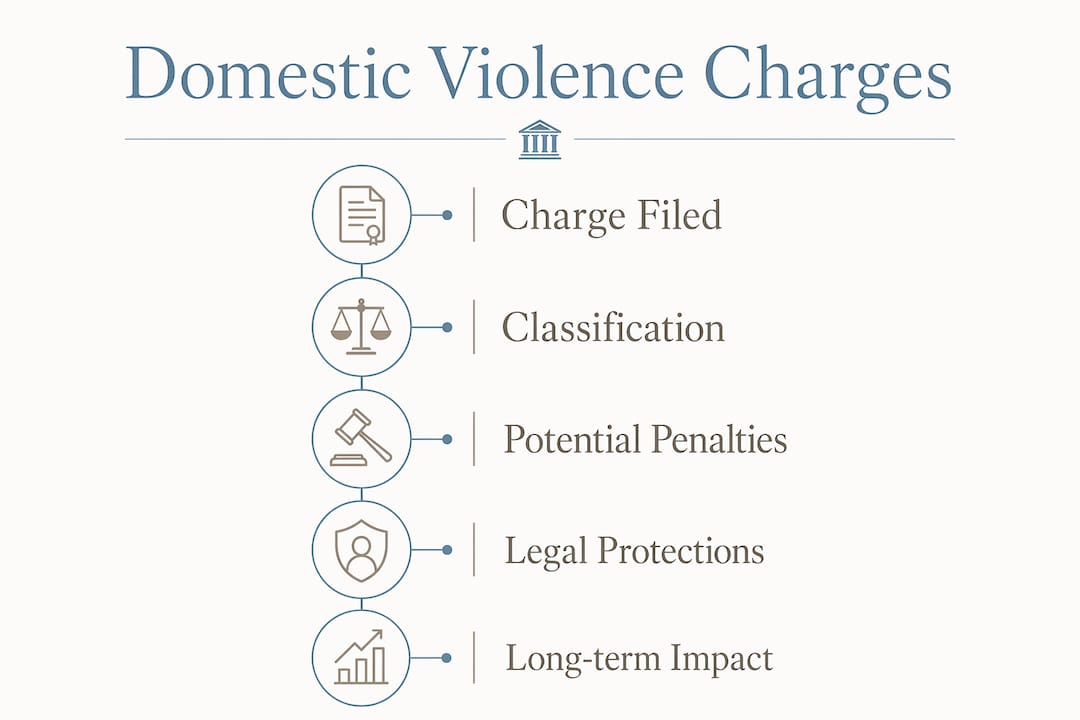
Domestic violence charges in New Hampshire are formal criminal accusations filed when a person commits specific abusive acts against a family member, household member, or intimate partner. Understanding domestic violence charges in New Hampshire means knowing that these offenses carry real criminal penalties, trigger protective orders, and can reshape family law outcomes like custody and visitation. New Hampshire law addresses these cases under RSA 173-B and related statutes, giving courts and law enforcement broad authority to act quickly. If you are facing charges or seeking protection, knowing the legal framework is the first step toward making informed decisions.
What acts constitute domestic violence charges in New Hampshire?
Domestic violence offenses in New Hampshire cover a wide range of criminal acts, not just physical assault. Under RSA 173-B:1, the law applies when those acts occur between people in qualifying relationships.
The following acts qualify as domestic violence under New Hampshire law:
- Physical assault — any intentional physical contact causing bodily injury
- Reckless conduct — behavior that creates a substantial risk of harm
- Criminal threatening — placing another person in fear of imminent bodily harm
- Sexual assault — any non-consensual sexual contact or penetration
- Interference with freedom — unlawfully restraining or confining another person
- Property destruction — damaging or destroying the victim’s property
- Harassment — repeated contact or conduct intended to alarm or distress
- Cruelty to animals — harming or threatening pets to control or intimidate a partner
These acts must be committed by family members, household members, or current or former intimate partners to qualify under RSA 173-B. The relationship between the parties is what separates a domestic violence charge from a general criminal charge.
New Hampshire courts define abuse as a pattern of coercive behavior that creates a credible present threat to the victim’s safety. A single incident can qualify, but courts also weigh past conduct when evaluating ongoing fear. This definition matters because it shapes how judges issue protective orders and how prosecutors build their cases.
How are domestic violence offenses classified and what penalties apply?
New Hampshire classifies most domestic violence offenses as Class A misdemeanors. The penalties are serious and the law limits how much a charge can be reduced.

| Offense type | Classification | Maximum penalty |
|---|---|---|
| Standard domestic violence offense | Class A misdemeanor | 1 year jail, $2,000 fine |
| Offense involving a deadly weapon | Elevated severity under RSA 631:2-b | Increased penalties apply |
| Violation of a protective order | Class A misdemeanor under RSA 173-B:9 | 1 year jail, $2,000 fine |
| Repeat violations within 6 years | Enhanced charges | Greater sentencing exposure |
Violating a protective order is itself a Class A misdemeanor carrying up to one year in jail and a $2,000 fine under RSA 173-B:9. That penalty applies even when the underlying act would otherwise seem minor. When a deadly weapon is used or threatened, RSA 631:2-b elevates the severity of the charge beyond a standard misdemeanor. Repeat violations within 6 years increase sentencing exposure further, making early legal intervention critical.
One detail that surprises many people: under RSA 625:9, domestic violence charges cannot be reduced to a lesser offense through plea negotiation the way other misdemeanors sometimes can. That restriction makes the charge harder to resolve informally and underscores why legal representation matters from the start.
Pro Tip: If you are arrested on a domestic violence charge in New Hampshire, do not make statements to police without an attorney present. Anything said at the scene can be used in court, and the non-reducibility rule under RSA 625:9 means the stakes are higher than with a typical misdemeanor.
What legal protections are available to domestic violence victims?
New Hampshire law gives victims access to civil and criminal remedies simultaneously. Both civil and criminal tools are available under RSA 173-B, and they operate independently of each other.
Domestic Violence Protective Orders are the primary civil tool. Key features include:
- Same-day issuance — courts can grant emergency orders the same day a petition is filed
- Initial duration — orders last up to one year from the date of issuance
- Renewal — orders can be renewed for up to five years when ongoing risk is demonstrated
- Scope — orders address physical assault, threats, stalking, harassment, and interference with freedom
- Enforcement — police can arrest without a warrant when probable cause exists that an order was violated
Violating a protective order triggers criminal charges automatically. The order is civil in nature, but violating it triggers criminal penalties under RSA 173-B:9. That distinction matters: a victim does not need to file a separate criminal complaint for an arrest to occur after a violation.
If you are a victim and an order is violated, call 911 immediately and report the violation to the issuing court with documentation. Police can arrest without a warrant on probable cause alone. Keeping records of violations, including texts, photos, and witness accounts, strengthens enforcement and any future renewal petition. You can also review your rights under restraining orders to understand exactly what protections apply to your situation.
What are the practical implications for those charged with domestic violence?
A domestic violence charge sets off a legal process that moves quickly and touches multiple areas of life. Here is what typically follows an arrest or charge in New Hampshire:
- Arraignment — the defendant appears before a judge, hears the charges, and enters a plea. Bail conditions often include a no-contact order.
- Pretrial hearings — both sides exchange evidence, and the defense evaluates the strength of the prosecution’s case.
- Trial or plea resolution — because charges cannot be reduced under RSA 625:9, defendants face a narrower set of options than in other misdemeanor cases.
- Sentencing — if convicted, penalties include jail time, fines, mandatory counseling, and loss of firearm rights under federal law.
The impact on custody and visitation is one of the most significant long-term consequences. New Hampshire family courts consider abuse patterns when making custody decisions, and a domestic violence conviction can result in supervised visitation or loss of parental rights. Understanding the burden of proof the prosecution must meet helps defendants and their attorneys assess realistic outcomes at each stage.
Pro Tip: Retain a criminal defense attorney before your arraignment if at all possible. The conditions set at arraignment, including no-contact orders and bail terms, directly affect your daily life and your family law case simultaneously.
Key Takeaways
Domestic violence charges in New Hampshire carry mandatory criminal penalties, cannot be reduced under RSA 625:9, and directly affect family law outcomes including child custody.
| Point | Details |
|---|---|
| Legal definition | Abuse is a pattern of coercive behavior creating a credible present threat, not just a single incident. |
| Charge classification | Most offenses are Class A misdemeanors with up to 1 year jail and a $2,000 fine. |
| Non-reducibility rule | RSA 625:9 bars reducing domestic violence charges, limiting plea options significantly. |
| Protective orders | Orders issue same day, last up to one year, and are renewable for up to five years. |
| Family law impact | Courts weigh abuse history when deciding child custody and visitation arrangements. |
What I’ve learned from watching these cases unfold
The most common mistake I see people make is treating a domestic violence charge like any other misdemeanor. They assume it will be negotiated down, resolved quietly, or dismissed if the other party does not cooperate. That assumption is wrong, and it costs people dearly.
New Hampshire’s non-reducibility rule changes the calculus entirely. Once a charge is filed, the path forward is narrower than most defendants expect. The legal system prioritizes victim safety by evaluating credible present threats rather than waiting for escalation. That is a sound policy, but it means defendants have very little room for error in how they respond from the moment of arrest.
The second thing I consistently see underestimated is the family law fallout. A criminal conviction does not stay in the criminal court. It follows you into custody hearings, visitation disputes, and divorce proceedings. Judges take abuse history seriously, and they have the discretion to act on it. Anyone facing these charges needs both a criminal defense attorney and awareness of how the case intersects with any active or potential family law matter. The domestic violence defense process in New Hampshire is specific enough that general legal advice rarely serves people well.
— Rich
How Narolaw supports New Hampshire residents facing these charges
Narolaw is a New Hampshire-based legal practice with focused experience in both criminal defense and family law. When domestic violence charges intersect with custody disputes, divorce proceedings, or protective orders, having one legal team that understands both sides of the case makes a real difference. Narolaw provides personalized representation for individuals facing criminal defense matters across New Hampshire, as well as guidance on how charges affect family law outcomes like custody and support. Contact Narolaw to schedule a free consultation and get a clear picture of where you stand.
FAQ
What is domestic violence defined as under New Hampshire law?
New Hampshire defines domestic violence as a pattern of coercive behavior that creates a credible present threat to the victim’s safety, committed by a family member, household member, or intimate partner under RSA 173-B:1.
Can a domestic violence charge be reduced to a lesser offense in New Hampshire?
No. RSA 625:9 prohibits reducing domestic violence charges to lesser offenses, which significantly limits plea negotiation options compared to other misdemeanor cases.
How long does a domestic violence protective order last in New Hampshire?
A protective order initially lasts up to one year and can be renewed for up to five years when the court finds ongoing risk to the victim’s safety.
Does a domestic violence conviction affect child custody in New Hampshire?
Yes. New Hampshire family courts consider documented abuse patterns when making custody and visitation decisions, and a conviction can result in restricted or supervised parenting time.
What should a victim do if a protective order is violated?
Call 911 immediately and report the violation to the court that issued the order. Police have authority to arrest without a warrant when probable cause exists that an order was violated.


