

TL;DR:
- Domestic violence charges in New Hampshire are serious criminal allegations that can result in jail time, fines, and firearm restrictions. These charges include physical abuse, threats, and emotional harm between family or household members, with penalties depending on the circumstances. Protective orders operate separately from criminal cases and can impose restrictions lasting over a year, making early legal intervention crucial.
Domestic violence charges in New Hampshire are criminal allegations of abuse or assault between family or household members, classified under RSA 631:2-b as a Class A misdemeanor in most cases. When a deadly weapon is involved, the offense escalates to a Class B felony. These charges carry serious consequences including jail time, fines, mandatory counseling, and restrictions on firearm possession. Understanding the legal framework, the court process, and your defense options is the first step toward protecting your rights.
What acts constitute domestic violence charges in New Hampshire?
Domestic violence under New Hampshire law covers a broad range of abusive acts between people in close personal relationships. The statute does not limit charges to physical violence alone. Emotional abuse, threats, and property destruction can all qualify depending on the circumstances.
The law defines “abuse” to include the following acts when committed against a family or household member:
- Physical assault — hitting, punching, kicking, or any intentional physical contact causing injury
- Threats — placing a person in fear of imminent bodily harm
- Sexual assault — any non-consensual sexual contact
- Stalking — repeated following, surveillance, or harassment
- Destruction of property — damaging shared or personal belongings to intimidate or control
- False imprisonment — restricting a person’s freedom of movement without consent
A “family or household member” under New Hampshire domestic abuse laws includes spouses, former spouses, people who currently cohabit or formerly cohabited, and former sexual or intimate partners. This definition is broader than many people expect. A person does not need to be married to the alleged victim for domestic violence charges to apply.
The distinction between criminal charges and civil protective orders matters here. Criminal charges are prosecuted by the state. Civil protective orders are sought by the alleged victim through the NH Judicial Branch and operate on a separate legal track. Both can run simultaneously, which significantly complicates your legal situation.

Pro Tip: If you are unsure whether a relationship qualifies under the statute, consult an attorney before making any statements to law enforcement. What you say early in the process can affect your case significantly.
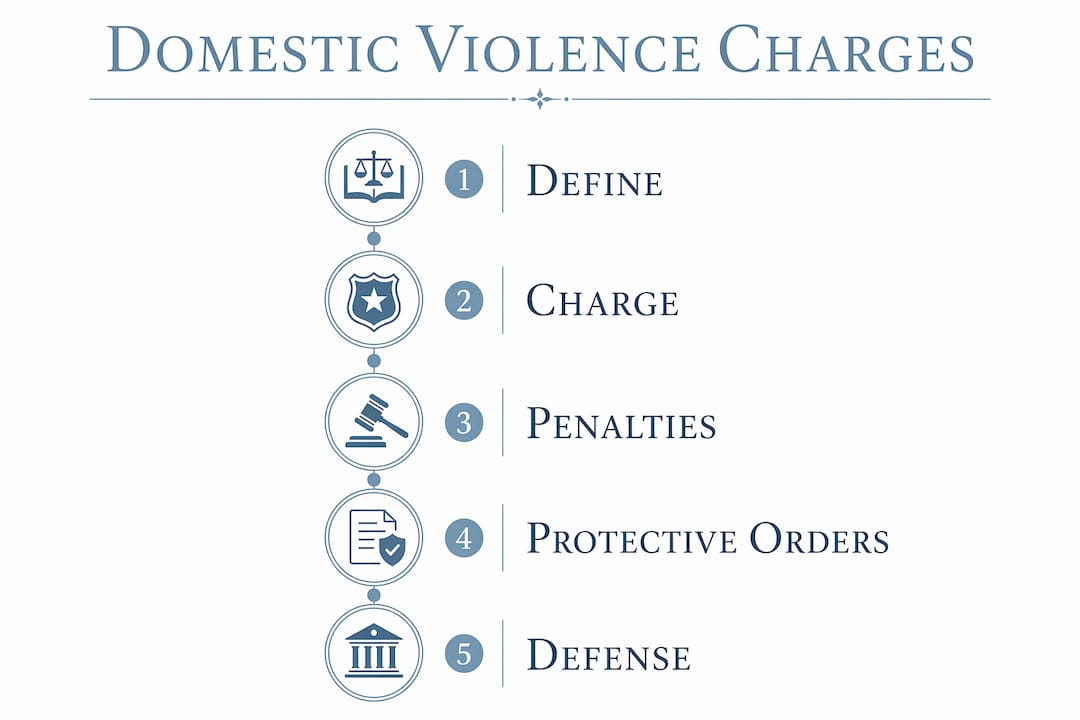
What are the penalties for domestic violence in New Hampshire?
The penalties for domestic violence in New Hampshire depend on the specific charge and the circumstances of the alleged offense. The table below outlines the key sentencing ranges.

| Charge level | Circumstances | Potential penalties |
|---|---|---|
| Class A misdemeanor | Standard domestic violence offense | Up to 1 year in jail, fines, probation |
| Class B felony | Use or threatened use of a deadly weapon | Up to 3.5 years in prison, higher fines |
| Protective order violation | Willful violation of a restraining order | Class A misdemeanor; repeat violations may be felonies |
A Class A misdemeanor conviction carries up to one year in the county jail. That sentence alone can cost a person their job, housing, and custody rights. Beyond incarceration, courts routinely impose fines, probation, and mandatory participation in a batterer intervention program.
One consequence that surprises many people is the firearm restriction. A domestic violence conviction triggers a federal prohibition on possessing firearms under the Lautenberg Amendment. New Hampshire state law reinforces this restriction. The penalties under state law also include the surrender of any firearms already owned.
Pro Tip: Do not wait to address a firearm surrender order. Failing to comply promptly can result in additional criminal charges that are entirely separate from the original domestic violence case.
How do New Hampshire protective orders work?
A civil protective order, also called a restraining order, is a court order issued under RSA 173-B to protect an alleged victim from further harm. It operates independently of any criminal case but often runs alongside one. Understanding how these orders work is critical for anyone facing domestic violence allegations.
New Hampshire protective orders can impose a wide range of conditions, including:
- No-contact provisions prohibiting all communication with the protected person
- Stay-away orders requiring you to maintain a specific distance from the person’s home, workplace, or school
- Exclusion from a shared residence, even if you own or lease the property
- Surrender of all firearms and ammunition
- Temporary custody arrangements and visitation restrictions for shared children
- Financial obligations such as temporary support payments
- Exclusive care of shared pets and a prohibition on harming or transferring animals
Orders last up to one year and are renewable. Courts can extend them beyond one year if the protected party demonstrates continued need. The duration and renewal process means a single incident can result in restrictions that affect your life for years.
Violating a protective order in New Hampshire is a criminal offense. A willful violation is charged as a Class A misdemeanor. Repeated violations can be elevated to felony charges, compounding the original domestic violence case significantly.
The relationship between a protective order and criminal charges is one of the most misunderstood aspects of these cases. Many people assume that if the alleged victim drops the protective order, the criminal case disappears. That is not how it works. The state prosecutes criminal charges independently. The alleged victim does not control whether the prosecution proceeds.
What happens after a domestic violence arrest in New Hampshire?
The post-arrest process in New Hampshire follows a structured sequence that moves quickly. Knowing what to expect at each stage helps you respond effectively.
- Arrest and booking — Police arrest the suspect and process them at the local station. Officers document the alleged offense and collect evidence.
- Bail hearing — A judge sets bail conditions, which often include a no-contact order with the alleged victim as a condition of release.
- Charging decision — The prosecutor reviews the evidence and decides whether to file formal charges, what level of offense to charge, and whether to pursue additional counts.
- Arraignment — You appear before the court, hear the formal charges, and enter an initial plea.
- Pretrial hearings — Both sides exchange evidence, file motions, and negotiate potential plea agreements.
- Trial or plea resolution — Cases either resolve through a negotiated plea or proceed to trial before a judge or jury.
Bail conditions in domestic violence cases are strict. Courts routinely impose no-contact orders as a condition of release, meaning you cannot return to a shared home or contact your children through the alleged victim. Violating bail conditions results in immediate re-arrest.
What defense strategies work for domestic violence charges in New Hampshire?
Effective domestic violence defense requires a thorough review of the evidence, the relationship between the parties, and the circumstances of the alleged incident. No two cases are identical, and the right strategy depends on the specific facts.
Common defense approaches include challenging the credibility of witness testimony, identifying inconsistencies in the alleged victim’s account, and scrutinizing how law enforcement collected and documented evidence. Physical evidence such as photographs, medical records, and 911 call recordings can support or undermine the prosecution’s case.
False accusations do occur in domestic disputes, particularly during contentious separations or custody battles. Attorneys who handle false accusation defenses examine text messages, emails, and social media activity to establish context and motive. Character witnesses and documented history of the relationship can also carry weight.
Plea negotiations are another legitimate path. Prosecutors sometimes agree to reduce charges or recommend alternative sentencing, such as a diversion program, in exchange for a guilty plea to a lesser offense. This outcome avoids a trial and can limit long-term consequences.
Pro Tip: Never contact the alleged victim to “work things out” after an arrest, even if they reach out to you first. Any contact can be used as evidence of a protective order violation and will damage your defense.
Key Takeaways
Domestic violence charges in New Hampshire are serious criminal matters that carry lasting consequences, and the outcome depends heavily on the quality of your legal defense.
| Point | Details |
|---|---|
| Charge classification | Most charges are Class A misdemeanors; a deadly weapon elevates the offense to a Class B felony. |
| Penalties are broad | Consequences include jail time, fines, probation, mandatory counseling, and firearm surrender. |
| Protective orders run separately | A civil protective order operates independently of criminal charges and can last over a year. |
| Post-arrest process moves fast | Bail conditions, charging decisions, and pretrial hearings follow arrest in rapid succession. |
| Defense options exist | Challenging evidence, disproving false claims, and negotiating pleas are all viable strategies. |
What I’ve learned about these cases that most articles won’t tell you
The single biggest mistake I see people make after a domestic violence arrest is assuming the situation will resolve itself. They believe the alleged victim will recant, the prosecutor will drop the case, or the charge is too minor to take seriously. None of those assumptions hold up in practice.
New Hampshire prosecutors treat domestic violence cases as high priority. They frequently proceed even when the alleged victim refuses to cooperate, relying on physical evidence, 911 recordings, and officer testimony. Waiting to hire an attorney until after the arraignment puts you at a real disadvantage.
The other thing most articles skip over is the emotional complexity of these cases. Many people facing these charges are simultaneously dealing with a collapsing relationship, potential loss of access to their children, and public embarrassment. That emotional weight makes clear thinking difficult. A good attorney does not just handle the legal strategy. They help you stay focused on what actually matters for your case outcome.
The interplay between criminal charges and protective orders is also more complicated than it looks on paper. Decisions made in the civil protective order hearing can affect the criminal case, and vice versa. You need someone who understands both tracks and can coordinate your defense across them.
— Rich
Narolaw’s criminal defense team is ready to help
Narolaw is a New Hampshire-based legal practice with deep experience in criminal defense and family law. If you are facing domestic violence charges, the firm’s attorneys understand the full scope of what is at stake, from your freedom and your record to your relationship with your children. Narolaw builds personalized defense strategies grounded in the specific facts of each case, not generic templates. The firm handles cases across New Hampshire, including Manchester, Concord, Nashua, and Portsmouth. Contact Narolaw’s criminal defense attorneys to schedule a free consultation and get a clear picture of your options before your next court date.
FAQ
What is a Class A misdemeanor domestic violence charge in New Hampshire?
A Class A misdemeanor is the standard classification for domestic violence under RSA 631:2-b, carrying up to one year in jail, fines, and probation. The charge escalates to a Class B felony when a deadly weapon is used or threatened.
Can a domestic violence charge be dropped if the victim recants?
The state of New Hampshire prosecutes criminal domestic violence charges independently of the alleged victim’s wishes. Prosecutors can and do proceed using physical evidence, 911 recordings, and officer testimony even when a victim refuses to cooperate.
How long does a New Hampshire protective order last?
Protective orders in New Hampshire are initially granted for up to one year and are renewable. Courts can extend them beyond one year if the protected party demonstrates continued need.
Does a domestic violence conviction affect firearm rights?
A domestic violence conviction triggers both state and federal firearm restrictions, requiring the surrender of all firearms. Federal law under the Lautenberg Amendment permanently prohibits convicted individuals from possessing firearms.
When should I hire a domestic violence attorney in New Hampshire?
Hire an attorney immediately after arrest, before your arraignment. Early legal representation allows your attorney to challenge evidence, negotiate bail conditions, and build a defense strategy from the start of the process.


