

TL;DR:
- Drug possession penalties in New Hampshire depend on the substance, quantity, and prior offenses, ranging from fines to lengthy prison sentences. Small amounts of marijuana for adults 21 and older are civil violations with low fines, while larger quantities and controlled substances lead to misdemeanor or felony charges with severe penalties. Law enforcement increasingly enforces transportation, school zone, and intent to sell laws, emphasizing legal risks for residents.
Drug possession penalties in New Hampshire are defined by substance type, quantity, and prior offense history, ranging from a $100 civil fine to felony charges carrying up to 20 years in prison. What are the penalties for drug possession in New Hampshire depends entirely on what you had, how much, and whether you’ve been charged before. New Hampshire law under RSA 318-B creates distinct tiers: civil violations, misdemeanors, and felonies. Recent legislative updates in 2025 added new transportation rules and enforcement risks that every resident should understand.
What are the penalties for drug possession in new hampshire?
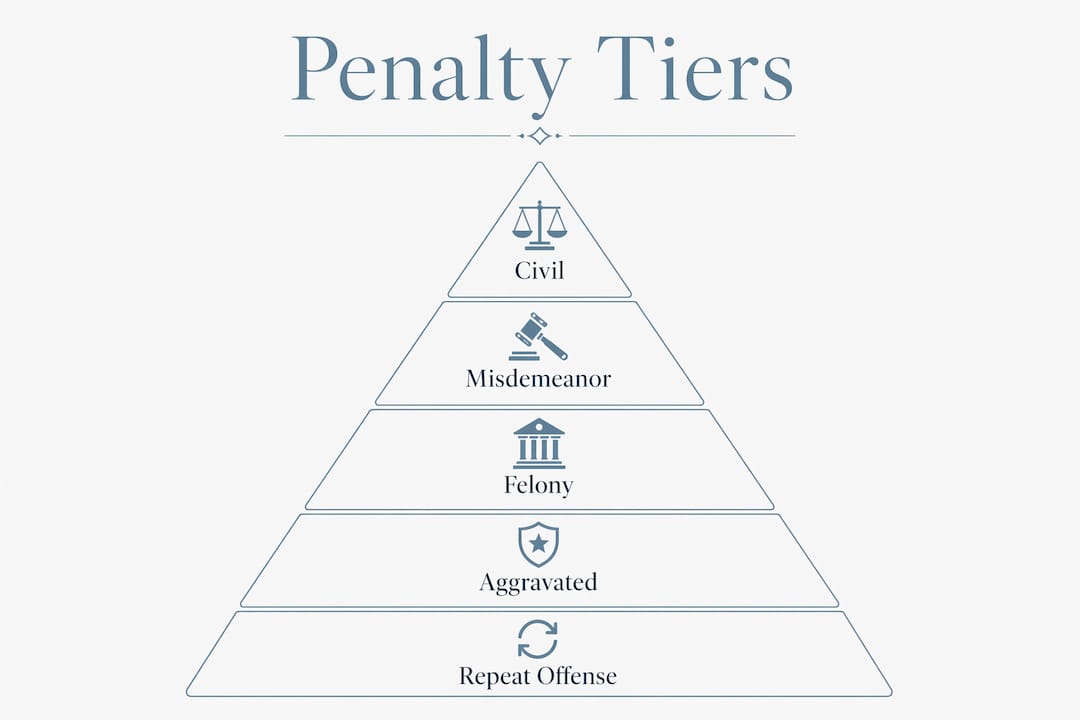
New Hampshire uses a tiered penalty system for drug possession, and the tier you fall into determines whether you walk away with a fine or face prison time. The law distinguishes between marijuana and other controlled substances, and it treats quantity as the primary factor in charging decisions.

For marijuana specifically, possession of up to 3/4 ounce by adults 21 and older is classified as a civil violation, not a crime. That means no arrest, no criminal record, and a $100 fine for the first two offenses within a three-year period. This is decriminalization, not legalization. Marijuana remains illegal in New Hampshire. The distinction matters because many people assume decriminalization means they are free to possess or use it without any legal risk.
For Schedule I and Schedule II controlled substances such as heroin, methamphetamine, or fentanyl, even small amounts can trigger felony charges. The penalties are far more severe than those for marijuana, and the legal consequences drug possession carries in these cases can follow you for life.
Civil violations: small marijuana possession thresholds
The civil violation category applies only to marijuana and only under specific conditions. Here is what the law currently covers:
- Adults 21 and older possessing up to 3/4 ounce of marijuana or 5 grams of hashish receive a civil violation.
- First and second offenses within a three-year window carry a $100 fine with no criminal record.
- Third offense within three years raises the fine to up to $300 and still qualifies as a civil violation.
- Fourth offense or more within three years is classified as a misdemeanor, which creates a criminal record.
- Edibles and concentrates are subject to separate quantity thresholds, and exceeding them changes the charge category.
- Minors do not qualify for civil violation treatment and face different consequences under juvenile or criminal statutes.
The civil violation path is narrow. Crossing any of these thresholds, whether by quantity, age, or repeat offense, moves you into criminal charge territory.
Pro Tip: If you receive a civil violation notice, pay close attention to the date. A third offense within three years still avoids a criminal record, but a fourth does not. Tracking your offense history matters.
Misdemeanor and felony charges for larger quantities
Once possession exceeds the civil violation threshold, the criminal charges for drug possession escalate quickly. New Hampshire law draws a clear line at 3/4 ounce and again at 1 ounce.
| Offense | Quantity / Conduct | Maximum Penalty |
|---|---|---|
| Misdemeanor possession | Over 3/4 oz up to 1 oz marijuana | 1 year jail, $350 fine |
| Felony possession | Over 1 oz marijuana | Up to 20 years, $300,000 fine |
| Felony: intent to sell | Under 1 oz with intent to sell | Up to 3 years, $25,000 fine |
| Felony: cultivation | Any amount, single plant | Severe penalties, scales with quantity |
| Felony: Schedule I/II drugs | Any amount heroin, meth, fentanyl | Significant prison time and fines |
Possession over 1 ounce can lead to felony charges with up to 20 years in prison and fines reaching $300,000. That is not a worst-case scenario reserved for large-scale dealers. It applies to any individual found with more than an ounce.
Growing marijuana at home carries its own serious risk. Cultivation of any amount, including a single plant, is classified as manufacturing under New Hampshire law. Manufacturing is a felony. Many residents assume growing one plant for personal use is a minor offense. It is not.
Pro Tip: Prosecutors look for evidence beyond the drugs themselves. Scales, multiple baggies, and large amounts of cash can convert a simple possession charge into a possession with intent to sell felony, even if you never sold anything.
How NH drug laws handle repeat offenses and driving
Repeat offenses and driving-related charges represent two areas where New Hampshire drug offense penalties escalate in ways that catch people off guard.
On repeat offenses, the pattern is straightforward:
- First and second marijuana civil violations carry no criminal record.
- Third and subsequent offenses raise fines and eventually trigger misdemeanor classification.
- A misdemeanor creates a permanent criminal record, which affects employment, housing, and professional licensing.
The 2025 open container law added a new layer of enforcement risk for drivers. Effective January 1, 2025, cannabis must be transported in a vehicle’s trunk. Keeping it in the passenger compartment, even sealed, violates the law. The fine is $150, and a license suspension is possible. Medical cannabis patients are exempt from this rule, but recreational users are not.
New Hampshire’s cannabis DUI standard is also distinct from alcohol DUI. The state uses an impairment-based standard with no fixed THC blood level threshold. Prosecutors must prove observable impairment, not just the presence of THC. This differs from alcohol DUI, where a 0.08% BAC is the legal limit. Refusing to submit to a test triggers an administrative license suspension separate from any criminal case. For a full breakdown of related penalties, Narolaw’s guide on NH DUI penalties covers the consequences in detail.
The 2025 open container law also creates a specific risk for residents who legally purchase cannabis in neighboring states like Massachusetts or Vermont and then drive back into New Hampshire. Transporting legally purchased cannabis from another state without proper trunk storage violates NH law, regardless of where it was bought.
How school zones and intent to distribute increase penalties
Location and intent are two factors that can dramatically increase drug possession penalties in NH, often beyond what defendants expect.
- School zone proximity: Selling or possessing with intent to sell within 1,000 feet of a school carries a mandatory minimum one-year prison sentence. The judge has no discretion to go below that minimum.
- Quantity escalation: Penalties increase with the amount involved. Larger quantities signal distribution activity to prosecutors and courts.
- Conspiracy and attempt charges: Under RSA 318-B:26, attempts and conspiracies to manufacture, sell, or distribute carry the same penalties as completed offenses. You do not need to complete a sale to face full felony consequences.
- Evidence of distribution: Items like scales, packaging materials, or multiple phones found during a search can elevate a possession charge to distribution, even without a buyer present.
| Charge Type | Key Trigger | Minimum Sentence |
|---|---|---|
| Simple possession | Quantity under threshold | Civil fine or misdemeanor |
| Possession with intent | Evidence of distribution | Felony, up to 3–20 years |
| Sale near school zone | Within 1,000 feet of school | Mandatory 1-year minimum |
| Conspiracy to distribute | Planning without completion | Same as completed offense |
Key takeaways
New Hampshire drug possession penalties range from a $100 civil fine for small marijuana amounts to felony charges carrying decades in prison, depending on quantity, substance type, and intent.
| Point | Details |
|---|---|
| Civil violation threshold | Adults 21+ with up to 3/4 oz marijuana face a $100 fine and no criminal record for first two offenses. |
| Felony at one ounce | Possession over 1 oz marijuana can result in up to 20 years in prison and a $300,000 fine. |
| Cultivation is a felony | Growing even one marijuana plant is classified as manufacturing under NH law. |
| School zone mandatory minimum | Selling within 1,000 feet of a school triggers a mandatory one-year prison sentence. |
| 2025 transport rule | Cannabis must be stored in the trunk of a vehicle or the driver risks a fine and license suspension. |
What i’ve learned watching NH drug cases unfold
New Hampshire occupies an unusual position. It has partially decriminalized marijuana while sitting between states like Massachusetts and Vermont where recreational use is fully legal. That gap creates real confusion, and I see it play out in cases regularly.
The most common misunderstanding is treating decriminalization as legalization. People drive back from Massachusetts with cannabis in their cup holder and have no idea they are now violating both the open container law and potentially triggering a DUI investigation. The NH impairment-based DUI standard means you can be charged without any blood test confirming impairment. That is a significant legal exposure most people do not anticipate.
The other pattern I see is people underestimating how quickly simple possession becomes a felony. One ounce is not a large amount. A few extra grams, a bag of edibles, or a single plant in a backyard can push someone from a civil fine into a felony charge with life-altering consequences. Getting legal help for drug possession early, before charges are formally filed, gives you the best chance of a favorable outcome.
— Rich
Facing drug charges in NH? Narolaw can help
Drug possession charges in New Hampshire move fast, and the difference between a civil fine and a felony often comes down to how quickly you act. Narolaw’s criminal defense attorneys in New Hampshire handle drug crimes across the full spectrum, from marijuana civil violations to felony distribution charges. The team understands how prosecutors build these cases and where defense strategies are most effective, including challenging improper searches and contesting intent-to-sell evidence. If you or someone you know is facing drug charges, contact Narolaw to schedule a free consultation and get clear answers about your options before your next court date.
FAQ
What is the fine for marijuana possession in new hampshire?
First and second marijuana civil violations carry a $100 fine for adults 21 and older possessing up to 3/4 ounce. A third offense within three years raises the fine to up to $300.
When does marijuana possession become a felony in NH?
Possession of more than 1 ounce of marijuana can result in felony charges with up to 20 years in prison. Possession with intent to sell, even under 1 ounce, is also a felony under New Hampshire law.
Does a marijuana civil violation go on your criminal record?
Civil violations for the first two offenses do not result in arrest or a criminal record. A fourth offense within three years is classified as a misdemeanor, which does create a criminal record.
Can i be charged with DUI for cannabis in new hampshire?
Yes. New Hampshire uses an impairment-based standard for cannabis DUI with no fixed THC limit. Prosecutors must show observable impairment, and refusing a test triggers a separate administrative license suspension.
Is growing marijuana at home legal in new hampshire?
No. Cultivation of any amount, including a single plant, is classified as manufacturing under NH law and carries felony penalties.


