

When you’re facing a divorce or custody matter in New Hampshire, the legal terminology can feel like a foreign language. Terms like legal custody, physical custody, equitable distribution, and parenting plans sound straightforward until you realize they carry specific legal meanings that directly affect your case outcome. Misunderstanding even one term on a court form or during negotiation can lead to agreements that don’t reflect your intentions or protect your rights. This guide translates the most important family law terms into plain English, helping you navigate New Hampshire’s divorce, custody, and support processes with confidence and clarity.
Table of Contents
- The most common family law terms in New Hampshire
- How New Hampshire divides property, alimony, and debt
- Parenting plans, custody types, and child support explained
- Understanding the official forms and court processes
- Get help with your New Hampshire family law case
- Frequently asked questions
Key Takeaways
| Point | Details |
|---|---|
| Clear definitions matter | Misunderstanding legal terms can lead to costly mistakes or missed opportunities. |
| Property and custody are separate | Terms for dividing assets and deciding child arrangements each have special meanings in New Hampshire. |
| Standard forms use specific language | Understanding NH’s official paperwork makes filing and negotiating much easier. |
| Legal help is available | Attorneys can clarify confusing terminology and guide you through every step. |
The most common family law terms in New Hampshire
Now that you understand why these terms matter, let’s break down the most common ones you’ll see in New Hampshire family law. These foundational terms appear repeatedly in court documents, settlement negotiations, and legal proceedings. Knowing exactly what they mean helps you communicate effectively with attorneys, understand your rights, and make informed decisions about your case.
Divorce refers to the legal termination of a marriage by court order. In New Hampshire, you must establish grounds for divorce, which can be fault-based or no-fault. The process results in a final decree that addresses property division, support obligations, and parenting arrangements if children are involved.
Legal separation allows spouses to live apart with court-approved terms for finances and children without actually ending the marriage. This option appeals to couples who have religious or financial reasons to remain married while living separately. Legal separation differs from divorce in that the marriage remains legally intact.
Annulment declares a marriage legally invalid from the beginning, as if it never existed. New Hampshire grants annulments only in specific circumstances, such as fraud, bigamy, or lack of capacity to consent. Unlike divorce, which ends a valid marriage, annulment erases it entirely.
Parenting plan is a required document in all New Hampshire divorce or separation cases involving minor children. It outlines residential schedules, decision-making authority, holiday arrangements, and communication protocols between parents. Divorce decrees require standardized elements including the parenting plan.
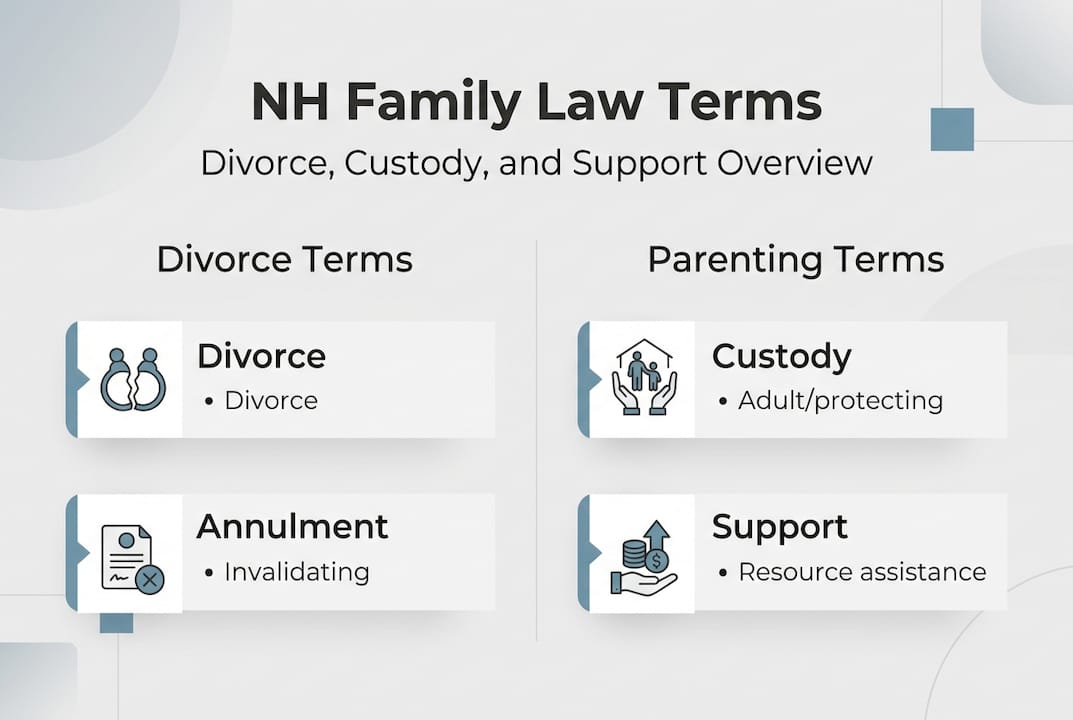
Custody encompasses two distinct concepts that parents often confuse. Legal custody means the authority to make major decisions about a child’s education, healthcare, and religious upbringing. Physical custody refers to where the child primarily resides and who provides day-to-day care. Courts can award joint or sole custody for each type independently.

Child support is the financial obligation one parent pays to help cover a child’s living expenses. New Hampshire calculates support using a formula that considers both parents’ incomes, the number of children, and certain allowable expenses. The amount appears in a Uniform Support Order, which is a standardized court document.
Alimony, also called spousal support, is money paid from one spouse to another after divorce to address economic disparities. New Hampshire courts consider factors like marriage length, each spouse’s earning capacity, contributions to the marriage, and the standard of living established during the marriage when determining alimony awards.
Equitable division describes how New Hampshire courts divide marital property and debt. Equitable means fair, not necessarily equal. While courts presume a 50/50 split, they can adjust the division based on factors like marriage duration, each spouse’s contributions, and economic circumstances.
| Term | New Hampshire Definition | Applies To |
|---|---|---|
| Divorce | Legal termination of marriage | All marital dissolutions |
| Legal Separation | Court-approved living apart while married | Couples wanting separation without divorce |
| Annulment | Declaration marriage was never valid | Limited circumstances only |
| Parenting Plan | Required document outlining custody arrangements | All cases with minor children |
| Legal Custody | Authority to make major child decisions | Child-related matters |
| Physical Custody | Where child primarily lives | Residential arrangements |
| Child Support | Financial obligation for child expenses | All cases with minor children |
| Alimony | Spousal financial support post-divorce | Cases with economic disparity |
| Equitable Division | Fair distribution of assets and debts | Property and debt matters |
Using the correct terminology matters significantly in court forms, settlement negotiations, and legal proceedings. A judge interprets your words according to their legal definitions, not your intended meaning. When you request joint legal custody but mean equal parenting time, you’re asking for decision-making authority, not a residential schedule. These distinctions affect real outcomes in your case.
How New Hampshire divides property, alimony, and debt
With those core definitions in mind, the next step is understanding how New Hampshire applies them to the real and financial assets that matter most. Property division, alimony awards, and debt assignment follow specific legal principles that may surprise you if you’re expecting a simple 50/50 split of everything.
New Hampshire follows equitable distribution, not community property rules. This means courts divide marital property fairly based on multiple factors rather than automatically splitting everything equally. Property division under RSA 458:16-a presumes equal division unless the marriage length, contributions, or other factors justify a different split.
The distinction between marital and separate property determines what gets divided. Marital property includes assets and debts acquired during the marriage, regardless of whose name appears on the title. Separate property consists of assets owned before marriage, inheritances, and gifts received by one spouse individually. However, separate property can become marital if it’s commingled with marital funds or used for the family’s benefit.
| Property Type | Definition | Subject to Division? |
|---|---|---|
| Marital Property | Assets/debts acquired during marriage | Yes |
| Separate Property | Pre-marriage assets, inheritances, individual gifts | Generally no |
| Commingled Property | Separate property mixed with marital funds | Possibly, depending on tracing |
| Marital Home | Primary residence purchased during marriage | Yes, unless proven separate |
| Retirement Accounts | Contributions made during marriage | Yes, marital portion only |
| Business Interests | Value increase during marriage | Yes, marital portion only |
Courts consider several factors when dividing property unequally. Marriage length matters significantly. A 25-year marriage typically results in more equal division than a three-year marriage. Each spouse’s contributions, both financial and non-financial, influence the split. Staying home to raise children while the other spouse built a career counts as a valuable contribution. The court also examines each spouse’s economic circumstances, including age, health, employability, and future earning capacity.
Pro Tip: Document your separate property carefully. Keep records showing when you acquired assets, their original value, and how you kept them separate from marital funds. Without clear documentation, courts may treat contested assets as marital property.
Marital debt receives the same equitable treatment as assets. Credit card balances, mortgages, car loans, and other debts incurred during the marriage get divided fairly between spouses. The court looks at who benefited from the debt, who has the ability to pay, and what’s fair given the overall property division. One spouse keeping the house usually means assuming the mortgage, while the other might take the car and its loan.
Alimony awards follow a similar factor-based analysis. Courts don’t use a formula for alimony like they do for child support. Instead, they evaluate the requesting spouse’s need for support and the other spouse’s ability to pay. The Uniform Support Order documents any alimony award, specifying the amount, payment schedule, duration, and conditions for modification or termination.
Three types of alimony exist in New Hampshire:
- Temporary alimony provides support during the divorce process before the final decree
- Rehabilitative alimony offers time-limited support while the recipient gains education or job skills
- Permanent alimony continues indefinitely, typically in long marriages where one spouse cannot become self-supporting
The length of marriage heavily influences alimony duration. Short marriages rarely result in long-term support. Marriages lasting 20 years or more often justify permanent alimony, especially when one spouse sacrificed career advancement for family responsibilities. Courts also consider the marital standard of living, each spouse’s age and health, and contributions made during the marriage.
Understanding how property division works helps you enter negotiations with realistic expectations. Alimony calculations involve discretion, not rigid formulas, so presenting your circumstances clearly matters. The family home often represents the largest asset, making its treatment particularly important in settlement discussions.
Parenting plans, custody types, and child support explained
Property and money are key, but when children are involved, family law introduces a different set of specialized language and requirements. These terms directly affect your relationship with your children and your daily life after divorce or separation.
Every divorce or legal separation involving minor children requires a parenting plan. This isn’t optional. New Hampshire mandates parenting plans as standardized elements in all decrees affecting children. The plan must address specific topics and receive court approval before your divorce finalizes.
A standard New Hampshire parenting plan includes:
- Residential schedule showing where the child lives each day of the year
- Holiday and vacation schedules with specific dates and times
- Decision-making authority for education, healthcare, and religious upbringing
- Communication protocols between parents and with the child
- Transportation arrangements for exchanges
- Dispute resolution procedures when parents disagree
- Provisions for modifying the plan as children’s needs change
The distinction between physical and legal custody confuses many parents. Physical custody determines where your child lives and who provides daily care. Legal custody governs who makes major decisions about your child’s upbringing. You can have joint legal custody, sharing decision-making authority, while one parent has primary physical custody, meaning the child lives mostly with that parent.
Parenting time describes the actual hours and days each parent spends with the child. This term has largely replaced older language like visitation, which implied one parent was just a visitor rather than an active parent. Modern parenting plans focus on maximizing both parents’ involvement when appropriate for the child’s wellbeing.
Joint legal custody means both parents share major decision-making responsibilities. You’ll need to consult each other and reach agreement on schools, medical treatments, religious practices, and similar significant matters. Courts favor joint legal custody unless evidence shows one parent is unfit or parents cannot communicate effectively enough to make joint decisions work.
Sole legal custody grants one parent exclusive authority to make major decisions without consulting the other parent. Courts award sole legal custody when parents have such high conflict that joint decision-making would harm the child, when one parent has abandoned involvement, or when safety concerns exist.
“The best interests of the child guide all custody and parenting time decisions in New Hampshire. Courts prioritize stability, safety, and maintaining meaningful relationships with both parents when possible.”
Child support calculations follow New Hampshire’s child support guidelines, which use both parents’ incomes and the number of children to determine the support amount. The calculation considers gross income from all sources, including wages, bonuses, self-employment income, rental income, and investment returns. Certain deductions apply, such as taxes, mandatory retirement contributions, and support obligations for other children.
The Uniform Support Order documents the child support obligation. This standardized form specifies the monthly payment amount, payment schedule, how long support continues, and provisions for health insurance and uncovered medical expenses. Child support calculations changed in 2025 to better reflect shared parenting arrangements.
Deviation from the guideline amount occurs when special circumstances make the calculated support unfair. Courts can adjust support up or down based on factors like extraordinary medical expenses, special educational needs, significant differences in parenting time, or either parent’s unusual financial circumstances. Any deviation requires specific findings explaining why the guideline amount is inappropriate.
Pro Tip: New Hampshire requires parents in contested custody cases to attend a parenting education class and attempt mediation before trial. Complete these requirements early in your case to avoid delays and demonstrate your commitment to cooperative co-parenting.
Enforcement mechanisms ensure child support gets paid. The state can garnish wages, intercept tax refunds, suspend driver’s licenses, and report non-payment to credit bureaus. Intentional non-payment can result in contempt of court charges. Support obligations continue regardless of parenting time changes unless you obtain a court order modifying the amount.
Understanding custody arrangements helps you advocate effectively for your preferred outcome. Negotiating custody terms often produces better results than leaving decisions entirely to a judge who has limited time to learn about your family’s unique dynamics.
Understanding the official forms and court processes
To apply this terminology confidently, you also need to understand how it shows up in the practical paperwork and procedures of New Hampshire’s family courts. The forms use specific legal language, and knowing what each term means helps you complete documents accurately and understand what you’re agreeing to.
New Hampshire family courts use standardized forms for most proceedings. These forms include defined terms and require specific information. Divorce decrees use standardized language and must address required elements in every case. When you encounter an unfamiliar term on a form, check the New Hampshire Revised Statutes or court rules for the legal definition rather than guessing based on common usage.
The main forms you’ll encounter include:
- Petition for Divorce or Legal Separation initiates your case by stating the grounds for divorce, basic information about your marriage, and what you’re requesting from the court
- Financial Affidavit requires detailed disclosure of your income, expenses, assets, and debts, providing the foundation for property division and support calculations
- Parenting Plan outlines all custody and parenting time arrangements, requiring specific details about schedules, decision-making, and communication
- Uniform Support Order documents child support and alimony obligations with payment amounts, schedules, and duration
- Final Decree of Divorce is the court’s final order dissolving your marriage and incorporating all agreements or decisions about property, support, and children
The family law court process in New Hampshire follows these key steps:
- File the petition and serve your spouse with copies of all documents
- Your spouse files an appearance and answer responding to your petition
- Both parties complete financial disclosures and exchange required documents
- Attend mandatory mediation if custody is contested, attempting to reach agreement
- Complete the required parenting education class if children are involved
- Engage in settlement negotiations, often with attorney assistance
- Attend a final hearing where the judge reviews your agreement or makes decisions on contested issues
- Receive the final decree incorporating all terms of your divorce
When you’re confused by legal terminology on a form, don’t guess or leave it blank. Court clerks cannot provide legal advice, but they can direct you to resources. The New Hampshire Judicial Branch website offers form instructions and self-help materials. Many terms link to statutory definitions you can look up. Preparing for a consultation with an attorney helps you get answers to specific questions about your forms and situation.
Understanding procedural terms also matters. A motion is a formal request asking the court to take specific action. A hearing is a court session where the judge listens to arguments and evidence before making decisions. Discovery refers to the formal process of obtaining information and documents from your spouse. Contempt means willfully disobeying a court order, which can result in penalties.
Default occurs when one party fails to respond to the petition or appear in court. The court can grant a default divorce, giving the petitioner most of what they requested. Modification refers to changing an existing court order when circumstances have substantially changed since the original order. You cannot simply stop following an order because your situation changed; you must file a motion and obtain court approval for modifications.
Get help with your New Hampshire family law case
Reading about these terms helps, but sometimes a conversation with an expert can clarify your exact situation. Working with an experienced family law attorney provides clear explanations tailored to your circumstances and helps you avoid costly mistakes that result from misunderstanding legal terminology. An attorney can review your forms before filing, explain what each term means in your specific context, and ensure your agreements actually say what you intend.
Many people discover too late that they agreed to something different than they thought because they misunderstood a legal term. Others miss opportunities to protect their interests because they didn’t realize certain options existed. Professional guidance helps you navigate the process confidently, understanding exactly what you’re signing and what it means for your future.
Family law attorneys in Manchester handle cases throughout New Hampshire, bringing experience with local court procedures and judges. Reviewing examples of family law cases shows how different terms and concepts apply in real situations. Custody attorneys in Merrimack understand the specific challenges parents face and can explain your options clearly.
If you have questions about terminology in your case, need help completing court forms, or want to understand what a proposed agreement actually means, reach out for a consultation. Getting clarity now prevents problems later and helps you make informed decisions about your family’s future.
Frequently asked questions
What is the difference between legal custody and physical custody in NH?
Legal custody means the right to make major decisions about a child’s education, healthcare, and religious upbringing. Physical custody means where the child lives and who provides day-to-day care. These terms are frequently misunderstood in New Hampshire divorce cases.
How is child support determined in New Hampshire?
Child support is calculated using New Hampshire’s guidelines based on both parents’ incomes, the number of children, and certain allowable expenses. The Uniform Support Order documents the final support obligation in every case involving children.
What does equitable distribution mean for divorce?
Equitable distribution means property is divided fairly based on factors like marriage length, contributions, and economic circumstances. Courts presume equal division unless specific factors justify a different split.
Do I need a parenting plan if we agree on everything?
Yes, New Hampshire law requires a signed parenting plan in all divorce or separation cases with minor children, even when both parents agree on all terms. The parenting plan is a required element of every decree involving children.
Where can I find the official definitions for NH family law terms?
Official definitions appear in New Hampshire statutes and court rules rather than a single glossary. The NH Judicial Branch site provides court rules, and the Revised Statutes Annotated contains statutory definitions. Consult an attorney if you’re unsure about a term’s legal meaning.


