

TL;DR:
- New Hampshire law is gender-neutral, focusing on the child’s best interests in custody decisions.
- Well-crafted parenting plans and cooperation can improve fathers’ custody and parenting time outcomes.
- Recent reforms favor equal parenting and often reduce child support responsibilities for involved fathers.
Many fathers walking into a New Hampshire courtroom believe the deck is stacked against them. That assumption, while understandable, is outdated. New Hampshire family law is explicitly gender-neutral, and recent reforms in 2025 pushed courts even further toward equal parenting as the default. Whether you are establishing paternity, negotiating a parenting plan, or trying to understand how child support is calculated, knowing your rights is the first step toward protecting them. This guide covers the current legal landscape, practical steps, and key challenges New Hampshire fathers face today.
Table of Contents
- How New Hampshire determines parental rights and child custody
- Parenting plans and how fathers can protect their time
- Child support and the 2025 equal-parenting reforms
- Special challenges: Paternity, domestic violence claims, and parental alienation
- A hard-won perspective on protecting your rights as a New Hampshire father
- Get expert help navigating father’s rights in New Hampshire
- Frequently asked questions
Key Takeaways
| Point | Details |
|---|---|
| Gender-neutral custody laws | New Hampshire law does not automatically favor mothers or fathers in custody decisions. |
| Parenting plan enforcement | Fathers can protect parenting time with required plans and new enforcement motions for noncompliance. |
| New child support rules | 2025 reforms may mean no support is owed if both parents have similar incomes and share time equally. |
| Proactive paternity steps | Unmarried fathers must establish legal parenthood in court to gain custody or visitation rights. |
| Seek expert support | Having skilled legal guidance is crucial for navigating NH family courts and asserting your rights. |
How New Hampshire determines parental rights and child custody
New Hampshire courts do not start with a presumption that mothers are better parents. The law requires judges to focus on one thing: what is best for the child. Understanding this standard puts you in a much stronger position from the start.
The best interests standard under RSA 461-A:6 is the foundation of every custody decision in the state. Judges weigh a specific set of factors when determining parenting arrangements, and gender is not one of them. Courts look at:
- The quality of the relationship between each parent and the child
- Each parent’s ability to meet the child’s physical, emotional, and developmental needs
- Each parent’s willingness to support the child’s relationship with the other parent
- The child’s adjustment to home, school, and community
- Any history of domestic violence or abuse
- The child’s own preferences, depending on age and maturity
This list matters. A father who is actively involved, cooperative, and consistent scores well on nearly every factor. Understanding father’s rights law basics before you enter any legal proceeding gives you a measurable advantage.
| Traditional assumption | Current NH legal standard |
|---|---|
| Mothers get primary custody by default | Both parents evaluated equally |
| Fathers receive limited visitation | Shared parenting is encouraged |
| Income determines custody weight | Involvement and co-parenting ability matter most |
New Hampshire’s commitment to gender-neutral custody is also reflected in NH custody laws that actively discourage courts from applying bias. Fathers who understand this framework are far better positioned to make a compelling case.
Parenting plans and how fathers can protect their time
Understanding the court’s priorities is crucial, but your strongest tool is the parenting plan you submit during your case. A well-crafted parenting plan can define your relationship with your child for years.
All custody arrangements in New Hampshire require a formal parenting plan, and 2025 updates to the Family Access Motion procedure have made enforcement faster and more accessible. For unmarried fathers especially, understanding parenting plans for unmarried fathers is essential before filing anything.
Here is how the process typically works:
- File a parenting plan with your divorce or paternity petition
- Attend mediation if the parents cannot agree on terms
- Submit the agreed or contested plan to the court for review
- Receive a court order formalizing the arrangement
- If the other parent violates the order, file a Family Access Motion procedure for expedited enforcement and makeup time
| Plan type | What it means for fathers |
|---|---|
| Shared or equal parenting | Equal time with child; stronger position on support |
| Primary with scheduled visitation | Set parenting time; less flexibility but still enforceable |
Fathers who lose parenting time due to a non-compliant co-parent can also use enforcing parenting plans resources to understand all available remedies. Review a parental rights checklist before your first court date to make sure nothing is overlooked.

Pro Tip: Fathers who engage in mediation early and show genuine flexibility often walk away with more parenting time than those who adopt an adversarial posture from the start. Cooperation is not weakness; it is strategy.
Child support and the 2025 equal-parenting reforms
With your parenting plan in place, the next big concern is finances. Let’s clarify how child support works in the new legal landscape.
New Hampshire uses the income shares model under RSA 458-C, which calculates support based on both parents’ incomes combined, then divides responsibility proportionally. The 2025 reform added a significant change: if both parents have roughly equal parenting time and similar incomes, there is now a rebuttable presumption of zero child support. That is a major shift in favor of involved fathers.
However, that presumption can be rebutted if:
- One child has significant special needs or medical costs
- There are large income disparities between parents
- One parent carries substantially higher childcare costs
- The child’s established living standard requires additional support
For a detailed breakdown of how this affects your situation, the NH support calculation rules page walks through specific scenarios. You can also review the legal workflow guide to understand how support intersects with other parts of your case.
Key fact: In New Hampshire, child support generally continues until a child turns 18, or up to age 21 if the child is still in high school.
Pro Tip: Organize documentation of your income, your time with your child, and any shared expenses before your first hearing. Judges respond to specifics, not generalizations.
Special challenges: Paternity, domestic violence claims, and parental alienation
While custody and support can be straightforward, fathers often face unique challenges that demand special attention. Some situations require more than just a solid parenting plan.
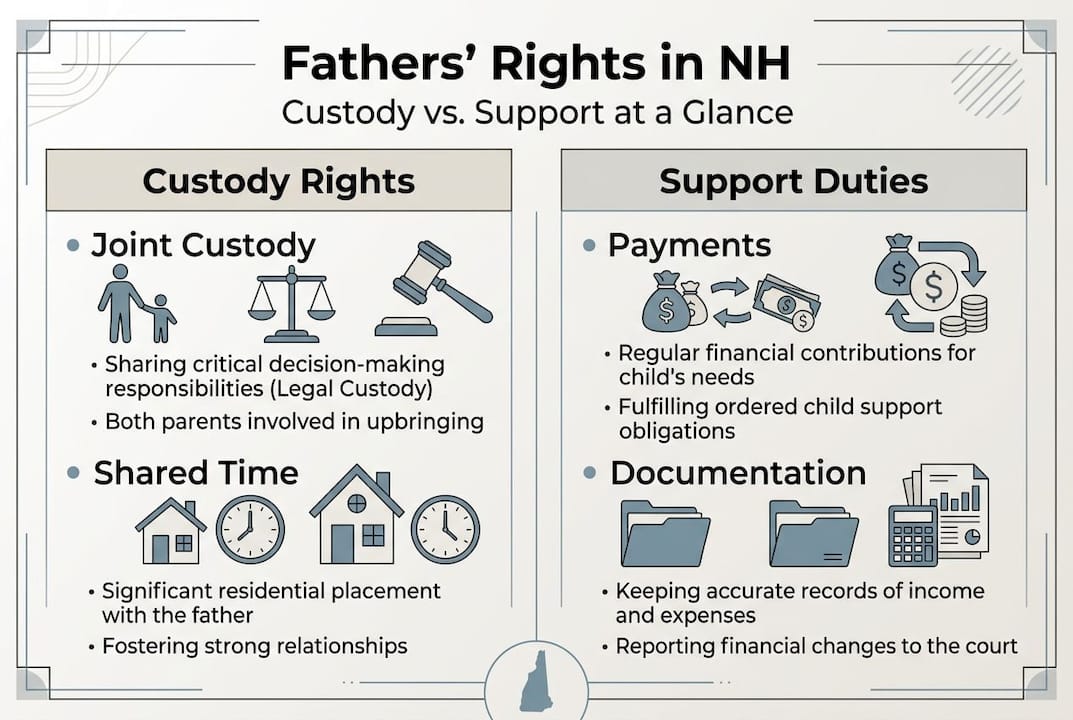
Unmarried fathers have no automatic legal rights in New Hampshire. To seek parenting time or custody, you must first establish paternity through the Circuit Court, Family Division. This can be done voluntarily through an Acknowledgment of Paternity or through a court-ordered genetic test if disputed.
Beyond paternity, fathers frequently encounter these challenges:
- Parental alienation: One parent systematically undermines the child’s relationship with the other. Courts take this seriously, but proving it requires documentation and consistent testimony.
- Domestic violence allegations: False or exaggerated claims can affect custody outcomes significantly. Fathers facing these situations need experienced legal representation immediately.
- High-conflict co-parenting: When communication breaks down, every exchange becomes a legal risk. Written records matter.
- Prolonged absence: Fathers who have been out of the picture face additional hurdles. Understanding absence and rights loss helps you assess where you stand.
New Hampshire’s legislature has seen active NH family law debate around parental alienation protections and domestic violence reform. The law remains nuanced, and outcomes depend heavily on the specific facts of each case. If you are in a contested situation, general guidance is not enough.
A hard-won perspective on protecting your rights as a New Hampshire father
Here is what many legal guides skip: winning in family court is rarely about being right. It is about being credible, consistent, and cooperative. Judges see hundreds of custody cases each year. They notice which parent shows up prepared, communicates respectfully, and prioritizes the child over the conflict.
Fathers who spend their energy building evidence of good co-parenting, like consistent pick-ups, school involvement, and calm communication, tend to outperform those who focus solely on winning arguments. That approach also feeds directly into real custody negotiation strategies that actually work in NH courts. Equal laws do not guarantee equal outcomes. Your behavior throughout the process shapes what a judge sees, and credibility is built long before you walk into the courtroom.
Get expert help navigating father’s rights in New Hampshire
If you feel your parenting rights are being overlooked or you are facing a contested custody situation, having a knowledgeable attorney on your side makes a real difference. Understanding NH family law help is a practical starting point for any father who wants to understand the full scope of what is at stake. Whether you need representation in Manchester or elsewhere in the state, a child custody attorney Manchester can help you build a case grounded in current law. If you want to get familiar with the terminology before your first consultation, review the NH family law terms resource. Naro Law offers free consultations for fathers ready to take the next step.
Frequently asked questions
Is New Hampshire still biased against fathers in custody cases?
No. NH law is gender-neutral in all custody decisions, meaning neither parent starts with an advantage. What matters most is each parent’s involvement, stability, and willingness to support the child’s relationship with the other parent.
How can an unmarried father get parental rights in New Hampshire?
Unmarried fathers must legally establish paternity through the Circuit Court, Family Division before they can request parenting time or custody. This can be done voluntarily or through a court-ordered test.
What happens if my child’s other parent won’t follow our parenting plan?
You can file a Family Access Motion to request expedited court enforcement and makeup parenting time when the other parent is not compliant with the existing order.
Will I have to pay child support if we share time equally in 2026?
Under RSA 458-C, equal parenting time combined with similar incomes now triggers a presumption of zero child support, though specific factors like special needs or major cost differences can override that presumption.


