

Many fathers in New Hampshire walk into custody disputes with more questions than answers about their rights. Facing confusing legal terms and common myths about parental authority, they often worry that the odds are stacked against them. Understanding the truth about equal parental rights and responsibilities helps you protect your relationship with your child and ensure your voice is heard throughout every stage of the court process.
Table of Contents
- Defining Fathers’ Rights And Common Misconceptions
- Types Of Custody And Legal Distinctions
- Establishing Paternity And Legal Process
- Parenting Plans And Court Determinations
- Pitfalls And Mistakes Fathers Should Avoid
Key Takeaways
| Point | Details |
|---|---|
| Equal Rights for Fathers | New Hampshire law grants fathers equal parental rights and responsibilities once paternity is established, regardless of marital status. |
| Importance of Written Parenting Plans | Informal agreements hold no legal weight; having a court-approved parenting plan is crucial for protecting your rights. |
| Establishing Paternity | Timely establishment of paternity is essential for gaining legal rights to custody, parenting time, and decision-making authority. |
| Best Interests Standard | Courts apply the best interests of the child standard equally to both parents in custody disputes, challenging common misconceptions about bias. |
Defining Fathers’ Rights and Common Misconceptions
Fathers in New Hampshire often enter custody disputes unsure of what legal rights they actually possess. The good news is straightforward: New Hampshire law treats fathers and mothers as equals when it comes to parental authority and responsibility. There’s no legal bias favoring mothers, despite what many fathers believe based on outdated assumptions.
What Are Fathers’ Rights in New Hampshire?
Fathers’ rights begin with establishing paternity. Once paternity is confirmed—either through a Voluntary Acknowledgment of Paternity at birth or a court order—fathers gain equal parental rights and responsibilities as mothers. This means decision-making authority over major life issues like education, healthcare, and religious upbringing.
Your parenting time is no longer labeled “visitation.” New Hampshire uses parenting plans that outline specific schedules, ensuring both parents have meaningful involvement. The law assumes shared parental responsibility unless evidence shows otherwise.
Child support obligations follow an income shares model, meaning both parents contribute proportionally based on their earnings. This isn’t punishment—it’s a shared financial responsibility toward the child’s welfare.
Common Misconceptions Fathers Hold
Many fathers believe courts automatically favor mothers in custody disputes. This isn’t accurate. New Hampshire family courts apply the best interests of the child standard equally to both parents, with no presumption favoring either.
Another widespread myth: fathers who weren’t married to the mother have fewer rights. The reality is different. Unmarried fathers who establish paternity have identical legal standing to married fathers. The process may require additional steps, but the end result is the same.
Some fathers think missing time with their child means losing rights permanently. While prolonged absence can affect custody arrangements, losing parental rights requires a specific legal process—usually termination of parental rights—which courts rarely grant without serious cause.
Key Rights You Actually Have
- Joint decision-making authority on education, medical care, and major life choices
- Parenting time defined through a custody order or parenting plan
- Access to your child’s school, medical, and dental records
- Right to notification of significant changes in your child’s life
- Legal standing to petition for custody or modification of existing arrangements
What Often Trips Fathers Up
Fathers sometimes assume informal arrangements with the mother protect their interests. Verbal agreements carry no legal weight. A written parenting plan filed with the court provides real protection and clarity.
Another pitfall: failing to follow the established parenting schedule. Inconsistency weakens your position in future disputes and can be used against you in court.
New Hampshire courts focus on what serves your child’s wellbeing, not on traditional gender roles. Understanding your actual rights—not your fears—puts you in the strongest position.
Pro tip: Document your involvement with your child consistently. Keep records of time spent together, conversations, medical appointments attended, and financial support provided. This evidence becomes invaluable if custody disputes arise.
Types of Custody and Legal Distinctions
New Hampshire stopped using the word “custody” years ago. Instead, the state now uses parental rights and responsibilities, a term that better reflects modern family structures and shared parenting. Understanding this distinction matters because it changes how courts view your role as a father.
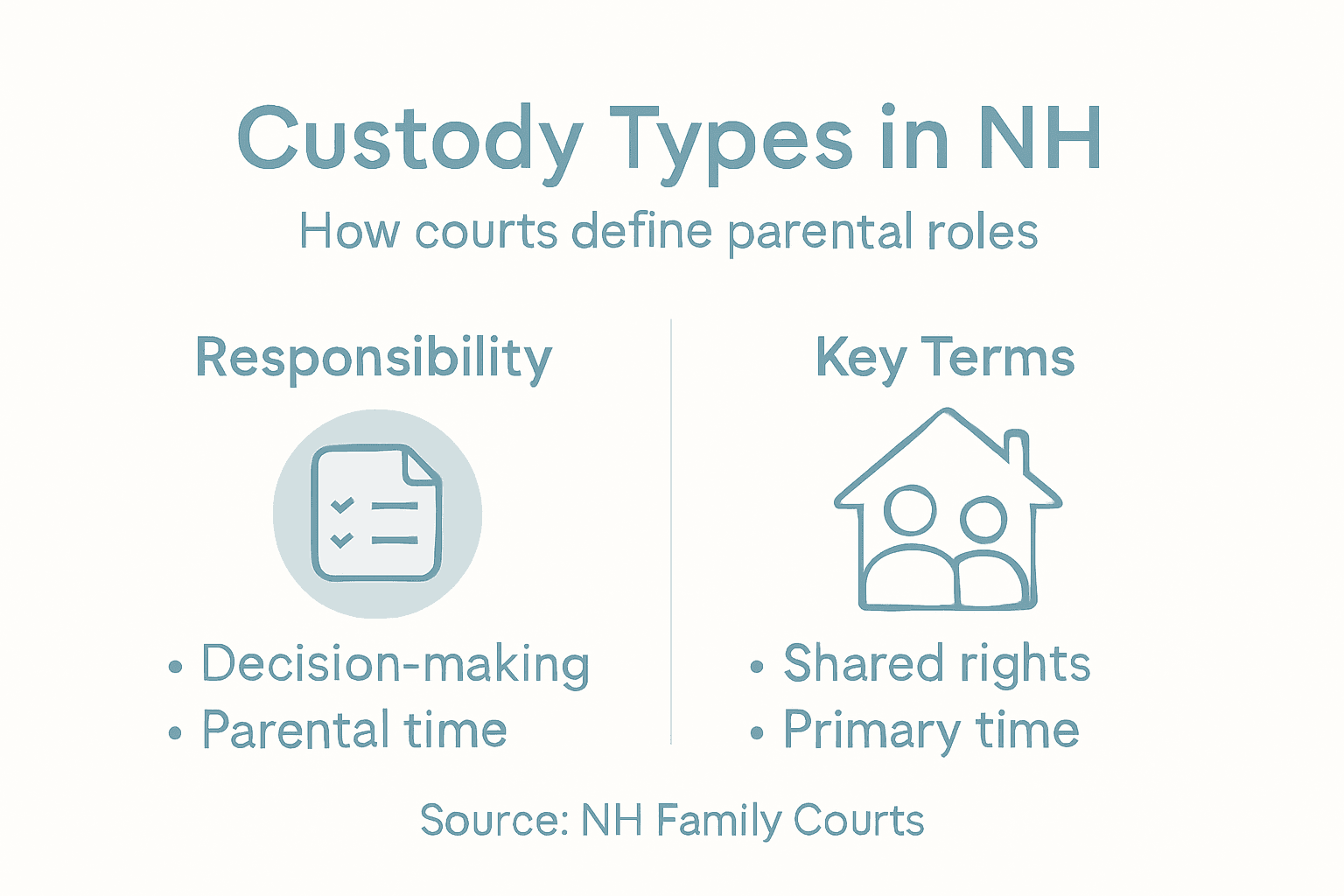
The old custody framework separated parents into “custodial” and “non-custodial” roles, implying one parent had more authority. New Hampshire’s newer approach recognizes that both parents can be equally involved in major decisions and daily parenting. This shift benefits fathers significantly.
Decision-Making Responsibility vs. Parenting Time
New Hampshire law splits parental rights into two separate components. Decision-making responsibility covers major life choices: which school your child attends, medical treatment decisions, religious upbringing, and similar significant matters.

Parenting time is the actual schedule of when your child is with you. It replaces the outdated term “visitation,” which implied you were simply visiting your own child. Parenting time can be equal, primary, or any arrangement the court deems in your child’s best interest.
Many fathers don’t realize these are independent. You might share decision-making but have a parenting time schedule favoring the other parent, or vice versa. The court customizes these to fit your family’s situation.
Shared Parental Rights and Responsibilities
When courts award shared parental rights, both parents hold equal decision-making authority. This means you have a genuine voice in your child’s education, healthcare, and major life decisions.
Shared custody in New Hampshire requires a cooperative approach. You and the other parent must communicate and make joint decisions, even if you disagree on parenting time schedules. Courts prefer this model because research shows children benefit from active involvement by both parents.
The cooperation requirement can feel challenging if relations are strained. However, the legal obligation to cooperate protects your rights and your child’s access to both of you.
Primary vs. Shared Parenting Time
Parenting time arrangements fall into a spectrum:
- Shared or equal parenting time: You and the other parent split time roughly 50/50, allowing equal involvement in daily life
- Primary parenting time: One parent has the child most of the time; the other parent has scheduled visitation
- Supervised parenting time: Court-ordered supervised visits if concerns exist about your ability to parent safely
- Limited parenting time: Minimal contact, ordered in rare circumstances involving serious risk
Your specific arrangement depends on factors like work schedules, proximity to the child’s school, and your relationship with the other parent. Courts don’t assume mothers need primary time with children. Each case stands on its own merits.
Here’s a comparison of the main types of parenting time arrangements under New Hampshire law:
| Parenting Time Type | Typical Schedule | When Courts Use It | Impact on Child-Parent Bond |
|---|---|---|---|
| Shared or Equal | Roughly 50/50 split | When both parents are fit and cooperate | High, maximizes daily involvement |
| Primary Parenting Time | One parent most of the time | When logistics or child needs favor one parent | Moderate, regular contact with both |
| Supervised Parenting Time | Limited, supervised visits | If safety or well-being concerns exist | Low to moderate, ensures protection |
| Limited Parenting Time | Minimal or rare visits | For rare cases involving serious risk or instability | Minimal, connection often impaired |
The Legal Framework Behind These Distinctions
The legal framework allocates decision-making rights and parenting time based on what serves the child’s best interest. New Hampshire courts consider your involvement history, your ability to cooperate with the other parent, and your child’s preferences (depending on age).
The shift from “custody” language to “parental rights and responsibilities” isn’t just terminology. It signals a legal philosophy that rejects outdated assumptions about gender roles in parenting.
Modern New Hampshire family law treats fathers as full parents, not backup caregivers. The law expects you to be actively involved in decisions and daily parenting.
Pro tip: When negotiating a parenting plan, separate the two components: clearly define which decisions require mutual agreement and establish a specific parenting time schedule with day and time details. Written clarity prevents misunderstandings and provides strong evidence if disputes arise later.
Establishing Paternity and Legal Process
Without legally established paternity, you have no parental rights or responsibilities in New Hampshire. This is the foundational step. Many fathers assume that being listed on a birth certificate automatically grants them legal rights. It doesn’t. You must formally establish paternity through a legal process.
Establishing paternity opens the door to everything else: custody rights, parenting time, decision-making authority, and the ability to support your child financially. Skip this step, and you’re legally invisible to your child.
The Voluntary Acknowledgment Path
The easiest way to establish paternity is through a Voluntary Acknowledgment of Paternity. If you and the mother agree, you can both sign this document at the hospital immediately after birth. No court appearance required.
This form doesn’t require genetic testing or legal proceedings. Both parents simply acknowledge the biological father. Once signed and filed, establishing paternity through acknowledgment creates a legal bond that triggers your parental rights and responsibilities.
Many hospitals offer this at discharge. If you miss the window, you can still file the affidavit later through the New Hampshire Division of Child Support Services or the Family Division of Circuit Court.
When Paternity Is Disputed
If the mother denies you’re the father or refuses to sign the acknowledgment, you’ll need to file a petition for paternity with the Family Division of Circuit Court. This triggers a legal process that can take several months.
The court will typically order genetic testing to determine biological parentage. Modern DNA tests are extremely accurate—over 99 percent. Results are usually available within weeks.
If genetic testing confirms paternity, the court issues an order establishing you as the legal father. If testing shows you’re not the biological father, your petition is dismissed. The process protects everyone’s interests by relying on scientific evidence.
What Happens After Paternity Is Established
Once paternity is legally established, several things occur automatically:
- Your name can be added to or corrected on the birth certificate
- A revised birth certificate is issued reflecting legal parentage
- You gain the right to pursue custody or parenting time arrangements
- Child support obligations begin (if applicable)
- You can make medical and educational decisions
- Your child may have inheritance rights if you pass away
Establishing paternity also protects your child. They gain access to your medical history, Social Security benefits, health insurance, and inheritance rights. It’s not just about your rights—it benefits your child significantly.
Timeline and Court Process
Voluntary acknowledgment is instant. Court-based paternity cases typically take 3-6 months from filing to final order, depending on court schedules and whether genetic testing is needed.
Once the order is entered, you have full standing to file for custody, parenting time, or child support modifications. You’re no longer an outside party—you’re a legal parent.
Establishing paternity is your legal foundation. Everything else in family law—custody, parenting time, child support—flows from this one step. Don’t delay.
Pro tip: If paternity is uncontested, sign the Voluntary Acknowledgment at the hospital or immediately after birth. Keep a certified copy with your important documents. If paternity will be contested, consult an attorney before the mother files her own action, as timing can affect your legal position.
Parenting Plans and Court Determinations
A parenting plan is your legal roadmap for raising your child after separation or divorce. It specifies who makes decisions, when your child is with each parent, and how you’ll handle communication. This document replaces the old “custody and visitation” framework with something more practical and father-inclusive.
Parenting plans aren’t optional suggestions. They’re court-approved legal orders. Violating them carries real consequences, including contempt of court charges. Understanding what goes into yours protects your rights.
What a Parenting Plan Includes
Parenting plans detail the division of decision-making authority and parenting time between both parents based on your child’s best interests. The document covers several critical areas:
- Decision-making responsibility: Who decides on education, medical care, religious upbringing, and major life choices
- Parenting time schedule: Specific days and times your child is with you (school year, summer, holidays)
- Communication protocol: How parents communicate about the child
- Transportation arrangements: Who handles pickups and drop-offs
- Dispute resolution: How conflicts are handled (mediation, arbitration, court)
Each parenting plan is customized. Courts don’t use templates. Your schedule accounts for your work hours, your child’s school location, and both parents’ involvement history.
How Courts Determine Parenting Plans
When parents can’t agree on a parenting plan, the court steps in. New Hampshire judges apply the best interests of the child standard, evaluating numerous factors to reach a fair decision.
Courts examine your involvement history, relationship with your child, stability, ability to cooperate with the other parent, and your child’s preferences (if old enough). The court also considers practical matters like proximity to schools and work.
This process isn’t quick. Contested parenting plan determinations typically take several months. Court dates, evaluations, and possible guardian ad litem involvement add time.
Agreed-Upon Plans Are Stronger
If you and the mother reach agreement, the court almost always approves your parenting plan without modification. Judges respect parental agreements because they reflect real-world solutions both parents accept.
Agreed plans also avoid the uncertainty of court determination. You control the outcome rather than hoping a judge sides with you. The process moves faster and costs significantly less.
Key Elements Courts Consider
- Each parent’s relationship with the child
- Each parent’s role in childcare historically
- Stability and safety of each home
- Distance between parents’ residences
- Your child’s adjustment to school and community
- Special needs or health considerations
- Your ability to encourage the child’s relationship with the other parent
- Whether either parent has a history of domestic violence
Courts strongly favor fathers who demonstrate consistent involvement. Attendance at school events, medical appointments, and activities matters. Documentation helps.
Court-determined parenting plans protect both parents’ rights, but agreed plans give you control over your arrangement. Negotiating a fair agreement often serves fathers better than litigation.
Pro tip: Draft your proposed parenting plan before mediation or court, specifying exact days, times, and decision-making splits. Present concrete proposals rather than vague preferences. Courts respond better to detailed, realistic plans that show you’ve thought through the logistics.
Pitfalls and Mistakes Fathers Should Avoid
Fathers navigating New Hampshire family law often make critical errors that weaken their legal position. Some mistakes are obvious. Others are subtle but equally damaging. Knowing what to avoid puts you ahead from day one.
The good news: most pitfalls are preventable. With awareness and proper guidance, you can protect your rights and strengthen your relationship with your child.
Failing to Establish Paternity Early
This is the foundational error. If you’re an unmarried father, delaying paternity establishment costs you time and legal standing. Every month you wait, the other parent could file first, gaining procedural advantages.
Common mistakes include failing to establish paternity early, which can result in lost rights and complications later. Sign the Voluntary Acknowledgment at the hospital. Don’t assume you’ll handle it later.
If paternity is contested, immediate action matters. Waiting gives the other parent leverage. Court timelines favor whoever files first.
Ignoring Court Orders
Violating a parenting plan or child support order is catastrophic for your case. Judges view non-compliance as disrespect for the court and indifference to your child’s welfare. This perception is hard to overcome.
Miss a scheduled parenting time? Document the reason. Can’t pay full child support? Petition to modify before you fall behind. Ignoring problems only makes them worse.
Consistency demonstrates reliability. Unreliability destroys credibility.
Attempting DIY Legal Strategy
Family law is complex. Procedure matters as much as substance. Fathers who try to represent themselves often miss filing deadlines, misinterpret rules, or present weak arguments in court.
You wouldn’t perform your own dental work. Family law deserves the same professional respect. The cost of an attorney is tiny compared to the cost of losing custody or overpaying child support for years.
Making Parenting Plans Verbally
Handshake agreements fail. Memories differ. The other parent changes their mind. Verbal arrangements carry zero legal weight.
Get everything in writing. Have a formal parenting plan filed with the court. This creates enforceability and protection.
Below is a summary of common pitfalls fathers face and their consequences:
| Pitfall | Why It Happens | Legal or Personal Consequence |
|---|---|---|
| Delaying paternity establishment | Lack of knowledge or procrastination | Loss of rights, delayed access |
| Verbal parenting arrangements | Trust in informal agreements | Unenforceable, potential disputes |
| Ignoring court orders | Underestimating legal importance | Weakens custody or support case |
| DIY legal strategy | To save on legal fees | Missed deadlines, adverse rulings |
| Poor communication with co-parent | Emotional stress or mistrust | Escalates conflict, hurts outcome |
Key Mistakes to Prevent
- Skipping paternity establishment or delaying it
- Missing court dates or deadlines
- Ignoring child support obligations
- Making informal parenting agreements without court approval
- Failing to communicate properly with the other parent
- Not documenting your involvement with your child
- Badmouthing the other parent to or around your child
- Taking the child out of state without permission
- Refusing to follow the parenting plan schedule
Poor Communication and Confrontation
Emotional conversations about custody destroy negotiations. Keep interactions factual, brief, and documented. Text or email communication creates a record courts value.
Never threaten to withhold parenting time or child support as leverage. Never promise to forgo support or parenting time without court approval. Both actions violate New Hampshire law.
Family law mistakes are costly and often permanent. Prevention through proper legal guidance costs far less than fixing problems after they develop.
Pro tip: Consult an attorney before making any major decisions about custody, parenting time modifications, or child support changes. Even one 30-minute consultation prevents expensive mistakes later. Document everything involving your child: communications, expenses, time spent together, and attendance at events.
Protect Your Fathers’ Rights With Experienced Legal Support in New Hampshire
Navigating fathers’ rights in the New Hampshire family law system can be overwhelming. From establishing paternity to negotiating parenting plans and understanding your decision-making responsibilities and parenting time, the legal process has many complex steps. If you are facing challenges like disputed paternity, contested custody, or concerns about enforcing parenting plans, you need clear guidance that respects your role as a father and prioritizes your child’s best interests.
At Naro Law, we specialize in family law advocacy designed to secure equal parental rights and responsibilities for fathers. Our compassionate team understands the emotional strain and legal pitfalls you may face such as delays in establishing paternity or navigating court determinations. We provide personalized solutions for fathers seeking to build strong, legally recognized relationships with their children. Whether you need help formalizing a parenting plan or defending your parenting time schedule, we are here to protect your rights with strategic and professional support.
If you want to move forward confidently and protect what matters most, do not delay. Visit Naro Law’s family law services page today and schedule your free consultation. Take the first step to ensure your involvement in your child’s life is recognized and secure under New Hampshire law.
Frequently Asked Questions
What rights do fathers have in New Hampshire regarding custody?
Fathers in New Hampshire have equal parental rights and responsibilities as mothers, including decision-making authority over education, healthcare, and religious upbringing once paternity is established.
How is paternity established in New Hampshire for fathers?
Paternity can be established through a Voluntary Acknowledgment of Paternity signed at birth or through a court petition that may require genetic testing if paternity is disputed.
What is a parenting plan, and why is it important for fathers?
A parenting plan outlines the decision-making responsibilities and parenting time schedules for both parents. It’s a court-approved legal document that provides clarity and enforceability regarding custody arrangements.
What should fathers do if they believe their parental rights are not being respected?
Fathers should document their involvement with their child and seek legal advice to understand their rights. If necessary, they can file a petition with the court to modify existing custody arrangements or enforce their rights.
Recommended
- How Long Does a Father Have to Be Absent to Lose His Rights in New Hampshire? – Naro Law
- Enforcement Of Parenting Plans – New Hampshire Strengthens Remedies For Parents Deprived Of Parenting Time
- Understanding New Parenting Rights And Responsibilities In New Hampshire: A Guide To Recent Legal Changes
- Who Gets Child Custody After Divorce in New Hampshire? – Naro Law


