

TL;DR:
- In New Hampshire, felony convictions prevent individuals from owning firearms unless they obtain a court pardon or annulment. Federal law also prohibits firearm possession after certain convictions, regardless of state actions. Restoring rights involves waiting periods, legal petitions, and verifying federal eligibility, with some offenses permanently disqualifying applicants.
New Hampshire law prohibits individuals convicted of felonies from owning or possessing firearms unless their rights are formally restored. Under RSA 159:3, this restriction applies to a broad range of offenses, including drug crimes, violent crimes, and felony obstruction of justice. Federal law under 18 U.S.C. § 922(g) adds a second layer of prohibition that operates independently of state law. If you are asking whether you can own a firearm after a criminal conviction in New Hampshire, the answer depends on your offense type, how much time has passed, and whether you have completed the legal restoration process.
Can I own a firearm after a criminal conviction in New Hampshire?
New Hampshire law under RSA 159:3 makes it a crime for a convicted felon to possess a firearm. This applies to both handguns and long guns, and it covers anyone whose conviction has not been annulled or pardoned. The restriction is not automatic upon release from prison. It remains in effect until a court grants annulment or the governor grants a pardon.

The law covers a wide range of felony types. Drug offenses, assault, robbery, and felony obstruction of justice all trigger the firearm prohibition. Misdemeanor convictions generally do not trigger the state ban, but domestic violence misdemeanors carry their own federal restrictions, which are addressed separately below.
| Restriction | New Hampshire Law (RSA 159:3) | Federal Law (18 U.S.C. § 922(g)) |
|---|---|---|
| Who is prohibited | Convicted felons | Anyone convicted of a crime punishable by more than one year |
| Domestic violence misdemeanors | Not covered under RSA 159:3 | Prohibited under federal law |
| Restoration pathway | Annulment or gubernatorial pardon | Federal relief or expungement recognized by federal courts |
| Penalty for violation | State felony charge | Federal felony charge, consecutive sentencing possible |
Violating RSA 159:3 is itself a felony offense. That means illegal possession after a prior conviction compounds your legal exposure significantly.
How can firearm rights be restored in New Hampshire after a felony conviction?
Annulment under RSA 651:5 is the primary legal method for restoring firearm rights in New Hampshire. A successful annulment seals the criminal record and treats the conviction as though it never occurred for most legal purposes, including firearm eligibility. The court reviews each petition individually, weighing rehabilitation against public safety.
Waiting periods are strict and non-negotiable:
- Class B felony: You must wait 5 years after completing your entire sentence before petitioning for annulment.
- Class A felony: You must wait 10 years post-sentence before filing.
- New conviction during the waiting period: The clock resets to zero. Any new offense restarts the eligibility timeline entirely.
- Violent felonies such as murder or kidnapping: These cannot be annulled. A gubernatorial pardon is the only pathway to restore firearm rights for these offenses.
- Felony obstruction of justice: Also permanently excluded from annulment eligibility.
The gubernatorial pardon is a separate process. It requires a formal application to the New Hampshire Governor’s office and is granted at the governor’s discretion. Pardons are rare and typically reserved for cases where annulment is unavailable or where extraordinary circumstances exist.
Pro Tip: Confirm your sentence completion date in writing with the New Hampshire Department of Corrections before you file for annulment. Parole supervision and unpaid restitution both count as active sentence components. Filing before those obligations are fully satisfied results in automatic denial and forces you to restart the process.
What federal firearm restrictions apply to convicted individuals in New Hampshire?
Federal law under 18 U.S.C. § 922(g) prohibits anyone convicted of a crime punishable by more than one year in prison from possessing a firearm. This threshold captures virtually all felony convictions. It also covers domestic violence misdemeanors, which many people do not realize carry a federal firearm ban.
Key federal restrictions that apply in New Hampshire:
- Any felony conviction triggers the federal prohibition, regardless of state annulment status.
- Domestic violence misdemeanor convictions result in a lifetime federal ban under the Lautenberg Amendment.
- The National Instant Criminal Background Check System (NICS) flags prohibited persons at the point of purchase from licensed dealers.
- State and federal charges can be filed simultaneously for the same act of firearm possession, resulting in consecutive sentences.
“Dual sovereign prosecutions mean that a single act of illegal firearm possession can result in both a New Hampshire felony conviction under RSA 159:3 and a separate federal conviction under 18 U.S.C. § 922(g). Courts have upheld consecutive sentencing in these cases, meaning the legal risk of unlawful possession is doubled.”
State annulment does not override federal firearm prohibitions. Even if a New Hampshire court grants your annulment petition, federal restrictions may remain in effect. You must verify your federal eligibility separately before possessing any firearm.
What are the practical steps for restoring firearm eligibility in New Hampshire?
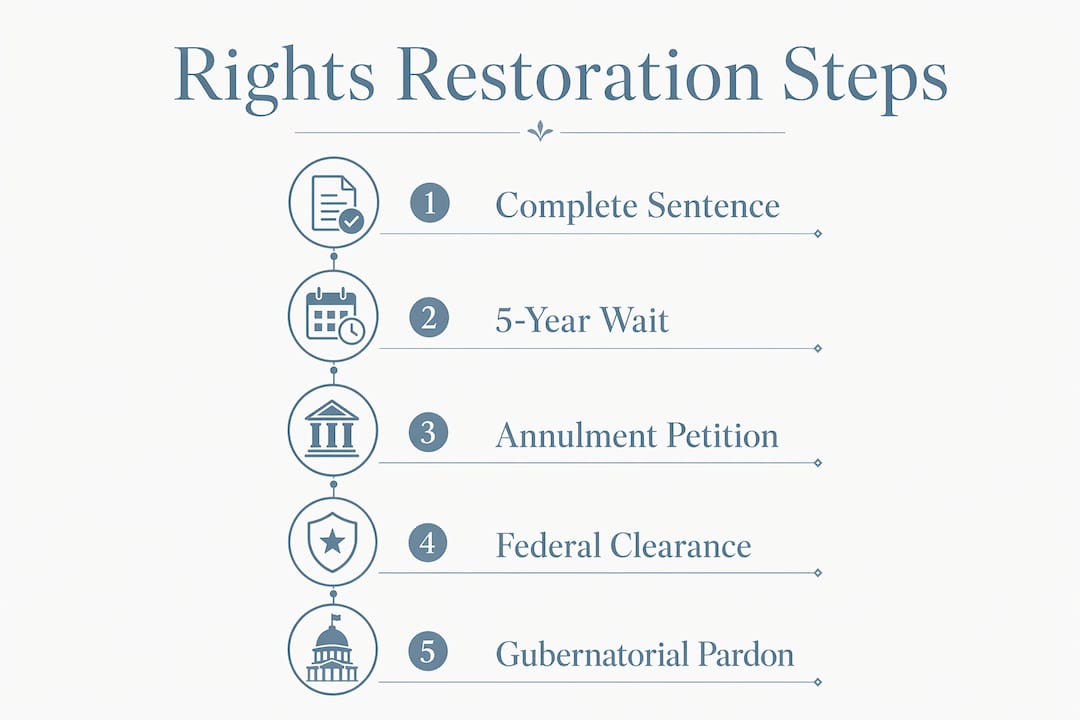
Restoring your right to own a firearm requires careful sequencing. Skipping steps or filing prematurely causes delays that set your timeline back significantly.
- Confirm full sentence completion. Contact the New Hampshire Department of Corrections to verify that all components of your sentence, including parole, probation, and restitution, are fully satisfied. The waiting period clock does not start until this date.
- Identify your felony class. Determine whether your conviction is a Class A or Class B felony. This dictates whether you face a 5-year or 10-year waiting period.
- Check for permanent exclusions. Review whether your offense falls under the list of crimes that cannot be annulled. Violent felonies and felony obstruction of justice require a gubernatorial pardon instead.
- Gather documentation. Collect court records, sentencing documents, and proof of sentence completion. Courts require complete documentation to evaluate your petition.
- File the annulment petition. Submit your petition to the court that handled your original conviction. The court will schedule a hearing and notify relevant parties, including prosecutors.
- Verify federal eligibility. After annulment, confirm with a qualified attorney whether your federal firearm prohibition has also been lifted. Do not assume state annulment resolves federal restrictions automatically.
Pro Tip: Filing for annulment before the waiting period ends is the most common mistake applicants make. A denial does not just delay your petition. It can require you to restart the entire process from the date of denial, adding years to your timeline.
Key Takeaways
Firearm rights restoration in New Hampshire requires completing both state and federal eligibility requirements, with annulment under RSA 651:5 as the primary but not the only pathway.
| Point | Details |
|---|---|
| State law prohibition | RSA 159:3 bars convicted felons from firearm possession until annulment or pardon is granted. |
| Waiting periods by class | Class B felonies require 5 years; Class A felonies require 10 years after full sentence completion. |
| Permanent exclusions | Violent felonies like murder cannot be annulled; only a gubernatorial pardon restores rights. |
| Federal law applies independently | 18 U.S.C. § 922(g) prohibits possession even after state annulment in some cases. |
| Timing is critical | Filing before sentence completion results in denial and resets the eligibility clock. |
What I’ve seen go wrong with firearm rights restoration in New Hampshire
Most people who contact an attorney about firearm rights restoration have already made at least one procedural mistake. The most common is filing for annulment before parole or restitution is fully completed. They assume “sentence done” means “prison done.” It does not. Parole supervision counts. Unpaid fines count. That misunderstanding costs people years.
The second issue I see regularly is people assuming that a New Hampshire annulment clears everything. It does not clear federal restrictions in every case. Someone can walk out of court with a granted annulment and still be prohibited under federal law from touching a firearm. That gap between state and federal law is where the most serious legal exposure lives. A federal firearm charge carries mandatory minimum sentences that state courts cannot override.
My honest advice: pursue annulment proactively once you are eligible. Do not wait. But before you file, and certainly before you possess any firearm, get a legal opinion that covers both RSA 159:3 and 18 U.S.C. § 922(g). The legal implications of violent crime convictions on firearm rights are particularly complex and deserve careful review. Rights restoration is achievable for many people. The process just requires patience and precision.
— Rich
Narolaw can help you navigate firearm rights restoration in New Hampshire
Narolaw is a New Hampshire criminal defense practice with direct experience handling annulment petitions, rights restoration cases, and the dual-jurisdiction complexities that arise when state and federal law overlap. If you have a felony conviction and want to understand your current eligibility, the team at Narolaw can review your record, identify your waiting period status, and guide you through the petition process from start to finish. Premature filings and missed exclusions are avoidable with the right legal support. Contact Narolaw’s criminal defense attorneys in New Hampshire to schedule a free consultation and get a clear picture of where you stand.
FAQ
Does a New Hampshire annulment restore my federal firearm rights?
Not automatically. State annulment does not override federal prohibitions under 18 U.S.C. § 922(g). You must verify federal eligibility separately before possessing any firearm.
Can felons own guns in NH after a Class B felony conviction?
Yes, but only after completing a 5-year waiting period following full sentence satisfaction and receiving a court-granted annulment under RSA 651:5.
What crimes permanently bar firearm ownership in New Hampshire?
Violent felonies such as murder and kidnapping, along with felony obstruction of justice, cannot be annulled. A gubernatorial pardon is the only available pathway to restore firearm rights for these offenses.
Does a domestic violence misdemeanor affect gun ownership in New Hampshire?
Yes. Federal law under the Lautenberg Amendment imposes a lifetime firearm ban for domestic violence misdemeanor convictions, regardless of New Hampshire state law.
Do background checks apply to all firearm purchases in New Hampshire?
Licensed dealers conduct federal background checks through the NICS system for all sales. New Hampshire does not require background checks for private sales, but prohibited persons remain legally barred from possession regardless of how a firearm is acquired.


