

TL;DR:
- In New Hampshire, alimony is limited to 50% of the marriage length and can end automatically with remarriage, cohabitation, or the payor’s retirement. Courts rarely award permanent alimony and typically rely on precise calculations based on marriage duration and income differences. Term alimony duration is a strict maximum, with exceptions requiring strong legal justification.
Alimony in New Hampshire is defined as court-ordered spousal support paid by one former spouse to another following divorce. Under New Hampshire law, the formal term is “spousal support,” though “alimony” is widely used and legally recognized. How long does alimony last in NH? The answer starts with one statutory rule: term alimony is capped at 50% of the length of the marriage, measured from the wedding date to the date the divorce petition is filed. That cap applies in most cases, but termination triggers, marriage length, and individual circumstances all shape the final outcome.
How long does alimony last in NH under state law?
New Hampshire law sets a clear ceiling on spousal support duration. Term alimony cannot exceed 50% of the marriage length, calculated precisely from the marriage date to the divorce filing date. A 10-year marriage yields a maximum of 5 years of support. A 20-year marriage yields a maximum of 10 years.
New Hampshire recognizes two primary types of spousal support with different duration rules. Term alimony covers ongoing financial support and follows the 50% cap. Reimbursement alimony carries a separate 5-year maximum and serves a different purpose. It compensates a spouse who sacrificed career advancement to support the other’s education or professional growth, rather than providing ongoing maintenance.
Courts can deviate from the 50% cap, but only when justice clearly requires it. The 2019 reforms shifted New Hampshire from indefinite alimony awards to predictable, term-based limits. That change reduced permanent alimony awards significantly and gave both parties a clearer picture of their financial future.
- Term alimony: Maximum duration equals 50% of the marriage length.
- Reimbursement alimony: Separate 5-year maximum, focused on career sacrifice compensation.
- Deviation from the cap: Allowed only when justice requires, with a heavy burden of proof on the requesting party.
- Permanent alimony: Rarely awarded since the 2019 reforms; reserved for exceptional circumstances.
Pro Tip: If you are negotiating a settlement, knowing the statutory cap gives you a firm baseline. Courts treat the 50% rule as the default, so any request for a longer term requires documented, compelling evidence.
What events can end or modify alimony in New Hampshire?
Alimony does not always run its full term. New Hampshire law defines specific events that automatically end payments, regardless of the original court order.
- Recipient’s remarriage. Alimony terminates automatically when the recipient remarries. If the new marriage ends within five years, the recipient may petition to reinstate support, but reinstatement is not guaranteed.
- Cohabitation in a marriage-like relationship. Alimony automatically terminates when the recipient begins living with a new partner in a relationship that resembles marriage. Courts look at financial interdependence, shared expenses, and the nature of the relationship.
- Payor’s retirement. Term alimony ends when the payor reaches full Social Security retirement age, currently 66–67 depending on birth year. The payor must provide at least 60 days’ advance notice before retirement. Payments do not stop on the day the payor announces intent to retire.
- Substantial and unforeseeable change in circumstances. Either party can petition the court to modify alimony duration if a major, unexpected change occurs, such as a serious illness, job loss, or significant income shift.
Pro Tip: Recipients should document any cohabitation arrangements carefully. Courts look beyond a shared address. Financial independence and separate finances can sometimes prevent automatic termination.
How does marriage length affect alimony duration?
Marriage length is the single most influential factor in determining how long spousal support lasts. Longer marriages produce longer maximum terms under the 50% rule. A 5-year marriage caps alimony at 2.5 years. A 15-year marriage caps it at 7.5 years.

Beyond the raw calculation, courts weigh individual circumstances heavily. Practitioners note that courts prioritize the recipient’s ability to become self-supporting, especially in long-term marriages. A spouse who left the workforce for 20 years to raise children faces a very different path to financial independence than one who maintained a career throughout the marriage.
| Marriage length | Maximum alimony term | Typical court focus |
|---|---|---|
| Under 5 years | Up to 2.5 years | Short-term bridge support |
| 5–10 years | Up to 5 years | Job retraining or re-entry support |
| 10–20 years | Up to 10 years | Income gap reduction, self-sufficiency |
| Over 20 years | Up to 10+ years | Long-term support, health and age factors |
Age and health also matter. A recipient in their late 50s with a chronic health condition faces a harder road to self-sufficiency than a 35-year-old with recent work experience. Courts factor these realities into duration decisions, even within the statutory cap. Courts can extend duration beyond 50% in exceptional cases, such as disability or advanced age, but such extensions are rare and require mutual agreement or substantial proof of need.
How to calculate the maximum alimony duration
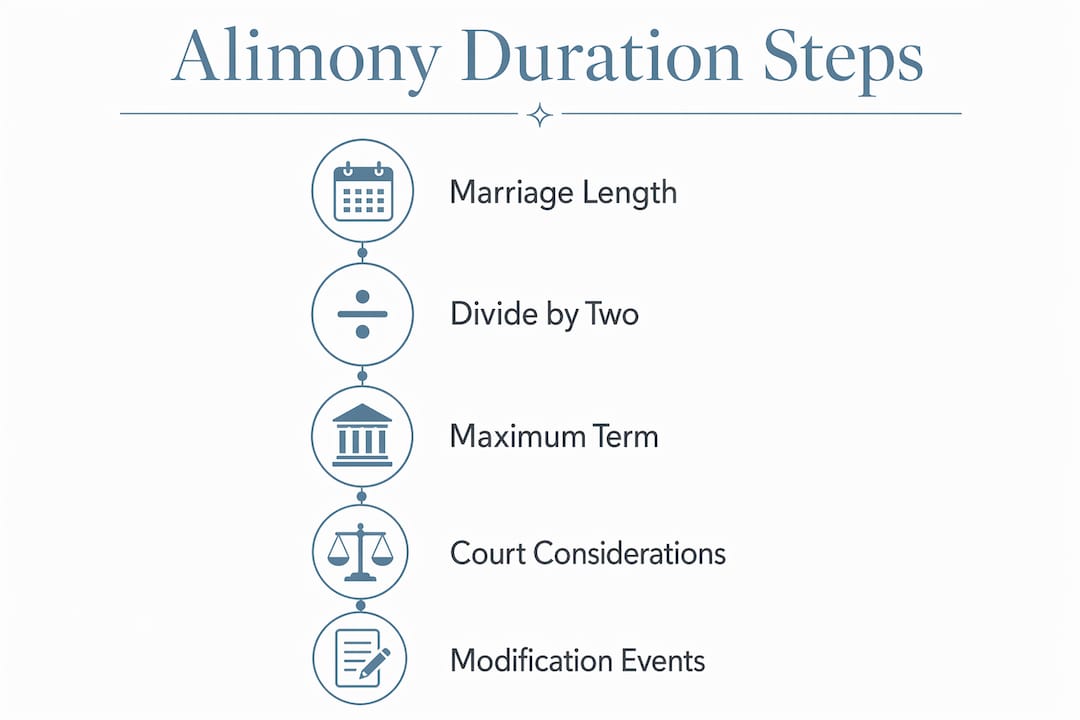
The calculation follows a straightforward formula. Divide the total marriage length by two. The result is the maximum term alimony duration in years.
New Hampshire measures marriage length precisely. The statutory duration runs from the marriage date to the divorce petition filing date without rounding. A 15.5-year marriage caps alimony at 7.75 years, not 8. That precision matters in cases where the marriage falls close to a round number.
Sample calculations:
- 5-year marriage: 5 ÷ 2 = 2.5 years maximum
- 10-year marriage: 10 ÷ 2 = 5 years maximum
- 15-year marriage: 15 ÷ 2 = 7.5 years maximum
- 20-year marriage: 20 ÷ 2 = 10 years maximum
Duration is only half the equation. New Hampshire also uses a statutory formula of 23% of the income difference between spouses to calculate the annual amount, capped by the recipient’s reasonable need. A $100,000 income gap between spouses produces roughly $23,000 per year in support under typical conditions. Duration and amount work together to define the full financial picture.
A common misconception is that the court automatically awards the maximum term. Courts treat the 50% cap as a ceiling, not a default. The actual term awarded often falls below the maximum, based on the recipient’s earning capacity, health, and the specific facts of the case.
Key takeaways
New Hampshire alimony duration is governed by a statutory 50% cap on marriage length, with clear termination triggers and rare exceptions for exceptional circumstances.
| Point | Details |
|---|---|
| Statutory duration cap | Term alimony cannot exceed 50% of the marriage length in New Hampshire. |
| Reimbursement alimony limit | Reimbursement alimony carries a separate 5-year maximum, distinct from term alimony. |
| Automatic termination events | Remarriage, cohabitation, and the payor’s retirement at full Social Security age all end payments automatically. |
| Calculation precision | Duration is measured to the exact day, without rounding, from marriage date to divorce filing date. |
| Deviation from the cap | Courts rarely extend beyond 50%; the requesting party bears a heavy burden of proof. |
What I’ve learned about alimony duration after years in NH family law
The 2019 reforms were genuinely good for clients on both sides of a divorce. Before those changes, “permanent alimony” created real uncertainty. Recipients sometimes received less than they needed because courts were reluctant to commit to open-ended orders. Payors lived with financial obligations that had no clear end date. The shift to term-based limits gave everyone a framework to negotiate from.
What I see most often now is clients underestimating the termination triggers. Cohabitation is the one that catches people off guard. A recipient who moves in with a new partner may not realize that financial independence between them does not automatically protect the alimony order. Courts look at the full picture of the relationship, not just separate bank accounts.
The other consistent issue is the gap between the statutory maximum and what courts actually award. The 50% cap is a ceiling. A recipient with strong earning potential and recent work history may receive a term well below the maximum, even in a long marriage. Understanding that distinction early changes how you approach settlement negotiations. Getting legal guidance on alimony before you finalize any agreement is the most practical step you can take.
— Rich
Narolaw: New Hampshire alimony and family law support
Alimony duration questions rarely exist in isolation. They connect to property division, retirement accounts, and child support in ways that affect your financial future for years. Narolaw is a New Hampshire-based family law practice that helps clients understand their rights under NH spousal support law and build realistic expectations before entering negotiations or court proceedings.
The team at Narolaw handles divorce, custody, and spousal support cases across New Hampshire, with a focus on clear communication and practical strategy. If you are facing a divorce and need to understand how alimony duration applies to your specific marriage length and circumstances, a free consultation with a New Hampshire family law attorney is the right starting point.
FAQ
How long does spousal support last in NH for a 10-year marriage?
A 10-year marriage in New Hampshire produces a maximum term alimony duration of 5 years. The court may award less depending on the recipient’s earning capacity and individual circumstances.
Can alimony be permanent in New Hampshire?
Permanent alimony is rarely awarded since the 2019 reforms. Courts now default to term-based limits, and permanent awards require exceptional circumstances such as severe disability or advanced age.
What stops alimony payments in New Hampshire?
Alimony ends automatically on the recipient’s remarriage, cohabitation in a marriage-like relationship, or the payor’s retirement at full Social Security retirement age. Either party can also petition the court to modify or end payments based on a substantial, unforeseeable change in circumstances.
Does New Hampshire round up partial years in alimony calculations?
No. New Hampshire calculates alimony duration precisely without rounding. A 15.5-year marriage caps term alimony at 7.75 years, not 8.
How is the alimony amount calculated in New Hampshire?
New Hampshire uses a statutory formula of 23% of the income difference between spouses, capped by the recipient’s reasonable need. Duration and amount are calculated separately and both apply to the final order.


