

TL;DR:
- Filing a restraining order in New Hampshire involves understanding different order types and preparing comprehensive documentation.
- Proper court selection, accurate forms, and strong evidence are essential to obtain effective protection and navigate proceedings successfully.
Feeling unsafe in your own home or community is one of the most distressing experiences a person can face. When harassment, threats, or abuse enter your life, knowing how to take legal action quickly and correctly can make a critical difference. Filing a restraining order in New Hampshire involves specific steps, particular courts, and detailed documentation requirements that can feel confusing without proper guidance. This article walks you through the entire process clearly and concisely, so you can protect yourself with confidence.
Table of Contents
- Understanding restraining orders in New Hampshire
- What you need before filing: checklists and preparation
- Step-by-step: How to file your restraining order petition
- After you file: what to expect and how to strengthen your case
- Recent changes and legislative considerations
- Our perspective: what most guides miss about restraining orders in NH
- Get legal help for your protective order in New Hampshire
- Frequently asked questions
Key Takeaways
| Point | Details |
|---|---|
| Know your options | Different situations call for different restraining orders, so identify which type matches your needs. |
| Prepare detailed evidence | Specifics on dates, locations, and incidents are essential to a strong petition and affidavit. |
| Follow each step carefully | Missing any paperwork or deadlines can set your case back or result in denial. |
| Stay updated on law changes | New Hampshire law may shift; always confirm the most current process before filing. |
| Get legal support if possible | Expert guidance can help you avoid mistakes and feel more confident during a stressful process. |
Understanding restraining orders in New Hampshire
Before you file anything, it helps to understand what kind of protective order applies to your situation. Not all restraining orders are the same, and the type you need determines which court handles your case and what process you follow.
In New Hampshire, people seeking protection from harassment or abuse generally file a petition for a protective order in Circuit Court, with Family and District divisions handling different categories of cases. The three main types of protective orders are domestic violence orders, stalking orders, and civil harassment orders. Each covers a different set of circumstances and relationships.
Understanding protective orders in New Hampshire is the first step toward choosing the right path. Here is a quick comparison to guide you:
| Order type | Who it covers | Which court | Common situations |
|---|---|---|---|
| Domestic violence protective order | Household members, intimate partners, family | Family Division, Circuit Court | Physical abuse, threats, coercive control |
| Stalking protective order | Any person being stalked | District Division, Circuit Court | Repeated following, surveillance, unwanted contact |
| Civil harassment order | Neighbors, coworkers, acquaintances | District Division, Circuit Court | Harassment, threats, repeated unwanted contact |
Knowing the difference between domestic violence and protection orders in New Hampshire matters because the eligibility rules and legal standards differ between them. For example, a domestic violence order requires a qualifying relationship between the parties, while a stalking order focuses on a pattern of behavior regardless of relationship status.
Who can file? Generally, any person who has experienced abuse, stalking, or harassment that meets the legal threshold in New Hampshire can petition for a protective order. Minors may file with the help of a parent or guardian. You do not need to have a criminal case open to apply for a civil protective order.
What you need before filing: checklists and preparation
Once you understand your options, the next step is gathering everything you need to build a clear, complete application. Walking into court without the right documentation is one of the most common mistakes people make, and it can delay protection significantly.

The petition process requires court forms and a written affidavit with specific incidents, including dates, locations, and descriptions of what occurred. Your affidavit is the foundation of your case. Vague statements like “he threatened me several times” are far less effective than specific entries such as “on March 4, 2026, at our shared residence at [address], the respondent pushed me against the wall and said he would hurt me if I called the police.”
Use the following restraining order checklist to prepare before you go to court:
- Full legal name, address, and date of birth of the person you are seeking protection from (the respondent)
- Your own identifying information
- A chronological list of specific incidents with dates, times, and locations
- Any physical evidence: photos of injuries, screenshots of threatening messages, voicemails, emails
- Names and contact information of any witnesses
- Documentation of prior police reports or criminal cases, if applicable
- Information about any children involved, especially if custody arrangements may be affected
It is also important to identify which protective order category fits your situation before arriving at court, since using the wrong form can result in your petition being sent to a different division or returned for correction.
Pro Tip: Draft your full affidavit at home before picking up official court forms. Writing it out in a quiet, private setting helps you recall details more accurately and saves time at the courthouse, where stress can affect your memory.
Step-by-step: How to file your restraining order petition
With all preparations in place, you are ready to submit your request and begin the formal protective process. Here is a numbered walkthrough of each stage:
- Identify the correct court. Domestic violence matters go to the Family Division of Circuit Court. Stalking and civil harassment cases typically go to the District Division. When in doubt, call the court clerk ahead of time to confirm.
- Obtain the correct forms. Forms are available at the courthouse clerk’s office. The NH courts website also provides an e-file-only petition and affidavit form for expedited hearings, which you can complete and submit digitally.
- Complete the petition and affidavit. Fill out every section completely. Leave nothing blank. If a question does not apply, write “N/A” rather than leaving the space empty.
- Submit your paperwork to the clerk. Hand in your completed forms at the clerk’s window. There is generally no filing fee for protective order petitions in New Hampshire.
- Wait for judicial review. A judge will review your petition, often the same day. If you demonstrate immediate danger, the judge may issue a temporary emergency order, also called an ex parte order, without notifying the respondent first.
- Receive your court date. Whether or not an emergency order is granted, a hearing will be scheduled, typically within 30 days, where both parties can present their case.
Understanding the restraining order process in New Hampshire ahead of time reduces anxiety and helps you avoid procedural errors. It also helps to understand the distinction between emergency and final restraining orders so you know what level of protection you have at each stage.
Pro Tip: File early in the morning. Courts that process emergency orders do so on a same-day basis, and cases submitted later in the afternoon may be pushed to the following business day.
After you file: what to expect and how to strengthen your case
Once you submit your paperwork, understanding the next phases helps you stay proactive and prepared throughout the process. Many people feel relief after filing, but the work is not finished.
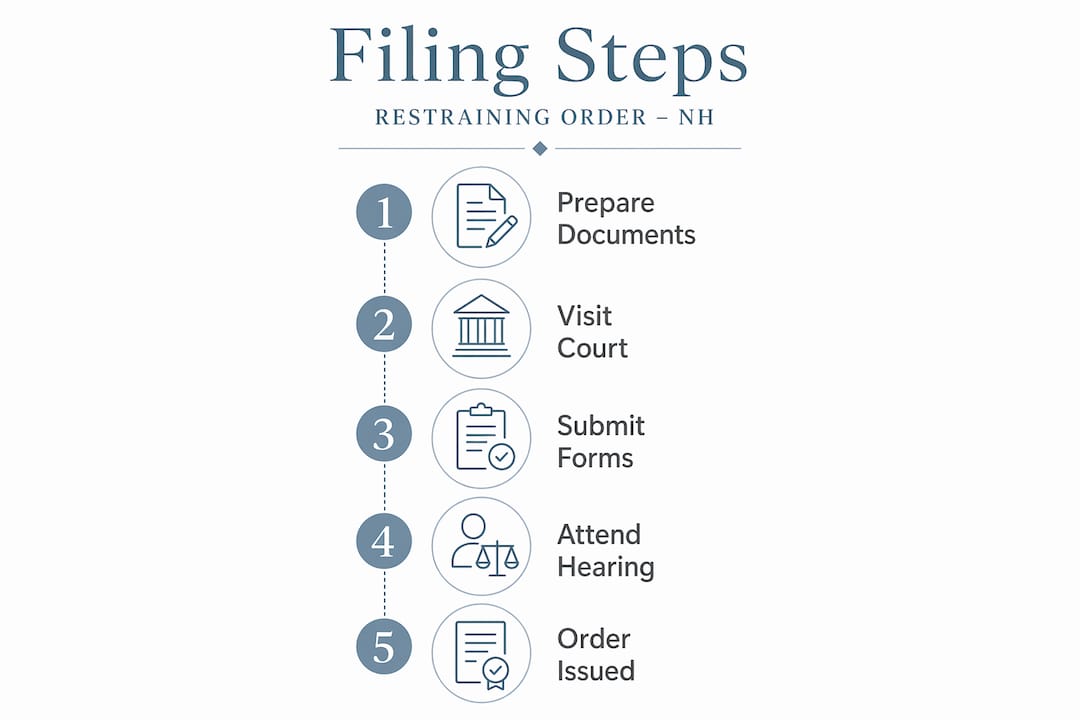
Be ready for a potential ex parte temporary order followed by a hearing where you will present your evidence. The temporary order is not permanent. It is a bridge designed to protect you until the full hearing takes place.
To strengthen your position at the hearing:
- Bring all supporting evidence, including printed copies of messages, photos, and any police reports
- Contact witnesses ahead of time and confirm they can attend or provide a written statement
- Dress professionally and speak calmly and clearly when addressing the judge
- Stick to specific facts rather than generalizations
- If you have an attorney, coordinate your testimony and evidence in advance
If your petition is denied or the judge needs more information, do not give up. You may be able to refile with a more detailed affidavit or return with additional evidence. Consulting an attorney at this stage, especially if you are filing for a restraining order for the first time, can help you understand what the court found lacking and how to address it.
Important: Attend every court date without exception. Missing a scheduled hearing can result in your temporary order being dissolved and your petition dismissed entirely. Bring all your documentation every time you appear.
Recent changes and legislative considerations
With your application in the system, ongoing changes in New Hampshire law could affect your situation. Staying informed is part of protecting yourself effectively.
New Hampshire has seen legislative proposals to overhaul the domestic violence protective order system, potentially changing how survivors access the civil pathway for protection. These proposals could shift filing requirements, eligibility criteria, or the structure of the hearing process.
Legislative note: Always verify your forms and procedures directly with the court clerk or a licensed attorney before filing. What was accurate six months ago may have changed.
Checking NH family law updates regularly keeps you aware of procedural shifts that could affect your case. Courts update their required forms periodically, and submitting an outdated form can slow down your petition significantly.
Our perspective: what most guides miss about restraining orders in NH
Most step-by-step guides cover forms and timelines, but they rarely address why valid claims get derailed. The honest answer is that small, overlooked details cause big problems. A missing date in your affidavit, an incorrect respondent address, or an unclear description of the threat can give a judge reason to deny emergency relief.
One of the most commonly missed steps is verifying form versions before arriving at court. Forms are updated without widespread announcement, and filing the wrong version wastes valuable time. Always confirm you have the current version directly from the clerk or the official court website.
The emotional weight of this process is real and should not be minimized. Many people find the act of writing out their experiences in an affidavit to be retraumatizing, and showing up to court and possibly facing the respondent adds another layer of stress. Seeking support from advocacy organizations, trusted family members, or a legal professional early in the process is not a sign of weakness. It is a practical strategy.
Our NH victim’s legal guide outlines additional protections available under New Hampshire law that many victims are unaware of. Legal advocacy groups across the state can also provide emotional support alongside practical guidance. The combination of informed preparation and personal support leads to better outcomes in court.
Get legal help for your protective order in New Hampshire
Filing a restraining order on your own is legally possible, but the process involves specific procedural requirements that are easy to miss under stress. An experienced attorney can review your affidavit before submission, help you select the correct court division, prepare you for the hearing, and represent you if the respondent contests the order.
At Naro Law, we understand family law in New Hampshire and the serious stakes involved in protective order cases. Our attorneys work directly with clients across the state, including those seeking help from a Manchester family law attorney. Whether your situation involves domestic violence, stalking, or civil harassment, we are here to guide you through every step. Contact us today to schedule a free consultation and take the first confident step toward your safety.
Frequently asked questions
What forms do I need to file a restraining order in New Hampshire?
You will need to complete a petition and a detailed affidavit, as the court process requires specific descriptions of each incident including dates, locations, and what occurred. Forms are available at the courthouse or through the NH Judicial Branch website.
Can I file a restraining order online in New Hampshire?
Some forms can be submitted digitally, as the NH courts website provides an e-file-only petition and affidavit option for expedited hearings. Check with your specific court division to confirm which submissions are accepted electronically.
How soon can I get protection after filing?
You may receive a temporary order the same day if the judge finds sufficient cause, as courts can issue an ex parte order before the respondent is even notified. A formal hearing for a longer-term order typically follows within 30 days.
Are there any recent changes to New Hampshire’s restraining order laws?
There have been recent proposals to overhaul the domestic violence protective order system in New Hampshire, so verifying current requirements with the court or an attorney before filing is strongly advised.
What happens if the court denies my restraining order request?
You may be able to refile your petition with a more detailed affidavit or return with additional supporting evidence. Consulting an experienced attorney after a denial can help you identify what the court needed and how to address it effectively.


