

TL;DR:
- Filing for divorce in New Hampshire requires meeting residency and grounds qualifications.
- Accurate documentation and timely disclosures are crucial to prevent case delays.
- Court procedures, especially involving children and complex cases, often need legal guidance.
Filing for divorce in New Hampshire is rarely simple, and the emotional weight of the process can make even basic legal steps feel overwhelming. Many people stumble over paperwork, miss critical deadlines, or make avoidable mistakes that delay their cases for months. Understanding the process from the start gives you a real advantage. This guide walks you through each stage, from confirming your eligibility to navigating court requirements, so you can move forward with confidence and avoid the most common pitfalls.
Table of Contents
- Who can file for divorce in New Hampshire?
- Gather necessary documents and prepare mandatory disclosures
- File the petition and serve your spouse
- Navigating court requirements: children, mediation, and unique cases
- What most guides miss about NH divorce: practical realities
- Get help with your New Hampshire divorce
- Frequently asked questions
Key Takeaways
| Point | Details |
|---|---|
| Residency matters | You must meet New Hampshire’s unique residency requirements to file for divorce. |
| Key paperwork needed | Organizing your documents and mandatory disclosures early prevents delays. |
| Special rules for children | Cases with minor children require a Child Impact Seminar and a detailed parenting plan. |
| Mediation resolves most disputes | About 75% of child custody or parenting disagreements are settled through mediation. |
| Legal help reduces risk | Hiring a lawyer minimizes costly mistakes, especially in complex or contested cases. |
Who can file for divorce in New Hampshire?
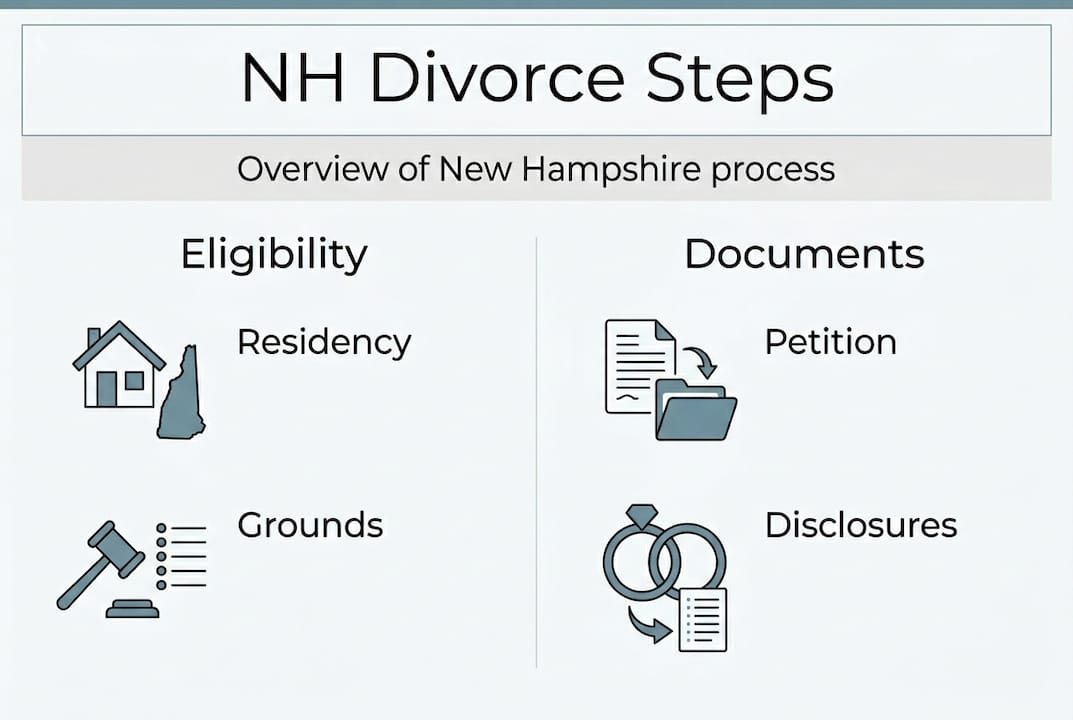
Once you understand your need to file, the first step is confirming you are legally eligible. New Hampshire courts have specific residency rules before they accept a divorce petition.
NH divorce filing basics are more specific than many people expect. According to state court guidelines, at least one condition must apply: both spouses are domiciled in New Hampshire, the petitioner has been domiciled in NH for at least one year before filing, or the cause of divorce arose in New Hampshire with one spouse living there.
If you were married in another state, you can still qualify. Divorce eligibility in other states follows a similar residency logic, and NH courts can still have jurisdiction over your marriage.
Residency and grounds: a quick comparison
| Scenario | Eligible to file in NH? |
|---|---|
| Both spouses live in NH | Yes |
| Only petitioner lived in NH for 1+ year | Yes |
| Cause of divorce arose in NH | Yes (with one spouse domiciled there) |
| Neither party has NH ties | No |
For the grounds themselves, nearly 90% of cases cite irreconcilable differences, which is a no-fault ground requiring no proof of wrongdoing. Fault-based grounds, such as adultery, extreme cruelty, abandonment, or habitual drunkenness, are available but less common.
Pro Tip: Choosing no-fault grounds almost always leads to a faster, smoother process. Fault grounds can occasionally offer legal advantages in property or custody arguments, but they typically increase conflict and legal costs.
Gather necessary documents and prepare mandatory disclosures
If you qualify to file, organizing your documents correctly can prevent frustrating setbacks during your case. Courts expect specific paperwork, and missing items are one of the top reasons cases stall.
Here are the core documents you will need:
- Marriage certificate (certified copy)
- Proof of New Hampshire residency (utility bills, lease, or driver’s license)
- Recent pay stubs and tax returns (typically the last two years)
- Bank and investment account statements
- Documentation of debts, mortgages, and liabilities
- A list of all marital assets, including property and vehicles
One of the most critical timelines to know is the 45-day disclosure rule. After filing, both parties must exchange mandatory financial disclosures within 45 days. Missing this deadline can delay your entire case.

| Document | Where to obtain it |
|---|---|
| Marriage certificate | Town or city clerk where you married |
| Bank statements | Your bank or online portal |
| Tax returns | IRS records or your accountant |
| Property deeds | NH Registry of Deeds |
| Pay stubs | Your employer |
For short marriages under five years, courts tend to return each spouse to their pre-marital financial position, meaning premarital assets are often kept separate. High-asset cases may require formal property valuations, which adds time and cost. A divorce preparation checklist can help you stay organized from day one.
Pro Tip: Gather every document before you file. Courts do not wait for missing paperwork, and delays at the disclosure stage can set your case back by weeks or even months.
File the petition and serve your spouse
With your documents in order, you are ready to take official action by filing and initiating notice to your spouse. This stage involves specific steps that must be followed carefully.
- Complete the Petition for Divorce form, available through the New Hampshire circuit court family division.
- File the petition at your local family division court. Filing fees typically apply, so confirm the current amount with your specific court.
- Request a case number and keep all receipts and court stamps as proof of filing.
- Serve your spouse with the divorce papers through an approved method, such as a sheriff, certified mail, or an authorized process server.
- File proof of service with the court once your spouse has been served.
New Hampshire courts confirm that residency must be established at the time of filing, so double-check your eligibility before submitting.
For additional guidance on location-specific rules, filing and serving details can vary by county, so knowing your local court’s expectations matters.
“Even minor errors in serving or missing deadlines can stall your case or force a re-filing.”
Pro Tip: After filing, call or visit the court to confirm your paperwork was received and accepted. Misplaced filings happen more often than most people expect, and catching it early saves significant time.
Navigating court requirements: children, mediation, and unique cases
After your spouse is served, court-ordered next steps begin, especially for parents or those with complex finances. This stage is where many people are caught off guard by additional requirements.
If your case involves minor children, you will face several mandatory steps:
- Child Impact Seminar: Both parents must complete this state-mandated seminar within 45 days of filing. The cost is $85 per parent, and it is designed to help parents support their children through the transition.
- Parenting plan: A formal parenting plan must be submitted to the court, outlining custody, visitation, and decision-making responsibilities.
- First appearance: Expect a court date within approximately 30 days after filing.
- Mediation: Courts typically require mediation before a contested hearing. Roughly 75% of custody disputes are resolved through mediation, at an approximate cost of $450 per case.
Understanding what a NH parenting plan requires in advance can reduce stress significantly. For contested custody, child custody mediation is often the most effective and least expensive path to resolution.
For high-asset divorces, formal valuations of property, businesses, or retirement accounts may be required before a settlement can be reached.
Pro Tip: Complete the Child Impact Seminar as early as possible. Courts often will not schedule hearings or advance your case until this requirement is met.
What most guides miss about NH divorce: practical realities
Most people who research divorce online get a solid understanding of the steps. What catches them off guard is the real-world execution. Filing on your own, also called pro se representation, is legally permitted, but strict timelines and required seminars create serious risk for those who are unfamiliar with court procedures.
A missed disclosure deadline or a skipped seminar can set your case back significantly, and in contested cases, procedural errors can actually weaken your legal position.
“Having an attorney early often prevents mistakes you didn’t know you were making.”
The real cost of a DIY divorce is often higher than anticipated, particularly when property, retirement accounts, or custody are involved. The benefits of a divorce lawyer extend beyond courtroom representation. An attorney helps you understand what you are entitled to and ensures you do not inadvertently waive rights through a poorly worded agreement.
Get help with your New Hampshire divorce
If you want peace of mind and professional support through this process, help is available. Naro Law provides tailored family law overview services for all New Hampshire residents, covering divorce, custody, mediation support, and more. Whether your situation is straightforward or involves complex assets and parenting disputes, our team is here to guide you through every stage. Review our detailed NH divorce guide or contact us to schedule a free consultation today.
Frequently asked questions
How long does it take to finalize a divorce in New Hampshire?
A typical New Hampshire divorce takes between three and six months, though cases with contested custody or complex finances may take considerably longer due to mandatory disclosure timelines and hearings.
What are the main costs involved in filing for divorce in NH?
Beyond court filing fees, expect to budget for mediation at $450 per case and the Child Impact Seminar at $85 per parent if children are involved, in addition to any attorney fees.
Can I file for divorce in NH if we got married in another state?
Yes. Where you were married does not determine where you can file. As long as you meet NH residency requirements, New Hampshire courts have jurisdiction over your divorce.
Do I need a lawyer to file for divorce in NH?
A lawyer is not legally required, but pro se filing carries real risk due to strict mandatory disclosures, mediation requirements, and procedural rules that are easy to mishandle without legal training.


