

TL;DR:
- Navigating divorce in New Hampshire requires meeting residency, grounds, and filing requirements to ensure a valid process.
- Uncontested divorces are faster, taking 2 to 3 months, while contested cases can last up to 14 months, depending on complexity.
Divorce rarely feels simple, even when the decision is clear. Between understanding court procedures, protecting your finances, and managing daily life, the sheer volume of steps can feel paralyzing. Knowing how to navigate the divorce process in New Hampshire, however, gives you a real advantage. This divorce process guide breaks down what to expect at each stage, from the first paperwork to the final hearing, with specific guidance on legal requirements, financial disclosures, child custody, and emotional coping strategies that apply directly to NH residents.
Table of Contents
- Key takeaways
- How to navigate the divorce process: NH prerequisites
- Filing and serving the divorce petition
- Financial considerations and court requirements
- Child custody, parenting plans, and emotional coping
- Finalizing divorce and post-divorce steps
- My perspective on navigating divorce in New Hampshire
- How Naro Law can help you through this
- FAQ
Key takeaways
| Point | Details |
|---|---|
| Residency rules matter first | NH requires at least one year of domicile if the other spouse lives out of state before you can file. |
| Uncontested is faster | Uncontested divorces typically resolve in 2 to 3 months; contested cases can stretch 8 to 14 months. |
| Financial disclosure is mandatory | Both spouses must file Form NHJB-2065-F, and incomplete disclosure can result in court sanctions. |
| Child custody follows one standard | Courts apply the best interests of the child, weighing safety, parental cooperation, and the child’s own preferences if mature. |
| Post-divorce updates are critical | Wills, beneficiary designations, insurance policies, and bank accounts all need to be updated after the decree is issued. |
How to navigate the divorce process: NH prerequisites
Before any paperwork is filed, you need to meet New Hampshire’s basic legal requirements. Getting these details right saves time and prevents your case from being dismissed early.
Residency: NH domicile rules state that if both spouses currently live in New Hampshire, you can file immediately. If the other spouse lives out of state, one of you must have been domiciled in NH for at least one year before filing.
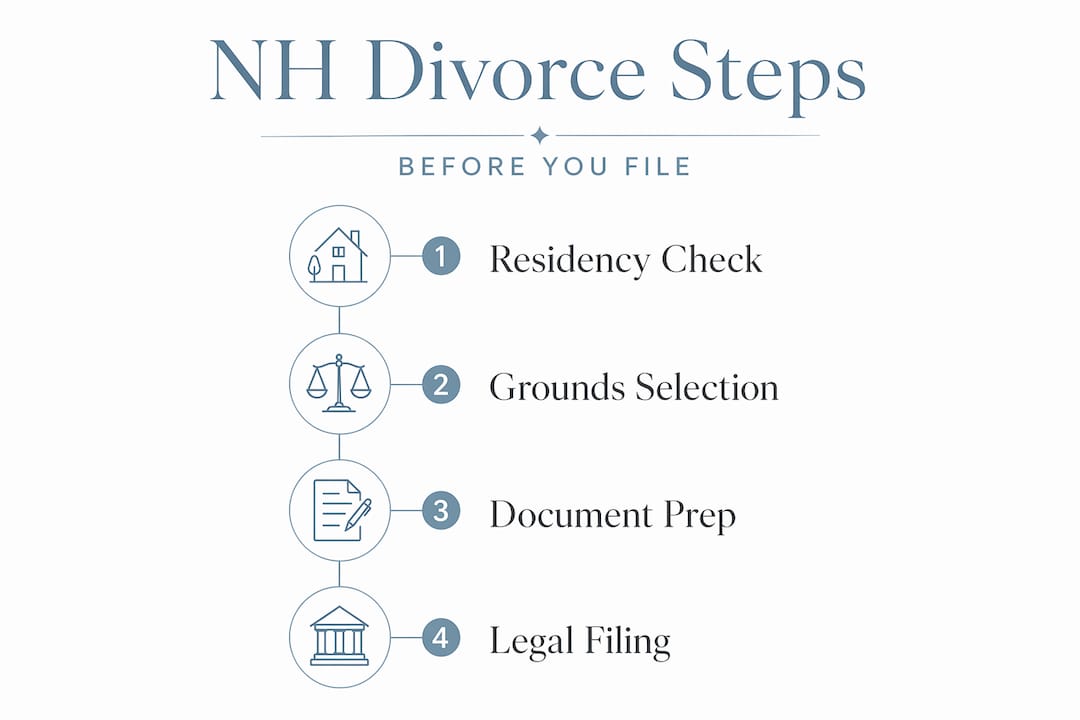
Grounds for divorce: New Hampshire recognizes both fault and no-fault grounds. Most filings today use the no-fault option, citing irreconcilable differences. This means you do not have to prove wrongdoing, which keeps proceedings less combative and faster overall.
Contested vs. uncontested divorce: An uncontested divorce means both spouses agree on all major issues, including property, support, and custody. A contested divorce means at least one issue is disputed and requires court resolution. The type you pursue directly affects your timeline and legal costs.
Key forms to gather before filing include:
- Petition for Divorce (NHJB-2073-F or joint version NHJB-2072-F)
- Financial Affidavit (NHJB-2065-F), which documents income, assets, and debts
- Parenting Plan form, if children are involved
- Vital records such as your marriage certificate
Pro Tip: Organize all financial documents before you consult an attorney. Bank statements, tax returns, and pay stubs from the past two to three years will be needed for your financial affidavit and will save you billable time during your first meetings.
Filing and serving the divorce petition
Once your paperwork is in order, the formal steps in divorce proceedings begin with filing and service. Here is how that process works in New Hampshire:
- Prepare your petition. Complete the divorce petition with accurate personal information, grounds for divorce, and your requests regarding property, support, and custody. Couples in agreement may file a joint petition together, which signals to the court that cooperation is likely.
- File with the Family Division. Submit your completed forms to the NH Circuit Court Family Division in the county where either spouse resides. Filing fees in NH range from $250 to $252. If finances are tight, you can request a fee waiver by submitting a hardship application at the time of filing.
- Serve the other spouse. If filing individually, you must formally serve your spouse with a copy of the filed petition. Acceptable methods include certified mail, sheriff service, or a private process server. Your spouse then has 30 days to respond after being served.
- File proof of service. After service is complete, you must file proof with the court confirming that your spouse received the documents. Without this, the court will not move your case forward.
- Wait for a response. If your spouse does not respond within 30 days, you may request a default hearing. If they file a response or counterclaim, the contested phase begins and both sides exchange information formally.
Pro Tip: If you and your spouse are on speaking terms, consider filing a joint petition. This single step signals cooperation to the court, can reduce procedural delays, and often lowers overall legal costs. Read more about this option in Naro Law’s uncontested divorce guide for New Hampshire.
Financial considerations and court requirements
Money is often where divorces get complicated. New Hampshire courts require complete transparency from both parties, and the financial affidavit is the mechanism that enforces it.

Both spouses must file Financial Affidavit Form NHJB-2065-F. Incomplete or dishonest disclosure can lead to sanctions, including adverse rulings on property and support. If you suspect your spouse is hiding assets, speak with an attorney before the disclosure deadline.
| Financial Issue | How NH Courts Handle It |
|---|---|
| Property division | Equitable distribution, meaning fair but not necessarily equal, based on length of marriage, contributions, and need |
| Alimony | Based on income disparity, length of marriage, standard of living, and each spouse’s earning capacity |
| Child support | Calculated using the income shares model, which considers both parents’ incomes and the child’s needs |
| Temporary orders | Courts can issue temporary custody and support orders while divorce is pending, including ex parte orders if there is immediate risk of harm |
On property division, New Hampshire courts divide marital assets equitably. The family home is often the most contested asset, and courts weigh factors such as who has primary custody of children and each spouse’s ability to maintain the property.
Key points to prepare for court on financial matters:
- Bring organized documentation for every asset and liability you list on your affidavit
- Know your monthly income and expenses before any hearing
- Be prepared to discuss contributions to the marriage, both financial and non-financial
Child custody, parenting plans, and emotional coping
For parents, custody is the most emotionally charged part of any divorce. Understanding how NH courts approach this area, and how to take care of yourself through it, is equally important.
NH custody decisions are governed by the best interests of the child standard. Courts evaluate the quality of each parent’s relationship with the child, each parent’s ability to provide a safe and nurturing home, any history of domestic violence or abuse, and the child’s own preferences if the court considers the child mature enough to express them.
A parenting plan is a required document in divorces involving children. It outlines the physical custody schedule, decision-making authority for education and healthcare, holiday arrangements, and how disputes will be resolved going forward. The more detailed your parenting plan, the fewer conflicts arise later.
Mediation is a powerful tool here. It reduces hostility, lowers costs compared to litigation, and produces agreements both parents are more likely to follow because they helped create them. When co-parenting is the long-term reality, a mediated agreement tends to preserve a workable relationship far better than a court-imposed one.
Tips for coping with divorce and managing your emotional health:
- Build a support network that includes trusted friends, family, or a licensed therapist
- Keep communication with your co-parent focused on the children, not the divorce
- Maintain routines for yourself and your children to provide stability during uncertainty
- Avoid using your children as messengers or venting to them about the other parent
Pro Tip: Reviewing common divorce mistakes before your case is resolved can protect you from avoidable setbacks. Many mistakes in custody disputes come from emotional reactions in the heat of the moment rather than deliberate choices.
Finalizing divorce and post-divorce steps
The final stage of the divorce process is the court hearing, and what you do immediately after the decree is just as important as what happens in the courtroom.
- Attend the final hearing. For uncontested divorces, this is typically a brief hearing where the judge reviews and approves the settlement agreement. Contested divorces involve a trial where both sides present evidence and the judge decides unresolved issues.
- Receive the final decree. Once the judge signs the divorce decree, your marriage is legally dissolved. Obtain certified copies of the decree, which typically cost $15 to $25 per copy, because you will need them for record updates.
- Update your legal documents. Revise your will, update beneficiary designations on life insurance and retirement accounts, and change any jointly held bank accounts or titles to reflect your new status.
- Handle your name change. If you are reclaiming a former name, the divorce decree authorizes it. You will need to update your Social Security card, driver’s license, passport, and bank accounts.
- Notify relevant institutions. Inform your employer’s HR department, your children’s schools, and any government agencies that need to reflect your updated status.
My perspective on navigating divorce in New Hampshire
I have worked with clients who came in organized and ready, and clients who were completely overwhelmed from day one. The biggest differentiator between outcomes, in my experience, is not how complex the case is. It is how prepared and mentally grounded the person is when they walk through the door.
What I have learned working in New Hampshire family law is that people consistently underestimate mediation. They see it as something to do when cooperation seems impossible, but it actually works best before positions harden. Getting to mediation early, even on one or two contested issues, can save months of litigation and thousands of dollars.
The other thing I tell clients: stay organized even when life feels chaotic. The divorce process rewards documentation. Every financial record, every communication about the children, every agreement you reach informally should be documented. Mindset matters enormously here. A clear head and a support network behind you will carry you further than any legal tactic alone.
— Rich
How Naro Law can help you through this
Divorce is a legal process, but it is also one of the most personal experiences you will face. Naro Law provides compassionate, experienced family law representation across New Hampshire, with focused expertise in divorce, child custody, spousal support, and property division. The firm approaches each case with a strategy built around your specific situation, not a one-size-fits-all playbook.
Whether you are just starting to research your options or you are ready to file, Naro Law offers free consultations to help you understand where you stand. From the first petition to the final decree, their attorneys are prepared to guide you through each stage. Reach out to schedule your consultation and take the first step with a legal team that prioritizes your outcome.
FAQ
What are the residency requirements for divorce in New Hampshire?
If both spouses are domiciled in New Hampshire, you can file immediately. If one spouse lives out of state, NH residency rules require at least one year of domicile before filing.
How long does a divorce take in New Hampshire?
Uncontested divorces typically resolve in 2 to 3 months, while contested cases can last 8 to 14 months depending on the complexity of disputed issues.
How does New Hampshire determine child custody?
NH courts apply the best interests of the child standard, weighing each parent’s relationship with the child, safety considerations, parental cooperation, and the child’s own preferences if mature enough.
What financial documents do I need for a New Hampshire divorce?
Both parties are required to file the Financial Affidavit Form NHJB-2065-F. You should also prepare tax returns, pay stubs, bank statements, and documentation of all assets and debts.
Can a judge issue temporary orders before the divorce is finalized?
Yes. NH courts can issue temporary orders covering custody, child support, and financial restraints while the divorce is pending. In cases of immediate harm, these orders can be issued without the other party present.


