

TL;DR:
- Receiving a subpoena in New Hampshire requires understanding your legal obligations and acting promptly to protect your rights.
- Failure to comply can result in serious penalties, including fines, contempt charges, or arrest warrants.
Receiving a subpoena in New Hampshire can feel alarming, especially if you have never been involved in legal proceedings before. You may not know whether you are required to appear in court, hand over documents, or both. What you do next matters enormously. Subpoenas require compliance unless you successfully challenge them through the proper legal channels, which means ignoring one is never a safe option. This article walks you through exactly what a subpoena means, what steps to take right away, and what rights you have to protect yourself throughout the process.
Table of Contents
- Understand what a subpoena means in New Hampshire
- First steps: What to do immediately
- How to respond: your options and rights
- Special considerations: out-of-state subpoenas and unique cases
- A practical perspective: why legal advice is essential, even for simple subpoenas
- Need legal guidance or representation for a subpoena in NH?
- Frequently asked questions
Key Takeaways
| Point | Details |
|---|---|
| Immediate action required | Never ignore a subpoena; prompt verification and response are critical under NH law. |
| Legal counsel protects you | Consulting a NH attorney ensures your rights and options—including objections—are properly asserted. |
| Know your rights | You may be able to modify or object to burdensome, improper, or privileged requests. |
| Special rules for out-of-state | Out-of-state subpoenas require special domestication steps under RSA 517:1 before enforcement. |
Understand what a subpoena means in New Hampshire
A subpoena is a formal legal order requiring you to do something, typically to appear and testify, to produce documents or records, or both. Courts, attorneys, and certain government officials in New Hampshire can issue subpoenas in both civil and criminal cases. Receiving one does not mean you are accused of wrongdoing. You may simply be a witness who holds information relevant to someone else’s case.
There are two primary types of subpoenas you are likely to encounter:
- Subpoena ad testificandum: Requires you to appear and give oral testimony, either in court or at a deposition.
- Subpoena duces tecum: Requires you to produce documents, records, or other tangible items, sometimes without requiring your personal appearance.
Understanding which type you received is critical because the response steps differ. You can find more guidance on NH legal articles covering how courts handle various types of evidence and testimony demands.
| Feature | Civil subpoena | Criminal subpoena |
|---|---|---|
| Who issues it | Attorneys or court | Prosecutor or defense counsel |
| Purpose | Evidence for civil lawsuit | Evidence for criminal prosecution or defense |
| Penalties for noncompliance | Contempt of court, fines | Contempt, possible arrest |
| Right to object | Yes, with proper motion | Yes, with proper motion |
Important: Failure to comply with a properly served subpoena can result in contempt penalties under New Hampshire law. These penalties may include fines and, in some cases, jail time. Do not assume a subpoena is optional.
The consequences of ignoring a subpoena are serious. A judge can issue a bench warrant for your arrest if you fail to appear as required. Courts treat noncompliance as a direct challenge to their authority, and they respond accordingly.
First steps: What to do immediately
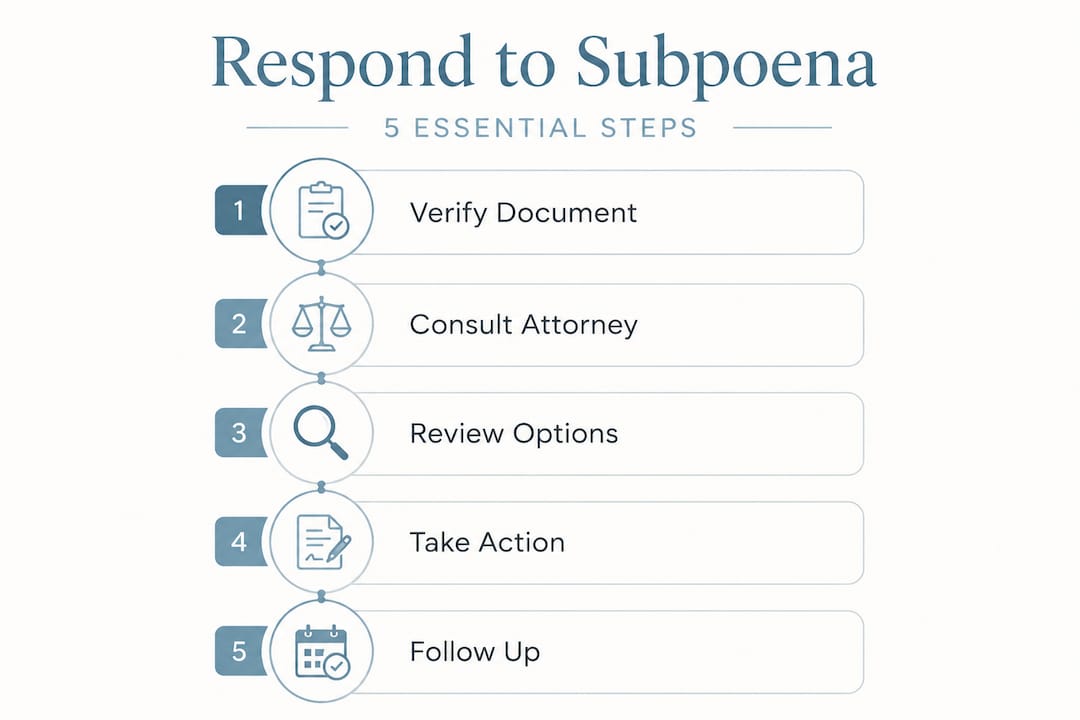
Once you receive a subpoena, calm deliberate action is your best protection. Panic leads to mistakes, and mistakes can have real legal consequences. Here is a structured approach to your first 24 to 48 hours.
- Read the document carefully. Confirm that your name is spelled correctly, that dates and deadlines are accurate, and that the document carries a court seal and the signature of the issuing authority.
- Note the deadline. Subpoenas carry strict response or appearance deadlines. Missing them, even by accident, can trigger contempt proceedings.
- Verify its authenticity. Fake court document scams have targeted New Hampshire residents. Contact the issuing court directly using contact information you find independently, not the phone number printed on the document you received.
- Identify what is being requested. Is this a request for your testimony, your records, or specific documents? Make a clear list so you can discuss it with an attorney.
- Do not respond informally. Do not call the opposing party’s attorney to work things out on your own. Any response you make without legal guidance could be used against you or could inadvertently waive important rights.
- Consult a New Hampshire attorney promptly. As noted by NH Courts, individuals subpoenaed in New Hampshire should immediately consult an attorney for guidance, as subpoenas require compliance unless successfully challenged.
Pro Tip: If you have ever navigated a step-by-step legal process before, you know that preparation and timing are everything. The same is true here. Acting quickly but carefully gives you the most options.
| Action | Timeframe | Why it matters |
|---|---|---|
| Read and note the deadline | Within hours of receipt | Avoids missing critical dates |
| Verify authenticity | Same day | Protects you from scams |
| Consult an attorney | Within 24 to 48 hours | Preserves your legal options |
| Avoid informal communication | Ongoing | Prevents accidental waivers |
If you have previously faced a similarly urgent legal timeline, such as the DUI process in New Hampshire, you already know that delay is your biggest enemy.
How to respond: your options and rights
Once you have verified the subpoena and consulted an attorney, you have three main paths forward: comply, negotiate, or formally object.

Option 1: Comply fully. If the subpoena is valid, the information requested is not privileged, and compliance is not unduly burdensome, full compliance is often the simplest and safest route. Gather the requested documents or prepare your testimony carefully with your attorney’s guidance.
Option 2: Negotiate a modification. Sometimes the scope of a subpoena is too broad or the timeline is impractical. Your attorney can often negotiate directly with the issuing party to narrow the request or extend the deadline, avoiding the need for formal court intervention.
Option 3: File a motion to quash or modify. This is a formal legal filing asking the court to cancel or limit the subpoena. Recipients can file a motion to quash if the subpoena is unduly burdensome, seeks privileged information, or fails to meet procedural requirements.
Legal grounds for objecting to a subpoena in New Hampshire include:
- Attorney-client privilege: Communications between you and your lawyer are generally protected.
- Physician-patient or therapist-patient privilege: Medical and mental health records often have strong protections.
- Undue burden or expense: If compliance would require extraordinary time or cost, that is a recognized legal basis for objection.
- Overbreadth: A subpoena that asks for far more than is reasonably necessary may be contested on scope grounds.
- Improper service: If the subpoena was not properly delivered according to New Hampshire procedural rules, that alone can be grounds to challenge it.
Know your rights: Third parties have the right to object if a subpoena imposes undue burden or expense, consistent with principles recognized across state and federal courts.
Pro Tip: If you are a third party, meaning you are not directly involved in the lawsuit but were subpoenaed for records or testimony, you have specific rights to protect your privacy and limit your involvement. Review the situation carefully with an attorney, especially when it touches sensitive personal or business information. You can also review guidance on responding to legal accusations to understand how legal formalities protect your position.
Filing a motion to quash requires following New Hampshire Superior Court procedural rules precisely. The motion must be filed before the compliance deadline, must state specific legal grounds, and must be served on all relevant parties. Courts will not excuse informal objections or verbal protests.
Special considerations: out-of-state subpoenas and unique cases
Not all subpoenas originate within New Hampshire, and out-of-state subpoenas present a different set of challenges. If you live in New Hampshire and receive a subpoena from a court in another state, or if a New Hampshire case involves out-of-state witnesses, the process becomes more layered.
Under RSA 517:1 requirements, out-of-state subpoenas must go through a domestication process, typically requiring a commission or letters rogatory (a formal request from one court to another) before a New Hampshire court will enforce them. This means you cannot simply be compelled by a subpoena from a foreign jurisdiction without that document being properly recognized by a New Hampshire court first.
Key points to know about out-of-state subpoenas in New Hampshire:
- A subpoena issued by a court in another state is not automatically enforceable in New Hampshire.
- The requesting party must obtain a commission or letters rogatory and present them to a New Hampshire court.
- Even after domestication, you retain the same rights to object on grounds of privilege, burden, or improper scope.
- You should still consult an attorney immediately, because deadlines can be tight and the domestication process can move quickly.
In rare but significant cases, judicial or official privilege may apply, such as when a subpoena is directed at a judge or government official regarding their official conduct. These situations require highly specialized legal advice and are almost always contested through formal motions. If you are facing a similarly complex situation as an out-of-state driver or non-resident caught up in New Hampshire legal proceedings, the added layers of jurisdiction make professional counsel even more essential.
A practical perspective: why legal advice is essential, even for simple subpoenas
Many people assume that if a subpoena seems straightforward, they can handle it on their own. That assumption is where things go wrong. Courts in New Hampshire operate under specific procedural rules, and NH Civil Rule 26 governs discovery-related obligations that often intersect with subpoenas. A missed procedural step, an improperly filed motion, or an informal objection that the court simply disregards can leave you in a far worse position than if you had done nothing at all.
One of the most underappreciated risks is inadvertent waiver. If you produce documents without raising a privilege objection in the proper format, you may permanently lose the right to claim that privilege later in the case. Similarly, if you comply with an overly broad subpoena without objecting, you may set a precedent that affects future discovery in the same matter.
There is also the issue of social media and digital evidence. Subpoenas increasingly target digital records, messaging apps, and online accounts. Responding to these requests without legal review can expose far more information than you intended to share, sometimes information that could harm you or someone close to you.
The bottom line is this: even a routine subpoena may contain hidden complexity. A brief consultation with a qualified New Hampshire attorney costs far less in time and money than cleaning up a mistake made by going it alone.
Need legal guidance or representation for a subpoena in NH?
Receiving a subpoena should not mean navigating the legal system by yourself. Whether your subpoena is connected to a criminal matter, a family law dispute, or a civil proceeding, having the right legal support makes a real difference in the outcome. Naro Law’s NH criminal defense attorneys and family law team are experienced in helping New Hampshire residents understand their obligations, protect their rights, and respond effectively. If you need additional background before speaking with an attorney, our legal resource center provides accessible information on a wide range of legal topics. Reach out today to schedule a free consultation and get the guidance you need.
Frequently asked questions
Can I ignore a subpoena if I believe it is fake?
No. Always verify authenticity by contacting the issuing court directly using independently sourced contact information. Never ignore any document that appears to be a subpoena while you investigate its legitimacy.
What should I do if complying with the subpoena is too expensive or difficult?
You can file a motion to quash or modify, citing undue burden or expense as your legal grounds. An attorney can help you present this argument properly to the court.
Are there special procedures for out-of-state subpoenas in New Hampshire?
Yes. Under RSA 517:1, out-of-state subpoenas must be domesticated through a commission or letters rogatory before they are enforceable in New Hampshire courts.
Can I object to a subpoena if it asks for privileged or confidential information?
Yes. You may file a motion to quash if the subpoena requests privileged information, such as attorney-client communications or protected medical records, and this must be done through a properly filed court motion before the compliance deadline.


