

TL;DR:
- Drivers in New Hampshire face increasing license suspensions for refusing DWI tests, with penalties rising in 2027.
- Proper conduct during traffic stops, including remaining calm and following instructions, can protect your rights.
- Refusing field sobriety or chemical tests carries significant legal and administrative consequences, but these tests are voluntary.
New Hampshire drivers face a unique legal landscape at traffic stops. The state has one of the nation’s highest DWI test refusal rates, reaching 75% in 2026, which has already prompted lawmakers to pass stricter penalties effective January 2027. That number tells a story: many drivers are making split-second decisions without fully understanding the consequences. This guide walks you through exactly what to do when you are pulled over, what rights you hold, and how recent legal changes could affect you directly.
Table of Contents
- What to do when you’re pulled over: Steps and responsibilities
- Your rights at a DUI/DWI stop in New Hampshire
- Should you refuse DWI tests? Risks, penalties, and changing laws
- Recent trends and what they mean for drivers
- Why knowing your rights is more crucial than ever
- Protect your rights with help from experienced New Hampshire attorneys
- Frequently asked questions
Key Takeaways
| Point | Details |
|---|---|
| Stay calm and compliant | Follow police instructions and provide documents promptly to avoid escalation. |
| Understand implied consent | Refusing post-arrest chemical tests leads to automatic license suspension under NH law. |
| Know refusal penalties | License suspension for refusing DWI tests increases to 9 months in 2027. |
| Right to legal counsel | You can request an attorney but should not delay compliance with law enforcement. |
| Be informed, be proactive | Knowing your rights ahead of a traffic stop can help you avoid costly mistakes. |
What to do when you’re pulled over: Steps and responsibilities
With the stakes clear, knowing the correct sequence of actions can make a significant difference in how a traffic stop unfolds. Staying calm and following proper procedure protects both you and the officer, and it reduces the risk of a routine stop escalating into something more serious.
When police signal you to pull over, follow these steps in order:
- Signal and move right promptly. Activate your turn signal and pull as far to the right as safely possible. Hesitating or pulling over slowly can raise suspicion, so act calmly and deliberately.
- Turn off the engine. Shut the car off, which signals cooperation and reduces the officer’s concern about a sudden departure.
- Keep your hands visible on the steering wheel. Place both hands where the officer can clearly see them before the officer reaches your window.
- Lower your window fully. A partially lowered window can create tension. Full cooperation starts with open communication.
- Wait to retrieve documents until asked. Do not reach into the glove compartment or your bag before the officer requests your license, registration, and proof of insurance. Sudden movements before the request can be misread.
- Provide your license, registration, and insurance. New Hampshire law requires you to present these documents upon request. When you do reach for them, announce your movement clearly: “My registration is in the glove box.”
- Remain in the vehicle unless directed otherwise. According to Portsmouth police guidance, drivers must stay inside the vehicle unless the officer specifically asks them to exit.
- Avoid arguing or raising your voice. Any disagreement with the officer’s actions should be handled through proper legal channels, not at the roadside.
“The roadside is not the courtroom. Anything you say or do during a stop can be used later, so protecting yourself starts the moment you see the flashing lights.”
Pro Tip: If you want to protect yourself at a DWI stop, one of the simplest and most effective things you can do is limit unnecessary conversation. You are not required to explain where you are coming from or where you are headed.
Common mistakes drivers make include reaching for their phone to record before the officer approaches, making sudden movements without explanation, and voluntarily offering information that is not required. Each of these behaviors, however innocent they seem, can complicate the stop.
Your rights at a DUI/DWI stop in New Hampshire
Knowing what to do is just as important as knowing your legal boundaries. New Hampshire law gives you specific protections during a traffic stop, but those protections come with important conditions.
Here are the core rights you hold during a suspected DUI/DWI traffic stop:
- Right to remain silent beyond basic identification. You must provide your name and documents, but you are not required to answer questions about your drinking, your destination, or your activities. Politely saying “I prefer not to answer questions” is legally within your rights.
- Right to refuse field sobriety tests. Standardized field sobriety tests (such as the walk-and-turn or one-leg-stand tests) are voluntary in New Hampshire. Refusal may increase an officer’s suspicion, but it cannot be used as direct evidence of impairment in the same way a failed test can.
- Right to refuse a pre-arrest breathalyzer (portable breath test). The roadside portable breath test is different from the post-arrest chemical test. You may decline the roadside device without triggering the implied consent penalties described below.
- Obligation to exit when ordered. Even though you have the right to stay in the vehicle initially, if an officer lawfully orders you to exit, you must comply. Refusing to exit when ordered can result in additional charges.
- Right to request an attorney. You can ask to speak with an attorney at any point. However, this right has limits when it comes to chemical testing (more on that below).
- Implied consent obligations. Under New Hampshire RSA 265-A:4, drivers who are lawfully arrested for DWI are deemed to have consented to chemical testing of breath, blood, or urine. Refusing this post-arrest test triggers automatic administrative license suspension.
Pro Tip: If you are unsure whether police have the authority to search your vehicle, learn what to do if police search your car before you face that situation. Knowing the difference between consent and lawful search authority is critical.
The distinction between pre-arrest and post-arrest testing is one of the most misunderstood aspects of DWI law in New Hampshire. Many drivers do not realize they are in different legal territory once an arrest occurs.

Should you refuse DWI tests? Risks, penalties, and changing laws
One of the most stressful decisions you may face at a DWI stop: should you refuse testing or comply? There is no single correct answer for every situation, but understanding the consequences gives you a clearer picture.
New Hampshire’s refusal rate reached 75% in 2026, making it second only to Florida based on historical comparisons from 2011 data. That high rate is precisely why lawmakers acted to increase penalties. Here is what the current law says and what changes in 2027:
| Scenario | Current penalty (through Dec 31, 2026) | Penalty effective Jan 1, 2027 |
|---|---|---|
| First refusal, post-arrest chemical test | 6-month license suspension | 9-month license suspension |
| First DWI conviction with test result | License suspension, fines, possible jail | License suspension, fines, possible jail |
| Refusal used in court | Allowed as evidence of consciousness of guilt | Still allowed as evidence |
The consequences of refusing a breathalyzer are automatic and administrative, meaning they happen regardless of whether you are convicted of DWI in criminal court. You could beat the DWI charge and still lose your license for refusing the test.
Factors that lead many drivers to refuse include fear that test results will be incriminating, belief that refusal prevents prosecution, and uncertainty about their rights in the moment. However, deciding whether to refuse a test is a legal strategy question that depends on the facts of your case. It is not simply a yes-or-no issue.
Key considerations before making that decision:
- Refusal does not prevent a DWI conviction if other evidence exists.
- A failed breath test may be challenged in court if the device was not properly calibrated.
- Refusal adds an immediate, separate penalty on top of any DWI outcome.
Recent trends and what they mean for drivers
Understanding the current numbers and debates helps put your rights into perspective. The data behind New Hampshire’s refusal rate reveals why this issue has become a legislative priority.
New Hampshire recorded 5,116 DUI arrests in 2019, and refusal rates have climbed steadily since. By 2026, three out of four drivers arrested for DWI were choosing to refuse the chemical test. That number is striking.
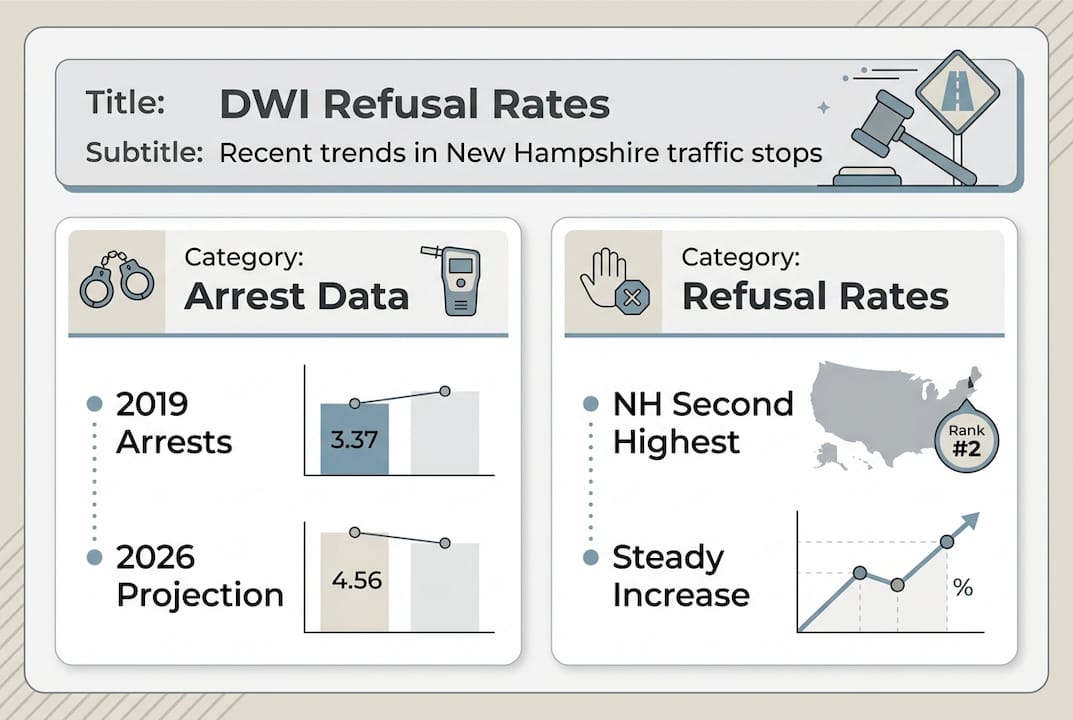
| Year | Estimated DUI arrests in NH | Approx. refusal rate |
|---|---|---|
| 2019 | 5,116 | ~50% (estimated) |
| 2026 | Not yet published | 75% |
The debate around harsher refusal penalties reflects a genuine tension in the law:
“Supporters of stricter penalties argue that high refusal rates create a loophole that allows impaired drivers to avoid prosecution. Critics counter that penalizing refusal infringes on personal liberty and may push some suspended drivers to continue driving unlicensed.”
Both sides raise valid points. For drivers, the practical takeaway is that the legal environment is tightening. Knowing the full scope of DWI penalties in New Hampshire helps you evaluate every option with realistic expectations. If you want a broader view, the complete guide to New Hampshire DUI penalties breaks down how courts treat first offenses, repeat offenses, and aggravating factors such as high BAC readings or having a minor in the vehicle.
The law’s direction is clear: New Hampshire is tightening consequences for refusal, not relaxing them. That trend is unlikely to reverse.
Why knowing your rights is more crucial than ever
Many drivers still assume that a traffic stop is a situation where common sense alone will carry them through. That assumption is increasingly risky. Laws change, and the gap between what drivers think they know and what the law actually requires is widening.
We see this pattern repeatedly: a driver makes a well-intentioned choice during a stop, not realizing that choice carries serious legal weight. The long-term effects of a DWI conviction extend far beyond fines and license suspensions. Employment background checks, professional licensing, insurance rates, and housing applications are all affected. Understanding your rights before you ever face a stop is not overpreparing. It is simply responsible.
The time to learn this information is now, not when you are on the side of the road at night with a flashlight in your face.
Protect your rights with help from experienced New Hampshire attorneys
Facing a DWI charge or concerned about how a traffic stop was handled? Naro Law’s criminal defense attorneys are experienced in navigating New Hampshire’s DWI laws and the real consequences that follow a stop gone wrong. Whether you are dealing with a license suspension after a refusal or facing charges from a recent arrest, timely legal guidance can make a meaningful difference in your outcome. Our team serving DWI defense in Merrimack and surrounding areas is ready to review your situation and help you understand your options. Contact us today for a free consultation.
Frequently asked questions
Do I have to get out of my car if asked by police in New Hampshire?
Yes. If an officer lawfully instructs you to exit the vehicle during a traffic stop, New Hampshire law requires you to comply; refusing to do so can lead to additional charges.
What happens if I refuse a breathalyzer after being arrested in NH?
Refusal after a lawful arrest triggers automatic administrative license suspension: currently 6 months for a first refusal, increasing to 9 months starting January 1, 2027.
Can I refuse field sobriety tests during a New Hampshire traffic stop?
Yes, field sobriety tests are voluntary in New Hampshire, but refusal may increase the officer’s suspicion and could factor into their decision to make an arrest.
Will refusing a DWI test prevent a conviction in New Hampshire?
Not necessarily. Refusal can trigger immediate license suspension under New Hampshire’s implied consent law, and prosecutors may still pursue a DWI conviction using other evidence such as officer observations and dashcam footage.
Can I speak to an attorney before taking a breath or blood test in NH?
You can request to speak with an attorney, but New Hampshire law does not require officers to delay the chemical testing process while you wait; refusing to take the test during any delay still carries the same suspension penalties.


