

TL;DR:
- A restraining order in New Hampshire is a court-issued directive that defines protections for victims and obligations for accused individuals. Petitioners automatically gain enforceable legal rights like no-contact, stay-away, firearm surrender, and custody provisions, while respondents must immediately comply to avoid criminal charges. Modifications require a court process, and violations carry serious legal consequences, including arrest and federal penalties for firearm non-compliance.
A restraining order, formally called a protective order under New Hampshire RSA 173-B, is a court-issued legal directive that defines specific protections for victims of abuse and binding obligations for those accused of it. Your legal rights under restraining orders depend entirely on which side of the order you stand on, and misunderstanding either position carries serious legal consequences. New Hampshire courts issue these orders with immediate effect, and they enter the national FBI database upon filing. Whether you are seeking protection or have been served with an order, knowing exactly what the law requires of you is the first step toward protecting yourself.
What rights do petitioners have under a New Hampshire protective order?
Petitioners in New Hampshire hold enforceable legal rights the moment a protective order is issued. These rights are not suggestions. They are court-mandated protections backed by both state statute and federal law, including the Violence Against Women Act (VAWA).
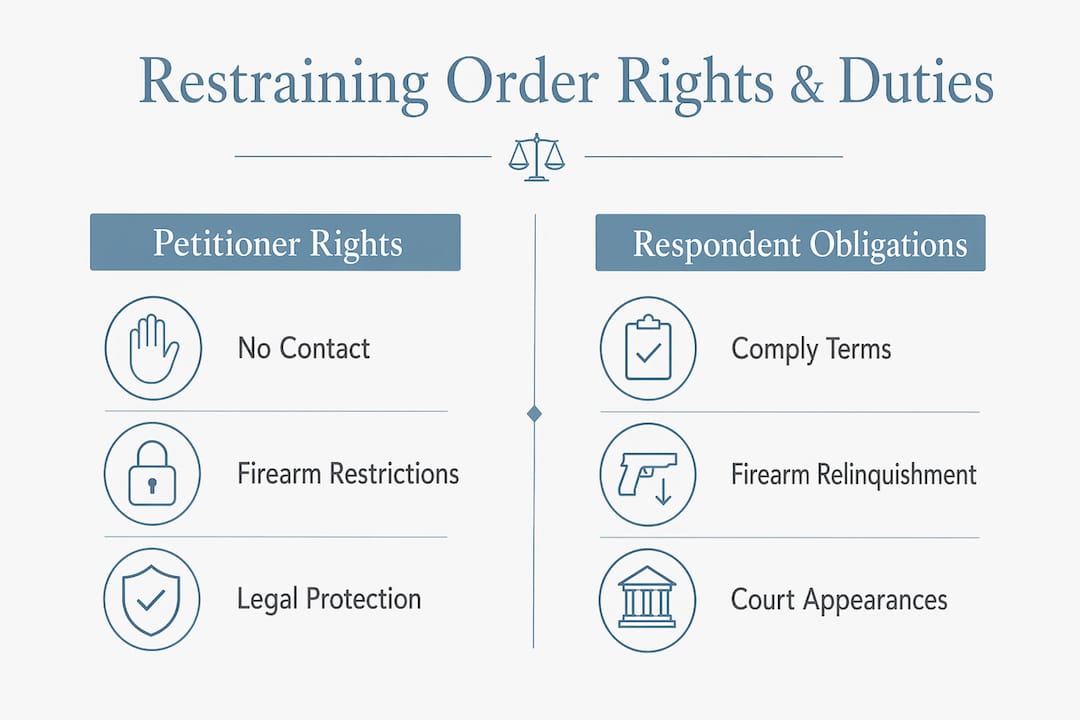
The core protections available to petitioners include:
- No-contact provisions: The respondent is legally prohibited from calling, texting, emailing, or contacting you through third parties.
- Stay-away orders: The respondent must maintain a specified physical distance from your home, workplace, and school.
- Firearm restrictions: NH protective orders require the respondent to surrender all firearms, a provision enforced under both state and federal law.
- Temporary custody controls: Courts may include provisions addressing child custody or visitation within the protective order itself.
- Stalking and harassment protection: Any continued pattern of contact, surveillance, or intimidation constitutes a violation regardless of whether physical contact occurs.
If the respondent violates any of these terms, violating a protective order is a criminal offense that can result in arrest and charges even without a separate underlying criminal case. You do not need to wait for physical harm to occur before reporting a violation. Contact law enforcement immediately and document every incident with dates, times, and any available evidence such as screenshots or witness statements.
Pro Tip: Keep a printed copy of your protective order with you at all times and provide copies to your employer, your children’s school, and local law enforcement. Courts and victim advocacy organizations in New Hampshire, such as the NH Coalition Against Domestic and Sexual Violence, can assist with safety planning.
What are the legal obligations of respondents served with a restraining order?
Being served with a protective order does not mean you have been convicted of a crime. It does mean you are legally bound by every term of that order from the moment it is served. Respondents who treat the order casually face criminal exposure that can escalate quickly.
Here is what respondents must understand and do immediately:
- Read every term carefully. The order specifies exactly what contact, proximity, and conduct is prohibited. Ignorance of a specific provision is not a legal defense.
- Cease all contact immediately. This includes indirect contact through mutual friends, family members, or social media. Courts treat third-party contact as a direct violation.
- Surrender firearms as ordered. New Hampshire law under RSA 173-B:9 and federal law both require compliance. Failure to surrender weapons can result in arrest independent of any other violation.
- Appear at all scheduled hearings. Failing to appear forfeits your opportunity to contest the order and allows the court to issue a final order by default.
- Retain legal counsel. Individuals subject to criminal protective orders require attorney representation because those orders belong to criminal cases and cannot be dissolved informally.
One of the most damaging misconceptions respondents hold is that time passing or a verbal agreement with the petitioner ends the order. Only a court can modify or dissolve a restraining order. Informal agreements between parties carry no legal weight, and contact made under such an assumption still constitutes a criminal violation.
Pro Tip: If you believe the order was issued based on false or exaggerated claims, do not attempt to resolve it directly with the petitioner. File a formal response with the court and present your evidence at the scheduled hearing with an attorney present.
How does New Hampshire law restrict firearm possession under protective orders?
Firearm restrictions are among the most serious and most frequently misunderstood components of a protective order. New Hampshire RSA 173-B:9 authorizes police to arrest respondents for disobeying firearm relinquishment orders, making compliance non-negotiable from the moment the order is served.
Federal law adds a second layer of prohibition. Under 18 U.S.C. 922(g)(8), individuals subject to qualifying protective orders are prohibited from possessing firearms, and violations can result in federal criminal penalties of up to five to twenty years in prison. This applies across state lines, meaning a New Hampshire protective order triggers federal restrictions regardless of where the respondent travels.
| Jurisdiction | Legal Basis | Consequence of Non-Compliance |
|---|---|---|
| New Hampshire (state) | RSA 173-B:9 | Arrest for disobedience of firearm order |
| Federal | 18 U.S.C. 922(g)(8) | Federal criminal charges, up to 5-20 years |
| Combined exposure | Both apply simultaneously | Compounded criminal liability |
Despite these laws, enforcement of firearm relinquishment in New Hampshire remains a documented gap, with recent legislative efforts to strengthen removal procedures stalled in 2026. For petitioners, this means proactively confirming with law enforcement that surrender has occurred. For respondents, it means that even if no one is actively checking, the legal risk of non-compliance is severe and permanent.
How can a restraining order be modified or dissolved in New Hampshire?
A restraining order does not have to be permanent, but ending or changing one requires a formal legal process. Dissolving or modifying an order requires filing a Motion to Dissolve or Motion to Modify with the court that issued the original order, accompanied by evidence of substantially changed circumstances.
Courts look for specific, documented evidence before granting any modification:
- Completion of a certified batterer intervention or counseling program
- A demonstrated period of compliance with no violations
- Changed living or employment circumstances that reduce the risk of harm
- Written or in-person testimony from the petitioner, provided voluntarily and without coercion
The petitioner’s position matters significantly in these hearings. However, judges weigh evidence carefully and assess whether the petitioner’s support for dissolution is genuinely voluntary or the result of pressure. A judge can decline to dissolve an order even if the petitioner requests it, particularly when safety concerns remain credible.
Respondents who violate the order while simultaneously seeking modification face the worst possible outcome: new criminal charges combined with a court that has direct evidence of continued non-compliance. The restraining order process in New Hampshire requires patience and strict adherence to procedure. Attempting to shortcut the process almost always extends the order rather than ending it.
Key takeaways
Understanding your legal rights under restraining orders in New Hampshire requires strict compliance with court terms, proactive enforcement by petitioners, and formal legal process for any modification.
| Point | Details |
|---|---|
| Petitioner protections are immediate | No-contact, stay-away, and firearm restrictions take effect the moment the order is issued. |
| Respondent violations carry criminal risk | Any contact, direct or indirect, constitutes a criminal offense regardless of the petitioner’s reaction. |
| Firearm compliance is mandatory | Both RSA 173-B:9 and federal law require surrender; non-compliance creates compounded criminal liability. |
| Only courts can end orders | Informal agreements and time passage do not dissolve a restraining order. A formal motion is required. |
| Legal counsel changes outcomes | Attorneys are critical for respondents contesting orders and for petitioners navigating enforcement gaps. |
What I’ve learned about restraining orders that most people get wrong
After working through restraining order cases in New Hampshire, the single most consistent problem I see is not malice. It is misunderstanding. Respondents who genuinely believe a phone call to “clear the air” is harmless end up facing criminal charges. Petitioners who assume the order enforces itself discover too late that they needed to report violations immediately and consistently.
The firearm issue deserves particular attention. The gap between what the law requires and what actually gets enforced in New Hampshire is real. Petitioners should not assume weapons have been surrendered simply because the order says so. Confirming compliance through law enforcement is a concrete safety step that too few people take.
For respondents, contesting an order you believe is unjust is a legitimate legal right. The process exists precisely for that purpose. But the window to exercise that right is narrow, and the consequences of missteps during that window are lasting. Seeking legal advice before the first hearing, not after, is the difference between a manageable situation and a criminal record.
The legislative environment in New Hampshire is also shifting. Bills to strengthen firearm removal procedures were rejected in 2026, but the conversation is ongoing. Both petitioners and respondents should stay informed about how statutory changes affect their rights and obligations.
— Rich
How Naro Law can help you with restraining orders in New Hampshire
Naro Law works with New Hampshire clients on both sides of protective order proceedings, providing clear legal guidance when the stakes are highest. Whether you need to file a restraining order to protect yourself or you have been served and need to understand your options, Naro Law’s family law team offers personalized, confidential support. The firm’s practice covers the full scope of family law in New Hampshire, including custody, support, and domestic violence matters that frequently intersect with protective orders. Contact Naro Law to schedule a free consultation and get a clear picture of where you stand legally.
FAQ
What is a restraining order under New Hampshire law?
A restraining order in New Hampshire is a court order issued under RSA 173-B that prohibits an individual from contacting, approaching, or harassing another person. It includes no-contact provisions, stay-away requirements, and mandatory firearm surrender.
What happens if a respondent violates a restraining order in NH?
Violating any term of a protective order is a criminal offense in New Hampshire and can result in immediate arrest and charges. Criminal penalties range from misdemeanors to felonies depending on the nature and frequency of the violations.
Can a restraining order be dropped if the petitioner agrees?
A petitioner’s agreement to dissolve an order is considered by the court but does not automatically end it. Judges assess whether consent is voluntary and may maintain the order if safety concerns remain, regardless of the petitioner’s request.
How long does a New Hampshire protective order last?
New Hampshire protective orders issued under RSA 173-B last one year from the date of issuance. They are entered into the national FBI database and can be extended by the court upon petition.
Do I need a lawyer to contest or modify a restraining order?
Legal representation is strongly advisable for both contesting and modifying a restraining order. Respondents subject to criminal protective orders require an attorney, as those orders involve prosecutors and cannot be resolved through informal agreement.


