

TL;DR:
- Navigating divorce in New Hampshire requires understanding residency, proper paperwork, and timely service of your spouse.
- Failure to follow procedural steps like filing in the correct county or submitting proof of service can cause significant delays or case dismissals.
Facing divorce in New Hampshire without a clear roadmap can turn an already difficult time into a procedural obstacle course. The state’s dissolution of marriage process, which is the formal legal term for what most people call divorce, follows a structured sequence of court filings, mandatory programs, and disclosure deadlines that are easy to miss without guidance. This step-by-step guide to the New Hampshire divorce process covers every stage, from confirming residency requirements to walking out of your final hearing with a signed decree, so you can move forward with clarity rather than confusion.
Table of Contents
- Key takeaways
- Step-by-step guide to the New Hampshire divorce process
- Documents and forms to prepare before filing
- Filing, serving your spouse, and the First Appearance
- Children and financial disclosures: the mandatory extras
- The final hearing and decree
- My perspective on where NH divorces really go wrong
- How Naro Law can help you through this process
- FAQ
Key takeaways
| Point | Details |
|---|---|
| Residency must be confirmed first | You must meet one of three jurisdiction pathways before filing any petition with the court. |
| Forms accuracy prevents delays | Incomplete or incorrect forms are a leading cause of rejection; gather all documents before you file. |
| Service of process is a hard stop | Until proof of service is filed, your case cannot move forward regardless of other preparation. |
| Children trigger extra requirements | Parents must complete the Child Impact Program within 45 days or face sanctions and scheduling delays. |
| Timeline depends on case type | Uncontested divorces can close in 60 to 90 days; contested cases may run 12 to 18 months. |
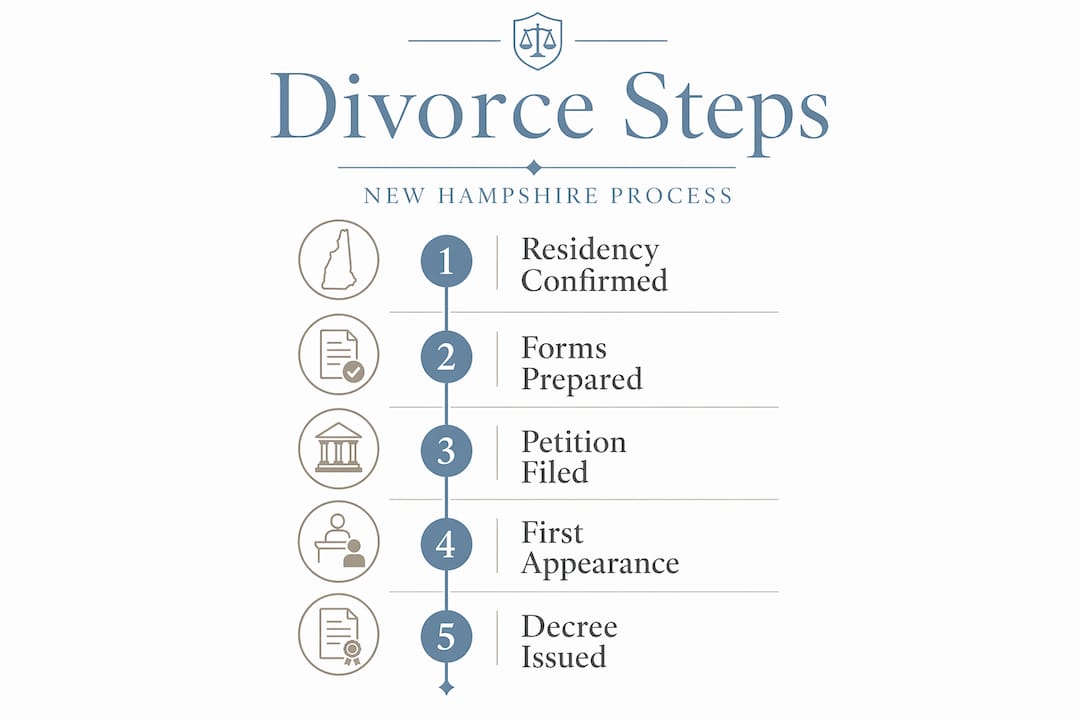
Step-by-step guide to the New Hampshire divorce process
Before you complete a single form, you need to confirm that New Hampshire courts have the legal authority to hear your case. This is called jurisdiction, and it is determined by residency. Three residency pathways qualify under NH law: both spouses currently live in New Hampshire; the petitioner has lived in New Hampshire for at least one year; or the petitioner lives in New Hampshire and can serve the spouse within state borders.
Once you confirm eligibility, you file in the Circuit Court Family Division for the county where either spouse resides. Filing in the wrong county is one of the most common procedural delays attorneys see, because a misplaced case requires a formal transfer before anything else can happen.
Here is what to confirm before you file:
- You meet at least one of the three residency criteria above
- You know which county court has proper venue over your case
- You understand that New Hampshire has no mandatory waiting period once residency criteria are satisfied
- If your spouse is out of state, service can still be valid as long as the petitioner meets the NH domicile requirement
Pro Tip: If you are unsure whether New Hampshire has jurisdiction because you were married in another state, review the divorce in a different state guide before you file.
Documents and forms to prepare before filing
Getting your paperwork in order before you walk into the courthouse saves time and prevents rejection at the clerk’s window. New Hampshire courts require specific forms, and the combination you need depends on your circumstances.
| Form | Required for | Where to find it |
|---|---|---|
| Petition for Divorce | All cases | courts.nh.gov |
| Personal Data Sheet | All cases | courts.nh.gov |
| Financial Affidavit | All cases | courts.nh.gov |
| Parenting Plan | Cases with minor children | courts.nh.gov |
| Child Support Worksheet | Cases with minor children | courts.nh.gov |
Early and comprehensive preparation of all required forms is the single most reliable way to avoid rejection or unnecessary delays. Forms can be downloaded directly from the New Hampshire Judicial Branch website at courts.nh.gov, which always reflects the most current versions.
Pay close attention to the Financial Affidavit. Financial disclosures must be exchanged within 45 days after service or at least 10 days before any scheduled hearing. Missing that deadline can result in court sanctions, which delays everything else in your case.
Pro Tip: Use the NH divorce preparation checklist to organize your documents before you file. Having bank statements, tax returns, and property records gathered in advance makes completing the Financial Affidavit significantly faster and more accurate.

Filing, serving your spouse, and the First Appearance
With your forms complete, you file the petition at the Circuit Court Family Division in your county. Filing fees are $252 without minor children and $282 when minor children are involved, with fee waivers available for qualifying individuals. New Hampshire also offers electronic filing through the Judicial Branch portal at odypa.nhecourt.us, which requires registration and proper compliance to avoid default judgments.
After filing, you must formally serve your spouse. Here is the standard sequence:
- Serve your spouse using personal service by a sheriff or process server, or obtain a signed waiver of service if your spouse agrees to cooperate.
- File proof of service with the court. Failure to file proof of service stops all case progress, and self-represented parties routinely underestimate how long this step takes.
- Your spouse then has approximately 20 to 30 days to file a response after being served.
- If your spouse does not respond, the court may proceed with a default judgment in your favor.
- Once the response period closes, the court will schedule a First Appearance.
The First Appearance session is not a hearing on the merits of your case. It is a structured orientation where the judge or marital master presents the court process, explains parental responsibilities when children are involved, and sets the schedule for the next event, whether that is mediation, a hearing, or something else.
The First Appearance is mandatory for cases involving children under 18. Missing it without a valid reason will set your case back significantly, so calendar it immediately after it is scheduled.
Children and financial disclosures: the mandatory extras
If your divorce involves minor children, two additional requirements run alongside the standard filing timeline, and both carry real consequences if ignored.
The Child Impact Program is a four-hour educational course that both parents must complete. The program must be finished within 45 days of filing or as otherwise ordered by the court. Its purpose is to help parents understand how divorce affects children and to encourage cooperation on parenting decisions. Missing the deadline can result in sanctions or delays to your court schedule.
Key points about managing these parallel requirements:
- Register for the Child Impact Program immediately after filing. Seats fill up and the 45-day window is shorter than it appears.
- Work backwards from your First Appearance date to confirm that both the program and financial disclosures will be completed on time.
- Exchange detailed financial affidavits and supporting documents within the court’s deadlines. Non-compliance risks sanctions that can affect the outcome of your entire case.
- If child custody arrangements are contested, review child custody considerations in NH to understand how courts approach those decisions.
Pro Tip: Treat the Child Impact Program deadline as a court order, not a suggestion. Courts have little patience for parents who miss it without documented cause.
The final hearing and decree
The final hearing is where your divorce becomes legally official. For uncontested cases, this session is often brief and focused on confirming that both parties understand and agree to the settlement terms. Uncontested divorces in New Hampshire can be finalized in 60 to 90 days, while contested cases often run 12 to 18 months depending on the complexity of disputes.
What to bring and expect at the final hearing:
- A copy of your signed settlement agreement covering property division, any spousal support, and parenting arrangements
- Any documentation the court previously requested
- Photo identification and your case number
After the judge signs the final decree, request certified copies from the court clerk. You will need them to update financial accounts, real estate records, and other legal documents. If either party’s name is being changed as part of the decree, certified copies are what government agencies require to process that change.
Pro Tip: In some uncontested cases, the court may waive the need for both parties to appear in person. Ask your attorney or the clerk’s office whether a written stipulation will satisfy the court’s requirements for your specific case.
My perspective on where NH divorces really go wrong
I’ve worked with enough New Hampshire clients to say this clearly: most divorce delays are not caused by disagreements between spouses. They’re caused by procedural missteps that happen before the first hearing.
The two most consistent problems I see are filing in the wrong county and missing the proof of service deadline. Both feel minor until they aren’t. A misplaced filing means a formal transfer that pushes your timeline back weeks. Unserved or improperly documented service means nothing else moves. At all.
What I’ve learned is that preparation is not just about having the right forms. It’s about understanding the sequence. Mediation, when used early, resolves financial and parenting disputes faster and at lower cost than contested hearings. Clients who enter mediation with organized financial records and realistic expectations finish in a fraction of the time. The clients who struggle are the ones who underestimate how much the early procedural steps shape everything that comes after.
— Rich
How Naro Law can help you through this process
Understanding the New Hampshire divorce process in theory is one thing. Applying it to your specific circumstances, your assets, your children, your timeline, is where having experienced legal counsel genuinely matters. Naro Law is a New Hampshire family law practice that guides clients through every stage of dissolution of marriage proceedings, from confirming jurisdiction and preparing accurate filings to negotiating settlements and attending final hearings.
Whether you are beginning an uncontested divorce or facing a contested custody dispute, the team at Naro Law provides personalized guidance grounded in NH family law. Visit the family law services page to learn more about how Naro Law approaches divorce, custody, and support cases, or schedule a free consultation to discuss your situation directly with an attorney.
FAQ
What are the residency requirements to file for divorce in NH?
You must meet one of three criteria: both spouses live in New Hampshire, the petitioner has lived in NH for at least one year, or the petitioner lives in NH and can serve the other spouse within the state. Filing without meeting these requirements will result in dismissal.
How long does a New Hampshire divorce take?
Uncontested divorces typically finalize in 60 to 90 days. Contested cases involving disputes over property, support, or custody can take 12 to 18 months depending on the complexity and court scheduling.
What is the Child Impact Program in NH divorce cases?
The Child Impact Program is a mandatory four-hour course for parents divorcing with minor children. Both parents must complete it within 45 days of filing or face court sanctions and potential delays to their case schedule.
How much does it cost to file for divorce in New Hampshire?
Filing fees are $252 for divorces without minor children and $282 when minor children are involved. Fee waivers are available for individuals who qualify based on financial need.
What happens at the First Appearance in an NH divorce case?
The First Appearance is an initial court session, mandatory when minor children are involved, where the court explains the divorce process and sets the schedule for upcoming events such as mediation or a formal hearing. It is not a substantive hearing on the merits of your case.


