

TL;DR:
- DUI penalties in New Hampshire vary based on offense history, BAC levels, and aggravating factors.
- Administrative license suspensions occur immediately upon testing refusal, separate from court penalties.
- Long-term effects include increased insurance costs, criminal record consequences, and potential impact on careers.
A common misconception is that all DUI charges in New Hampshire carry roughly the same punishment. In reality, penalties vary significantly based on your blood alcohol content, prior offenses, the circumstances of your arrest, and whether aggravating factors apply. A first-time offense and a third offense are worlds apart in terms of consequences. Understanding exactly what you are facing under New Hampshire law can help you make informed decisions, protect your rights, and work more effectively with legal counsel to navigate what lies ahead.
Table of Contents
- What qualifies as DUI in New Hampshire?
- Core penalties for DUI convictions
- Administrative penalties and implied consent
- Long-term consequences and repeat offenses
- A fresh perspective: penalties versus prevention
- Facing DUI charges? Get help from New Hampshire defense experts
- Frequently asked questions
Key Takeaways
| Point | Details |
|---|---|
| Legal thresholds matter | New Hampshire has specific BAC and drug impairment limits—with edge cases—so understanding them is key. |
| Penalties vary widely | DUI consequences depend on experience, circumstances, and prior offenses, including possible jail, fines, and license loss. |
| Administrative penalties are separate | Refusing tests may trigger a license suspension immediately, regardless of court outcomes. |
| Repeat offenses are serious | Repeat DUI offenders face harsher penalties and are more likely to require ignition interlock devices. |
| Education can help | Prevention and legal education are often more effective than just increasing penalties for reducing DUIs. |
What qualifies as DUI in New Hampshire?
New Hampshire treats driving under the influence seriously, and the law casts a wider net than many people expect. Under RSA 265-A:2, it is illegal to operate a vehicle with a blood alcohol concentration (BAC) of 0.08% or higher. However, that threshold drops to 0.02% for drivers under 21 and to 0.04% for commercial vehicle operators. Impairment caused by drugs, including prescription medications, also qualifies as a DUI offense.
Here is a quick breakdown of the BAC thresholds:
| Driver category | BAC threshold |
|---|---|
| Standard adult (21+) | 0.08% |
| Commercial driver | 0.04% |
| Driver under 21 | 0.02% |
The law also applies beyond public roads. Boating and operating off-highway recreational vehicles (OHRVs) while impaired fall under the same statutes. New Hampshire recently strengthened its rules, and wrong-way DWI now carries enhanced penalties under updated legislation.
Out-of-state drivers are not exempt either. Prior DUI convictions from other states can count against you in New Hampshire through the interstate compact, potentially increasing your sentencing exposure. You can learn more about how out-of-state DUI impact works under New Hampshire law.
Key situations that qualify as DUI include:
- Operating with a BAC at or above the applicable threshold
- Driving while impaired by alcohol, illegal drugs, or prescription medications
- Boating or OHRV operation while impaired
- Wrong-way driving under the influence, which triggers enhanced charges
Pro Tip: If your situation involves any edge case, such as a prescription medication or an out-of-state prior conviction, consult an attorney before making any statements to law enforcement.
Core penalties for DUI convictions
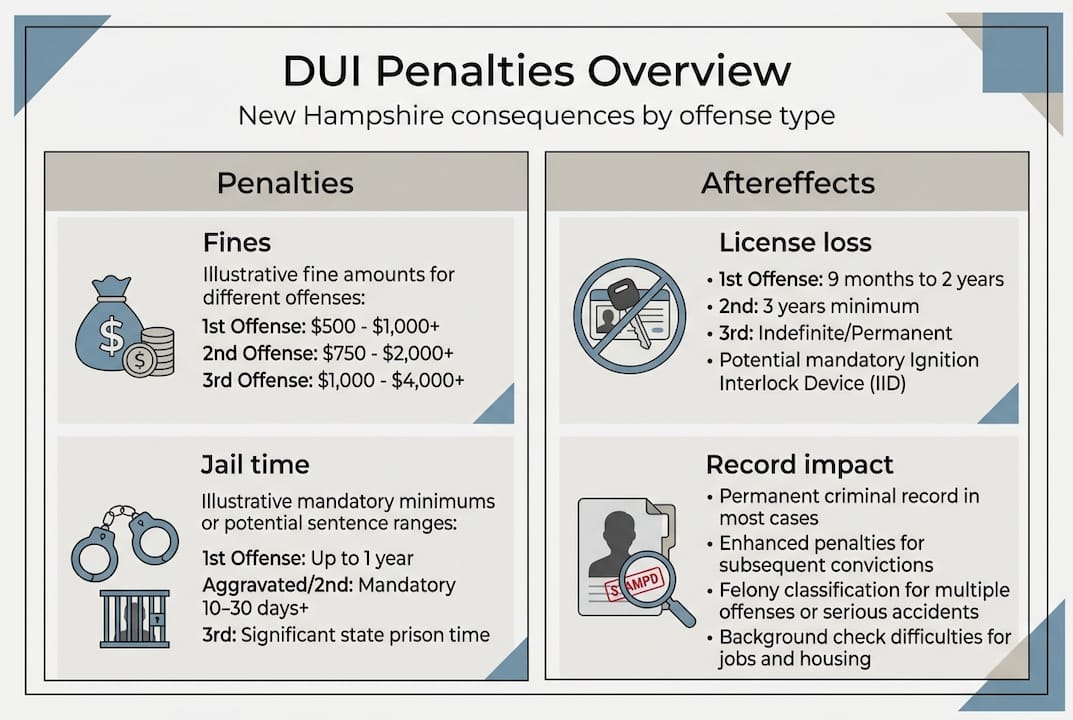
With the legal criteria covered, let’s move on to the range of penalties you might face for different DUI convictions. The consequences escalate sharply with each offense.
| Offense | Fine | Jail time | License revocation |
|---|---|---|---|
| First offense | $500 minimum | Up to 12 months | 9 months minimum |
| Second offense | $750 minimum | 17 days to 12 months | 3 years |
| Third offense (felony) | $2,000 minimum | 180 days to 5 years | Indefinite |
Aggravated DWI, governed by RSA 265-A:3, applies when specific factors are present: a BAC of 0.16% or higher, speeding more than 30 mph over the limit, having a passenger under 16, causing injury, or eluding police. This charge carries a minimum $750 fine, at least 17 days in jail, an 18 to 24 month license revocation, and a mandatory ignition interlock device (IID). An IID prevents your vehicle from starting if it detects alcohol on your breath.
Here is the general order of consequences you will likely face:
- Arrest and booking
- Administrative license suspension (separate from criminal penalties)
- Criminal fines and potential jail time
- Mandatory alcohol or drug education programs
- Ignition interlock device installation (for aggravated or repeat offenses)
One important point: many charges are dismissed or reduced when an experienced attorney identifies procedural issues, such as improper breath test administration or insufficient observation periods. New Hampshire ranks 31st in strictness nationally, meaning there is meaningful room for legal strategy. Reviewing the full DWI penalties overview can help you understand what your specific charge may involve.
Administrative penalties and implied consent
In addition to criminal penalties, there are important administrative processes you need to know. These run parallel to the court process and can affect your license even before a conviction.

New Hampshire operates under an implied consent law. By driving on New Hampshire roads, you automatically consent to chemical testing if an officer has reasonable grounds to suspect impairment. Refusing a breath or blood test triggers an automatic administrative license suspension (ALS), separate from any criminal punishment.
Key facts about implied consent and administrative penalties:
- First refusal: 180-day automatic license suspension
- Subsequent refusals: Up to 2 years of suspension
- Suspension is imposed immediately, regardless of whether criminal charges are filed
- The ALS process is handled by the DMV, not the criminal court
- You have a limited window to request a hearing to challenge the suspension
According to Citizens Count, the ALS suspension for a first refusal is 180 days and can extend to 2 years for repeat refusals, entirely separate from any sentence a judge imposes.
Many people are surprised to learn that refusing a test does not automatically help their case. Prosecutors can still use the refusal as evidence of consciousness of guilt. Understanding whether to refuse breath tests is a nuanced decision best made with legal guidance.
Pro Tip: Acting quickly after a DUI arrest matters. The window to request a DMV hearing to contest your license suspension is short, and missing it can mean an automatic loss of driving privileges.
Long-term consequences and repeat offenses
Finally, it is crucial to understand how a DUI conviction can affect your future and why repeat offenses carry extra weight. The courtroom penalties are just the beginning.
Nationally, ignition interlocks reduce repeat DUI offenses by approximately 67%, which is a significant figure. Yet roughly 25% of convicted DUI offenders reoffend within five years. Repeat offenders are also overrepresented in fatal crashes, accounting for 36% of drivers in DUI-related fatalities who had a prior conviction.
Key insight: Repeat DUI offenders are not simply unlucky. They represent a pattern that courts take seriously, and New Hampshire law reflects that with sharply escalating penalties.
Beyond the courtroom, a DUI conviction creates ripple effects that can last years:
- Criminal record: Limits employment opportunities, especially in fields requiring background checks
- Auto insurance: Premiums typically increase dramatically or coverage may be dropped
- Professional licenses: Certain careers, including healthcare and law, may be affected
- Housing: Some landlords screen for criminal records
- Ignition interlock costs: Installation and monthly monitoring fees add up over time
Understanding the long-term effects of a DWI conviction in New Hampshire is essential for anyone weighing their legal options. The stakes extend well beyond the initial fine or jail sentence.
A fresh perspective: penalties versus prevention
Having covered the details, let’s step back and look at penalties in light of prevention strategies. New Hampshire sits in the middle tier nationally for DUI strictness, which raises a fair question: do harsher penalties actually prevent DUIs, or do education and treatment do more of the heavy lifting?
The evidence leans toward treatment and education producing better long-term outcomes, particularly for first-time offenders. Ignition interlocks are effective but costly, and not everyone can afford them without hardship. Meanwhile, debates continue around marijuana decriminalization, which has made drug-impaired driving harder to detect and prosecute consistently. This creates real enforcement gaps that stricter penalties alone cannot close.
If you are facing charges, understanding NH DWI penalties is only part of the picture. Completing education programs voluntarily, even before a court requires it, can demonstrate good faith and sometimes influence outcomes positively.
Facing DUI charges? Get help from New Hampshire defense experts
Navigating DUI penalties in New Hampshire is not something you should do alone. The legal process moves quickly, administrative deadlines are strict, and the consequences of a conviction can follow you for years. Naro Law provides experienced criminal defense representation across the state, including Concord criminal defense, Manchester criminal defense, and Portsmouth criminal defense. Whether you are facing a first offense or a repeat charge, our team can review your case, explain your options, and build a strategy tailored to your situation. Schedule a free consultation today.
Frequently asked questions
How long is your license suspended for a first DUI in New Hampshire?
A first DUI conviction typically carries a minimum 9-month license suspension through the criminal court. If you also refused a breath test, a separate 180-day administrative suspension applies on top of that.
Can out-of-state DUIs affect your penalties in New Hampshire?
Yes. Through the interstate compact, out-of-state prior convictions can be counted when determining your offense level in New Hampshire, potentially pushing you into harsher sentencing territory.
What is an ignition interlock device and when is it required?
An ignition interlock device (IID) is a breathalyzer connected to your vehicle’s ignition. It is mandatory for aggravated DWI and repeat offenses in New Hampshire, preventing the car from starting if alcohol is detected.
What are the penalties for refusal to take a breathalyzer?
Refusing a breath or blood test triggers an automatic 180-day suspension for a first refusal, with up to 2 years for subsequent refusals, entirely separate from any criminal penalties imposed by a court.
Is marijuana use treated differently in DUI cases?
No. Drug impairment, including marijuana, falls under the same DUI statutes as alcohol. Recent decriminalization of marijuana has created enforcement challenges, but the legal standard for impaired driving still applies.


