

TL;DR:
- New Hampshire focuses on parental rights and responsibilities, centered on the child’s best interests.
- Courts presume shared parenting time and decision-making, with recent reforms emphasizing equal time.
- Successful custody outcomes depend on cooperation and demonstrating reliability, not just legal rights.
Many parents entering a custody dispute in New Hampshire assume the goal is to “win” custody. That framing is understandable, but it misses how NH custody laws actually work. New Hampshire does not use the traditional terms “custody” and “visitation.” Instead, the law focuses on “parental rights and responsibilities,” and every decision centers on one standard: the best interests of the child. This guide walks you through the key concepts, the legal process, recent 2025 reforms, and practical steps you can take right now.
Table of Contents
- How New Hampshire defines custody: Parental rights and responsibilities
- Parenting plans and the decision-making process
- How the court decides: Key factors and recent legal reforms
- Exceptions, modifications, and special circumstances
- Our perspective: What most parents miss about NH custody laws
- Get experienced legal help with New Hampshire custody
- Frequently asked questions
Key Takeaways
| Point | Details |
|---|---|
| Best interests are central | Every custody decision in New Hampshire centers on the child’s best interests, not parent preference. |
| Parenting plan is mandatory | All custody actions require a detailed parenting plan or the court will create one if parents can’t agree. |
| Shared parenting favored | Recent legal changes promote shared parenting time unless exceptions or risks exist. |
| Cooperation is key | Judges look for parental cooperation and involvement above strategy or rivalry. |
| Special rules for exceptions | Cases with abuse, relocation, or major change have specific rules and protections for children. |
How New Hampshire defines custody: Parental rights and responsibilities
If you have searched for “custody” in New Hampshire statutes, you may have come up empty. That is intentional. RSA Chapter 461-A replaced older custody language with “parental rights and responsibilities” to shift the focus from parental ownership to parental function.
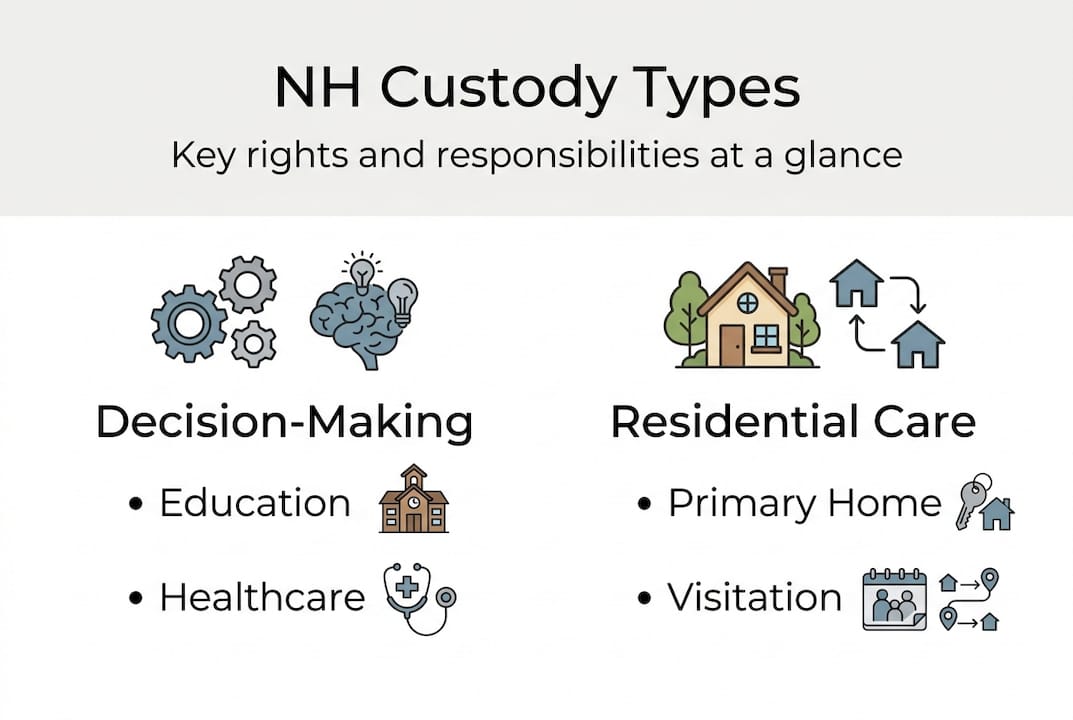
The law breaks this into two categories. Decision-making responsibility covers major choices about a child’s education, healthcare, and religious upbringing. Residential responsibility determines where the child lives and on what schedule. Understanding NH custody terminology helps you speak the same language as the court from day one.
| Traditional term | New Hampshire term |
|---|---|
| Legal custody | Decision-making responsibility |
| Physical custody | Residential responsibility |
| Visitation | Parenting time |
| Custody order | Parenting plan |
Under RSA 461-A:6, courts evaluate the best interests of the child by weighing several factors:
- The child’s relationship with each parent
- Each parent’s ability to meet the child’s daily needs
- The child’s adjustment to home, school, and community
- Any history of domestic violence or abuse
- The willingness of each parent to support the child’s relationship with the other parent
- The child’s own preferences, depending on age and maturity
With the common terminology clear, let’s look at how these principles play out in legal processes.
Parenting plans and the decision-making process
Once you understand the legal framework, the next key step is creating a detailed parenting plan. In New Hampshire, parenting plans under RSA 461-A:4 are required in virtually all custody proceedings, whether the parents are divorcing or were never married.
A complete parenting plan must address the following:
- Decision-making responsibility for education, healthcare, and religion
- Residential schedule, including weekdays, weekends, and overnights
- Holiday and vacation time for each parent
- Transportation arrangements for exchanges between households
- Dispute resolution process for future disagreements
If parents cannot agree, the court will impose a plan based on the child’s best interests after reviewing evidence from both sides. That court-created plan may not reflect what either parent hoped for, which is a strong incentive to negotiate in good faith.
One important note: unmarried parents must legally establish paternity before either parent can assert parental rights. Without that step, the court cannot address parenting plans for unmarried parents at all. Also keep in mind that once a plan is in place, parenting plan enforcement has real legal teeth in New Hampshire.
Pro Tip: Before submitting your parenting plan, review it carefully for gaps in holiday coverage, school pickup logistics, and how you will handle last-minute schedule changes. Vague language in a plan is the most common source of future disputes.
How the court decides: Key factors and recent legal reforms
Understanding what’s expected in a parenting plan, let’s break down exactly how courts in New Hampshire approach custody decisions.
New Hampshire law is gender-neutral and cooperative by design. Neither parent starts with an advantage based on gender. Courts presume joint decision-making is best unless evidence shows otherwise, such as a history of abuse, severe conflict, or one parent’s inability to meet the child’s needs.
A major shift came with HB 185, effective January 2025. Shared parenting time is now the starting point, and courts must provide written justification if they deviate significantly from equal time.

| Factor | Before HB 185 | After HB 185 (2025) |
|---|---|---|
| Default time split | No formal presumption | Equal time presumed |
| Court’s burden | Discretionary | Must justify deviations in writing |
| Shared parenting emphasis | Encouraged | Legally required starting point |
In contested cases, mediation is mandatory before trial. The custody mediation success rate in New Hampshire is striking:
Approximately 75% of disputed custody cases in New Hampshire are resolved through mediation, avoiding a full trial.
Factors that can shift the court’s balance include:
- Documented history of domestic violence or substance abuse
- A parent’s consistent involvement in school and medical appointments
- Each parent’s willingness to encourage the child’s bond with the other parent
- Geographic proximity of the two households
- The child’s established routine and community ties
Reviewing negotiation tips for custody before mediation can meaningfully improve your outcome.
Exceptions, modifications, and special circumstances
While most cases follow the standard processes, certain situations call for a very different approach.
If domestic violence is present, New Hampshire law creates a legal presumption against awarding decision-making or residential responsibility to the abusive parent. This presumption can be overcome only with clear evidence that the arrangement serves the child’s best interests, which is a high bar.
Relocation is another sensitive area. If the parent with primary residential responsibility wants to move, they must provide 60 days’ written notice to the other parent. The relocating parent must show the move serves a legitimate purpose and is in the child’s best interests. The other parent may object, and the court will decide.
Modifying an existing order requires proof of a substantial change in circumstances since the original order was issued. Examples include a parent’s remarriage, a significant change in work schedule, or a child’s evolving needs. Modifying plans after remarriage is one of the more common triggers for a modification request.
Steps to request a modification:
- Identify and document the substantial change in circumstances
- File a motion to modify with the family court
- Serve the other parent with notice of the motion
- Attend mediation if the modification is contested
- Present evidence at a hearing if mediation does not resolve the issue
Pro Tip: Keep a written log of all significant events, schedule changes, and communications with the other parent. This documentation becomes critical evidence if you need to request or oppose a modification later.
Our perspective: What most parents miss about NH custody laws
After working with many families through custody disputes, one pattern stands out. Parents who focus on “getting more time” or “winning decision-making” often fare worse than those who walk into court demonstrating reliability, flexibility, and a genuine focus on their child’s needs.
Judges notice everything. They watch how parents communicate, whether they show up consistently, and whether they support the child’s relationship with the other parent. Cooperation and showing involvement matter far more to outcomes than arguing over legal rights in theory.
The most successful cases we see follow a practical custody workflow built around the child’s schedule, not the parents’ preferences. That shift in mindset, from competition to cooperation, is the single most impactful thing you can do before stepping into a courtroom.
Get experienced legal help with New Hampshire custody
Navigating New Hampshire’s parenting rights framework is manageable with the right guidance. Whether you are drafting your first parenting plan, preparing for mediation, or facing a modification request, an experienced attorney can help you build a strategy that puts your child’s needs first. A Manchester family law attorney at Naro Law can walk you through every step. Start with our 2026 custody negotiation guide or review child custody tips for NH parents to take your first informed step forward.
Frequently asked questions
What factors do New Hampshire courts consider in child custody cases?
Courts apply a best interests standard under RSA 461-A:6, weighing safety, parental involvement, cooperation between parents, and any history of domestic violence or abuse.
Is joint custody the default in New Hampshire?
NH presumes joint decision-making is best, but it is not automatic. Both parents start with equal standing, provided each is fit and willing to cooperate.
What if parents cannot agree on a parenting plan?
If parents cannot reach an agreement, the court creates a plan based on the child’s best interests after hearing evidence from both sides.
How are child custody disputes typically resolved in NH?
Roughly 75% of disputed cases resolve through mandatory mediation before ever reaching a full trial.
Can parenting orders be changed after the divorce?
Yes, but courts require proof of a substantial change in circumstances before they will consider modifying an existing parenting order.


