

TL;DR:
- In New Hampshire, courts focus on the child’s best interests rather than awarding custody to one parent, emphasizing parental rights and responsibilities. The legal process involves evidence-based evaluation of factors like relationship quality, daily needs, and co-parenting willingness, rather than competition between parents. Understanding and documenting these factors early can lead to effective negotiations and stronger court cases, with support available from experienced family law professionals.
When parents in New Hampshire face divorce, most assume the court will decide who “wins” custody of their children. That assumption leads to confusion, unnecessary conflict, and sometimes poor legal strategy. New Hampshire law actually takes a different approach: rather than awarding custody to one parent, courts determine parental rights and responsibilities under RSA 461-A:6 using a child-centered “best interests” standard. Understanding this distinction early can shape your entire approach to the divorce process.
Table of Contents
- How New Hampshire defines parental rights and responsibilities
- Understanding the best interests standard (RSA 461-A:6)
- The divorce process and establishing parental rights in New Hampshire
- Child support and responsibilities after divorce
- Why mapping evidence to best interests matters more than ‘custody rights’
- Where to get help with your parental rights and divorce process
- Frequently asked questions
Key Takeaways
| Point | Details |
|---|---|
| Focus on child’s best interests | In NH, parental rights are set based on what serves the child’s needs—not who ‘wins’ custody. |
| Present strong, relevant evidence | Courts prioritize evidence linked to best-interest factors such as relationship and stability. |
| Understand ongoing responsibilities | Child support and parenting plans can continue and evolve after divorce. |
| Use legal resources | Accessible expert guidance improves outcomes and helps navigate complex divorce processes. |
How New Hampshire defines parental rights and responsibilities
Many states still use the language of “primary custody” and “visitation,” but New Hampshire moved away from those labels deliberately. The state’s framework treats both parents as having rights and responsibilities toward their child, unless the evidence shows otherwise. This shift matters because it changes the questions a court asks.
Instead of asking “who should have custody,” a New Hampshire judge asks: “What arrangement best serves this child’s needs?” That is a fundamentally different question, and it requires a different kind of preparation from parents.
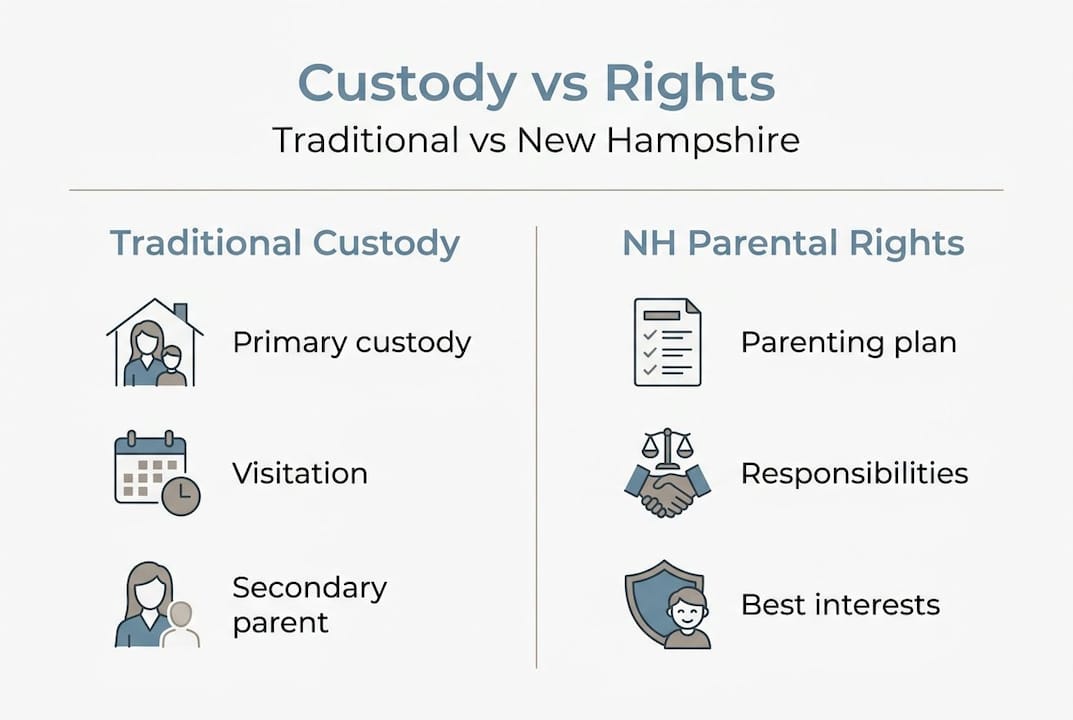
Here is a quick comparison of how the traditional custody framework differs from New Hampshire’s approach:
| Traditional custody framework | New Hampshire framework |
|---|---|
| “Primary” vs. “secondary” custody | Parental rights and responsibilities |
| Visitation for the non-primary parent | Residential schedule for both parents |
| One parent often seen as the “winner” | Both parents evaluated on child’s needs |
| Focus on parental status | Focus on child’s best interests |
Understanding NH child custody laws helps you see that the law is not designed to punish or reward parents. It is designed to protect children.
Parental rights in NH generally cover two categories:
- Decision-making responsibility: Who has authority over major decisions like education, healthcare, and religious upbringing.
- Residential responsibility: Where the child primarily lives and the schedule for time with each parent.
Courts can allocate these responsibilities jointly or assign them primarily to one parent, depending on what the evidence shows. The types of child custody recognized in New Hampshire reflect these distinctions clearly, and knowing the difference helps you understand what you are actually negotiating or litigating.
Key takeaway: New Hampshire does not hand a “win” to either parent. The court’s role is to craft an arrangement that serves the child, not to validate a parent’s grievances or reward good behavior during the marriage.
Understanding the best interests standard (RSA 461-A:6)
Once you accept that the court’s focus is the child’s best interests, the next step is understanding exactly what that means legally. RSA 461-A:6 provides courts with a specific list of factors to weigh when making these decisions. These best-interests factors include the child’s relationship with each parent, each parent’s ability to meet daily needs, the child’s adjustment to home, school, and community, any history of domestic violence or abuse, each parent’s willingness to support the other parent’s relationship with the child, and the child’s own preferences based on age and maturity.
The following table shows how courts generally weigh these factors in practice:
| Factor | What the court looks at |
|---|---|
| Relationship with each parent | Quality of daily interactions, involvement, emotional bond |
| Ability to meet daily needs | Housing, nutrition, medical care, school support |
| Adjustment to home/school/community | Stability of current environment, friendships, routine |
| History of abuse or domestic violence | Documented incidents, safety risks to the child |
| Willingness to support co-parenting | Communication patterns, respect for the other parent’s role |
| Child’s preferences | Age-appropriate input, not a deciding vote |
For parents preparing their case, the path forward follows a clear sequence:
- Identify which factors favor your involvement as a parent.
- Gather concrete, documented evidence for each relevant factor.
- Organize that evidence so it maps directly to the statutory criteria.
- Avoid arguments that focus on the other parent’s personal failings unless they directly affect the child.
- Demonstrate a willingness to co-parent, as courts view this as a strong positive indicator.
Check out this essential child custody guide for a deeper breakdown of how these factors play out in real NH cases.
Pro Tip: Keep a simple, dated journal of your parenting activities, including school pickups, medical appointments, homework help, and bedtime routines. This kind of documented record maps directly to the “ability to meet daily needs” and “relationship with each parent” factors, and it is far more persuasive than general claims about being a good parent.
The divorce process and establishing parental rights in New Hampshire
Knowing the legal standard is one thing. Knowing how the process unfolds is another. When a divorce involves minor children in New Hampshire, the case follows a structured path that includes specific steps for resolving parental rights.
Key steps in the process:
- Filing the divorce petition and identifying that minor children are involved.
- Completing a parenting plan proposal, which outlines your proposed residential schedule and decision-making arrangement.
- Attending mediation, which is often required in contested parenting cases, to try to reach an agreement before going to a judge.
- Participating in a parenting education program, which NH courts frequently require for divorcing parents.
- If no agreement is reached, proceeding to a hearing where both sides present evidence.
- Receiving the court’s final decree, which includes the approved parenting plan.
Understanding the full parental rights legal workflow helps you prepare at each stage rather than reacting to surprises.
When it comes to courtroom strategy, the best-interests factors under RSA 461-A:6 function as the evaluation rubric. Evidence that maps to those factors is typically far more persuasive than arguments centered on parental status or abstract notions of “custody rights.” A parent who walks into court with school attendance records, medical appointment logs, and examples of cooperative communication will almost always make a stronger impression than one who only argues that they “deserve” more time.
Effective preparation includes:
- Requesting school, medical, and extracurricular records that document your involvement.
- Collecting text messages or emails that show respectful co-parenting communication.
- Documenting any safety concerns with police reports, medical records, or witness statements.
- Reviewing a solid child custody negotiation guide to understand what agreements courts typically approve.
Pro Tip: During mediation, focus your proposals on the child’s routine and needs rather than on splitting time equally. Parents who frame proposals around school schedules, activity involvement, and health needs tend to reach agreements faster and with better outcomes for everyone.
Child support and responsibilities after divorce
Parental rights do not end when the divorce decree is signed. Child support is a continuing legal obligation that runs alongside the parenting plan, and it is governed by RSA 461-A as well.

New Hampshire calculates child support using an income shares model, which considers both parents’ incomes and allocates the financial responsibility proportionally. The amount can be adjusted for childcare costs, health insurance premiums, and other documented expenses related to the child.
Key facts about child support in New Hampshire:
- Support generally continues until the child turns 18.
- If the child is still enrolled in high school at age 18, support continues until graduation or age 20, whichever comes first.
- Children with disabilities may qualify for support beyond those age limits.
- Either parent can petition for a modification if circumstances change significantly, such as a job loss, a major income change, or a shift in the child’s living arrangement.
Life does not stay static after a divorce. Parenting plans and support orders can be revisited through the court when there is a meaningful change in circumstances. Whether you need to explore modifying child custody or support or need guidance on post-divorce modifications more broadly, knowing when and how to file for a change is an important part of long-term planning.
Why mapping evidence to best interests matters more than ‘custody rights’
Here is a perspective that many parents only discover after they have already spent months and significant money in litigation: judges are not scoring a competition between parents. They are making a practical decision about a child’s life.
When a parent walks into court focused on proving they “deserve” custody, they often miss the point entirely. The judge is not asking who worked harder, who sacrificed more during the marriage, or who is the better person. The question is always: what arrangement will actually serve this child day to day?
We have seen cases where a parent had strong emotional arguments and a compelling personal story but little concrete documentation of their parenting role. That parent often loses ground to a parent who can show a school attendance pattern, a consistent pickup and drop-off schedule, and a history of attending pediatric appointments. Evidence mapped to best-interests factors is persuasive precisely because it answers the right questions.
The practical takeaway is this: stop fighting over labels and start building a record. Every documented meal, appointment, or school event is stronger evidence than any argument about who “should” have custody. Parents who internalize this early tend to negotiate better agreements and, when necessary, present stronger cases in court. A thorough review of our child custody guide is a good place to reframe your thinking before you get too deep into the process.
Where to get help with your parental rights and divorce process
Navigating parental rights, divorce proceedings, and child support in New Hampshire is manageable when you have the right information and support. At Naro Law, we help NH parents understand exactly where they stand, what evidence matters, and how to present their case effectively. Whether you are just starting the process or dealing with a modification dispute, our NH family law basics resources offer a clear starting point. If you are in the Manchester area, our Manchester custody attorney page explains how we can assist locally. You can also explore our full range of child custody resources to build your knowledge before your first consultation. Contact Naro Law today to schedule a free consultation and get personalized guidance for your situation.
Frequently asked questions
Do New Hampshire courts favor mothers or fathers in parental rights cases?
NH courts apply a gender-neutral standard focused entirely on the child’s best interests under RSA 461-A:6, so neither parent receives an automatic advantage based on gender.
At what age can a child choose which parent to live with in New Hampshire?
There is no set age at which a child gains the legal right to decide; courts consider the child’s preferences based on their age and maturity as one factor among many.
When does child support end in New Hampshire?
Support typically ends at age 18, but statutory milestones such as high school completion or a disability diagnosis can extend the obligation beyond that age.
Can parental rights and responsibilities be modified after divorce?
Yes, either parent can petition the court for a modification when there is a significant change in circumstances, and our guidance on modifying custody or support explains the process in detail.


