

Many parents in New Hampshire mistakenly believe parental rights simply mean having access to their children. In reality, parental rights encompass a complex web of legal responsibilities, custody arrangements, support obligations, and decision making authority that courts carefully regulate. Understanding these rights is crucial for protecting both your interests and your child’s wellbeing. This guide breaks down what parental rights actually mean under New Hampshire law in 2026, how child support works, and practical steps you can take to navigate family law challenges with confidence.
Table of Contents
- Understanding Parental Rights In New Hampshire
- How Child Support Works Under New Hampshire Law
- Resolving Custody And Parental Rights Disputes In New Hampshire Courts
- Practical Tips For Protecting Your Parental Rights In New Hampshire
- Need Help With Child Custody Or Parental Rights In New Hampshire?
- Frequently Asked Questions About Parental Rights In New Hampshire
Key takeaways
| Point | Details |
|---|---|
| Child centered decisions | New Hampshire courts prioritize the child’s benefit when determining support, education, and custody arrangements. |
| Support order stability | Child support orders undergo careful judicial review and courts rarely overturn established orders without substantial evidence. |
| Compliance consequences | Failing to meet child support obligations results in arrearages that courts actively enforce through legal mechanisms. |
| Parental duties | Both parents share legal responsibilities for child support and education decisions regardless of custody arrangements. |
Understanding parental rights in New Hampshire
Parental rights in New Hampshire extend far beyond simple visitation schedules. These rights form the legal foundation for how you interact with, support, and make decisions for your children. New Hampshire law mandates courts focus on child support and education provisions to benefit the child above all other considerations.
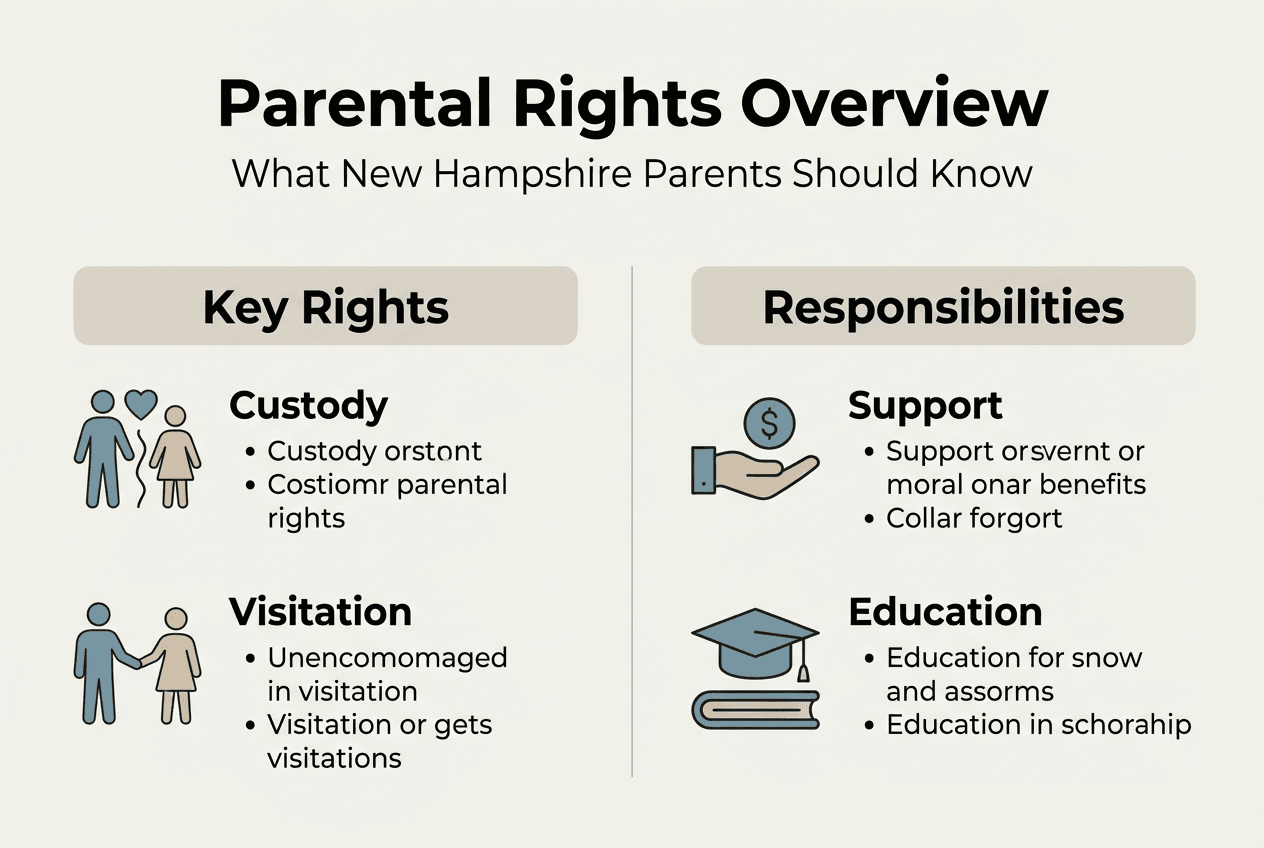
When courts evaluate parental rights cases, they examine multiple dimensions of your relationship with your child. Physical custody determines where your child lives day to day. Legal custody governs who makes major decisions about education, healthcare, and religious upbringing. Visitation rights establish when and how noncustodial parents spend time with their children. Financial support obligations ensure both parents contribute to raising their child.
New Hampshire courts allocate parental rights through several legal pathways:
- Divorce petitions that dissolve marriages with children
- Legal separation proceedings that maintain marriage while dividing parental duties
- Paternity actions establishing father child relationships
- Allocation petitions specifically addressing parental responsibilities
Each pathway requires courts to balance parental rights against child welfare. Judges possess broad discretion in crafting arrangements that serve children’s best interests. This means cookie cutter solutions rarely work. Your specific circumstances, including work schedules, living situations, and parenting capabilities, shape how courts structure your parental rights.
Pro Tip: Document every interaction, payment, and communication related to your children. Courts value evidence based arguments, and thorough records strengthen your position in any parental rights dispute.
Both parents retain fundamental rights and responsibilities even after separation or divorce. You cannot simply walk away from parental obligations because a relationship ends. Courts enforce these duties rigorously, recognizing that children depend on both parents for emotional and financial support. Understanding new parenting rights and responsibilities in NH helps you navigate evolving legal standards. Fathers’ rights in New Hampshire receive equal consideration under law, dispelling outdated assumptions about gender based custody preferences.
How child support works under New Hampshire law
Child support represents one of the most consequential aspects of parental rights in New Hampshire. Courts calculate support obligations using formulas that consider both parents’ incomes, the number of children, and parenting time arrangements. These calculations aim to ensure children maintain a standard of living consistent with both parents’ financial capabilities.
The child support process follows specific steps:
- Courts gather detailed financial information from both parents including wages, benefits, and other income sources
- Judges apply New Hampshire’s child support guidelines to calculate presumptive support amounts
- Courts consider deviations based on special circumstances like medical expenses or educational needs
- Final orders specify payment amounts, schedules, and methods
- Enforcement mechanisms activate if parents fail to comply with orders
New Hampshire courts have broad discretion in reviewing child support orders. This discretion means judges can adjust support based on changing circumstances, but they rarely overturn existing orders without compelling evidence. You cannot simply request modifications because you dislike the current arrangement. Courts require substantial changes in income, parenting time, or child needs to justify adjustments.

Parents must actively communicate about employment changes affecting support obligations. If you lose your job, receive a promotion, or experience significant income shifts, notify your co parent and the court promptly. Failure to comply with child support orders can result in arrearages and enforcement actions. Courts take noncompliance seriously, deploying wage garnishment, license suspension, and even contempt proceedings against delinquent parents.
| Support Factor | Impact on Calculation |
|---|---|
| Gross income | Primary determinant of support obligation |
| Parenting time percentage | Adjusts obligation based on overnight stays |
| Health insurance costs | Added to base support amount |
| Childcare expenses | Shared proportionally between parents |
| Extraordinary medical needs | May increase support beyond guidelines |
Pro Tip: Keep detailed records of all child support payments, including dates, amounts, and payment methods. If disputes arise about payment history, documentation proves invaluable in court proceedings.
Understanding child support calculations in New Hampshire requires familiarity with both statutory guidelines and judicial interpretations. Recent legal changes affecting equal parenting and child support have shifted how courts approach shared custody arrangements. When parents split time more evenly, support calculations become more nuanced, reflecting reduced residential expenses for the higher earning parent.
Resolving custody and parental rights disputes in New Hampshire courts
Disagreements about parental rights inevitably arise during separation or divorce. New Hampshire courts provide structured processes for resolving these disputes while protecting children from prolonged conflict. Understanding how these proceedings work helps you advocate effectively for your parental rights.
Common parental rights disputes include:
- Physical custody arrangements determining where children primarily reside
- Legal custody decisions about major life choices for children
- Visitation schedules and holiday parenting time
- Child support payment amounts and modification requests
- Education decisions including school choice and special services
- Medical treatment authorization and healthcare decisions
Courts consider divorce, annulment, separation, paternity, or allocation petitions when deciding support and education matters. Each petition type triggers specific procedural requirements and timelines. Divorce petitions address all aspects of dissolving a marriage, including parental rights division. Paternity actions establish father child relationships and accompanying rights and responsibilities. Allocation petitions focus specifically on parenting arrangements without addressing marital status.
New Hampshire courts employ a multistep approach to resolving parental rights disputes. Initial filings trigger mandatory disclosure of financial information and proposed parenting plans. Many courts require mediation before proceeding to contested hearings. Mediation allows parents to negotiate agreements with neutral facilitator assistance, often producing better outcomes than adversarial litigation.
If mediation fails, cases proceed to evidentiary hearings where both parents present testimony and evidence supporting their positions. Judges evaluate numerous factors when determining custody and parental rights arrangements. Child preference carries weight when children reach sufficient age and maturity to express reasoned opinions. Parental fitness, including mental health, substance abuse history, and caregiving capabilities, heavily influences decisions. Geographic proximity affects practical custody arrangements. Sibling relationships factor into keeping children together when possible.
| Dispute Resolution Method | Advantages | Considerations |
| — | — |
| Mediation | Cost effective, preserves co parenting relationship, faster resolution | Requires good faith negotiation, not suitable for abuse cases |
| Collaborative law | Team approach with attorneys and specialists, creative solutions | Both parties must commit to process, can be expensive |
| Litigation | Clear legal standards, binding court orders, appeals available | Adversarial, expensive, damages co parenting relationship |
Courts balance parental rights against child welfare throughout dispute resolution. You possess fundamental rights to maintain relationships with your children, but these rights yield when they conflict with child safety or wellbeing. Judges make difficult decisions weighing competing interests, often with incomplete information and tight timelines.
Understanding custody importance in New Hampshire helps you appreciate what’s at stake in these proceedings. The parental rights legal process involves multiple stages, each with specific requirements and strategic considerations. Professional legal guidance proves essential for navigating this complex terrain effectively.
Practical tips for protecting your parental rights in New Hampshire
Protecting your parental rights requires proactive planning and consistent attention to legal obligations. These practical strategies help you maintain strong legal standing while prioritizing your children’s needs.
Document everything related to your parenting relationship. Keep copies of custody orders, support payment receipts, medical records, school communications, and text messages with your co parent. Courts rely heavily on documentation when disputes arise. Parents who maintain organized records consistently fare better in legal proceedings than those relying on memory or verbal agreements.
Communicate changes promptly and transparently. Parents are required to notify each other of employment changes per court orders. Beyond legal requirements, good communication prevents misunderstandings that escalate into costly disputes. Use written communication methods like email or co parenting apps that create permanent records. Avoid heated exchanges that could be used against you in court.
Consider mediation before rushing to litigation. Court battles damage co parenting relationships and traumatize children caught in the middle. Mediation offers a less adversarial path to resolving disagreements while preserving your ability to work together as parents. Many disputes that seem irreconcilable in the heat of conflict become manageable with neutral facilitator guidance.
Prioritize consistency in your parenting approach:
- Maintain regular visitation schedules even when inconvenient
- Attend school events, medical appointments, and extracurricular activities
- Pay child support on time every month without exception
- Follow court orders precisely, even provisions you disagree with
- Support your child’s relationship with the other parent
Pro Tip: Never use your children as messengers for adult communications or involve them in parental disputes. Courts view this behavior as harmful to children and it damages your credibility in custody proceedings.
Seek experienced legal counsel early in any parental rights matter. Family law in New Hampshire involves nuanced statutes, evolving case law, and local court practices that vary by jurisdiction. Attorneys familiar with child custody tips for NH parents provide strategic guidance tailored to your situation. A qualified child custody lawyer in New Hampshire protects your rights while helping you avoid costly mistakes that could compromise your parental relationship.
Stay informed about your legal obligations and rights. Laws change, court interpretations evolve, and what worked for a friend’s case may not apply to yours. Invest time understanding New Hampshire family law basics so you can make informed decisions and recognize when you need professional help.
Need help with child custody or parental rights in New Hampshire?
Navigating parental rights and child custody matters requires specialized legal knowledge and strategic thinking. New Hampshire family law involves complex statutes, discretionary judicial decisions, and high stakes outcomes affecting your relationship with your children. Expert attorneys guide you through custody disputes, support modifications, and parental rights protection with personalized strategies tailored to your family’s unique circumstances.
Naro Law offers dedicated support for New Hampshire parents facing family law challenges. Our experienced team understands the emotional and legal complexities of custody battles, support disputes, and parental rights cases. We provide compassionate advocacy while pursuing favorable outcomes that protect your rights and your children’s best interests. Whether you need help with initial custody arrangements, support modifications, or enforcement actions, professional legal representation makes a meaningful difference.
Don’t navigate these critical decisions alone. A family law attorney in Manchester NH provides local expertise and court familiarity essential for effective representation. Our child custody lawyers in New Hampshire have successfully handled diverse family law cases across the state. Contact us today for a consultation to discuss your parental rights concerns and explore your legal options.
Frequently asked questions about parental rights in New Hampshire
What circumstances allow termination of parental rights in New Hampshire?
Courts terminate parental rights only in extreme cases involving abuse, neglect, abandonment, or unfitness. Termination represents the most severe family law action, permanently severing the legal parent child relationship. New Hampshire requires clear and convincing evidence that termination serves the child’s best interest and that parents have failed to remedy serious deficiencies despite intervention opportunities.
How does physical custody differ from legal custody in New Hampshire?
Physical custody determines where your child lives and which parent handles day to day care decisions. Legal custody governs major life decisions about education, healthcare, and religious upbringing. Parents can share both types of custody, or courts may award one parent primary physical custody while maintaining joint legal custody. These arrangements depend on your specific circumstances and your child’s needs.
Can unmarried parents in New Hampshire establish formal parenting plans?
Unmarried parents absolutely can and should establish formal parenting plans through New Hampshire courts. Paternity actions create legal father child relationships and allow courts to issue custody, visitation, and support orders. Without formal court orders, unmarried parents lack legal protections and enforcement mechanisms if disputes arise. Understanding why unmarried New Hampshire parents need parenting plans helps you protect your parental rights from the start.
How long must a father be absent before losing parental rights in New Hampshire?
New Hampshire does not specify an automatic timeframe for abandonment based termination of parental rights. Courts evaluate the totality of circumstances, including reasons for absence, efforts to maintain contact, and financial support provision. Simply being physically absent does not automatically terminate rights. However, prolonged absence combined with failure to support or communicate can support termination petitions. Learn more about father absence and parental rights in NH to understand these nuanced standards.
What happens if my co parent violates our custody order?
Custody order violations allow you to file contempt motions asking courts to enforce existing orders. Courts can impose sanctions including makeup parenting time, attorney fee awards, and in serious cases, custody modifications or criminal penalties. Document violations thoroughly with dates, times, and specific details. Consistent pattern violations carry more weight than isolated incidents. Always seek court intervention rather than taking self help measures that could backfire legally.
Recommended
- Parental rights legal workflow in New Hampshire: 2026 guide
- Understanding New Parenting Rights And Responsibilities In New Hampshire: A Guide To Recent Legal Changes
- How Long Does a Father Have to Be Absent to Lose His Rights in New Hampshire? – Naro Law
- Criminal Records & Parental Rights in New Hampshire


