

TL;DR:
- Prenups are legal contracts that protect assets, debts, and financial interests before marriage.
- They cannot determine child custody or child support in New Hampshire courts.
- Creating a valid prenup requires full disclosure, independent legal advice, and proper signing before marriage.
Many couples planning a wedding in New Hampshire assume that prenuptial agreements are reserved for celebrities, business moguls, or people entering their second or third marriage. That assumption is wrong, and it leads many everyday couples to skip a conversation that could protect them both. A prenup is a legal contract created before marriage that lists each person’s property and outlines rights during the marriage and after it ends, whether by divorce or death. This article walks you through what prenups are, what they can and cannot cover under New Hampshire law, and how to create one that actually holds up.
Table of Contents
- What is a prenuptial agreement?
- Key benefits of having a prenup
- What can (and can’t) a prenuptial agreement cover in New Hampshire?
- Steps to create a valid prenuptial agreement in New Hampshire
- What most couples misunderstand about prenups in New Hampshire
- Next steps: Expert guidance on prenuptial agreements in New Hampshire
- Frequently asked questions
Key Takeaways
| Point | Details |
|---|---|
| Clarity and protection | A prenuptial agreement provides clear direction for handling finances and assets in marriage and divorce or death. |
| State-law limits | New Hampshire restricts prenuptial agreements on child custody and support, leaving those decisions to the courts. |
| Valuable for all couples | Prenups are not just for the wealthy; any couple can benefit from proactive financial and legal planning. |
| Professional guidance matters | Working with an attorney ensures your prenup is enforceable and personalized to your needs. |
What is a prenuptial agreement?
A prenuptial agreement, commonly called a prenup, is a written contract that two people sign before getting married. It spells out how assets, debts, and financial matters will be handled both during the marriage and if the marriage ends. Think of it as a financial roadmap that both partners agree on before combining their lives.
Understanding prenuptial agreement basics helps clear up one of the biggest myths: that prenups are only for the wealthy. In reality, any couple with property, savings, student loans, a business, or children from a prior relationship can benefit from having one. Even modest financial situations benefit from clarity.
“A prenuptial agreement is a legally binding contract that two people sign before marriage to decide how financial matters will be handled during the marriage and if the marriage ends.”
Here is what a prenuptial agreement can typically address:
- Separate property: Assets each person owned before the marriage and wants to keep separate
- Marital property: How property acquired during the marriage will be divided
- Debt responsibility: Who is responsible for debts brought into the marriage or accumulated during it
- Spousal support: Whether alimony will be paid, and under what conditions
- Business interests: Protecting a business one partner owns or co-owns
- Inheritance rights: How assets will pass to children or other heirs
A prenup does not mean you expect the marriage to fail. It means you and your partner are approaching your future together with honesty and preparation.
Key benefits of having a prenup
With a solid grasp of what a prenup is, it is worth exploring what makes them genuinely useful, especially for everyday couples in New Hampshire.
The most direct benefit is asset protection. Protecting assets with a prenup ensures that property you owned before the marriage, such as a home, investment account, or family inheritance, does not automatically become subject to division if the marriage ends. Without a prenup, New Hampshire’s equitable distribution rules give courts significant discretion over how marital assets are divided.

Debt protection is equally important. If your partner carries significant student loans or credit card debt, a prenup can specify that those obligations remain theirs alone. This protects your credit and financial standing if things go wrong.
Here are several practical benefits couples often overlook:
- Clarity for blended families: If either partner has children from a previous relationship, a prenup can protect assets intended for those children
- Faster, less expensive divorce proceedings: Agreed-upon terms reduce the time attorneys spend negotiating, which directly lowers legal costs
- Reduced conflict: Knowing in advance how finances will be handled removes a major source of tension during an already difficult time
- Business protection: A prenup can prevent a spouse from claiming an ownership stake in a business you built before or during the marriage
- Estate planning alignment: Prenups can work alongside wills and trusts to ensure your wishes are honored
Pro Tip: Have an open, honest financial conversation with your partner before meeting with an attorney. Couples who discuss money, debts, and financial goals openly before drafting a prenup tend to reach agreement faster and with far less stress.
What can (and can’t) a prenuptial agreement cover in New Hampshire?
Understanding the benefits, couples often wonder about what exactly a prenup can and cannot do, particularly under New Hampshire law.
New Hampshire courts will generally enforce a prenup that is fair, voluntary, and based on full financial disclosure. However, there are clear limits on what these agreements can address.
| What a prenup CAN cover | What a prenup CANNOT cover |
|---|---|
| Division of premarital assets | Child custody arrangements |
| Spousal support (alimony) terms | Child support obligations |
| Debt allocation between spouses | Provisions that encourage divorce |
| Business ownership and valuation | Anything illegal or against public policy |
| Inheritance and estate distribution | Personal lifestyle clauses (generally unenforceable) |
| Property acquired during marriage | Waiving rights to public benefits |
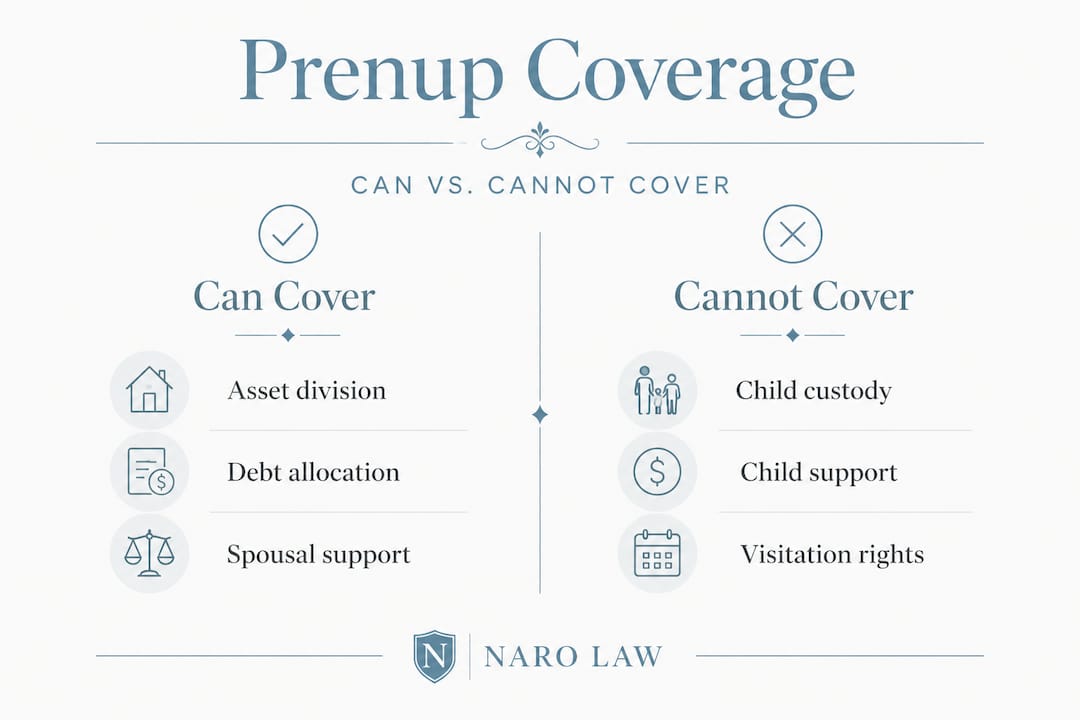
One of the most important things to understand about prenup legal boundaries in New Hampshire is how courts treat child-related provisions. Courts in New Hampshire will not enforce prenup clauses that attempt to predetermine child custody or child support. These matters are decided based on the best interests of the child at the time of the divorce, not based on what parents agreed to years earlier.
This is not a loophole or a flaw. It reflects a deliberate legal principle: children’s needs change, and no contract signed before they were even born can adequately account for those future needs. If you have questions about how child custody agreements work in New Hampshire, it is worth reviewing that process separately.
Pro Tip: Even if you and your partner have already discussed how you would handle custody, do not include those terms in your prenup expecting them to be binding. Talk to your attorney about how to address parenting intentions in a way that is legally appropriate.
Steps to create a valid prenuptial agreement in New Hampshire
Once you know what areas a prenup can cover, here is the straightforward process for creating one in New Hampshire.
- Full financial disclosure: Both partners must fully disclose their assets, debts, income, and financial obligations. Hiding assets can invalidate the entire agreement later.
- Hire separate attorneys: Each partner should have their own independent legal counsel. This protects both parties and strengthens the agreement’s enforceability.
- Negotiate terms together: Work through the key areas, including asset division, debt responsibility, and spousal support, with input from both partners and their attorneys.
- Draft the agreement: Your attorney will draft a formal document that complies with New Hampshire law. This includes precise legal language to ensure clarity and enforceability.
- Review carefully: Both partners should read the entire document and raise any concerns before signing. Do not rush this step.
- Sign and notarize before the wedding: A prenup must be signed by both parties before the marriage takes place. Notarization adds an additional layer of legal protection.
The table below summarizes the legal requirements versus best practices:
| Requirement | Legal minimum | Best practice |
|---|---|---|
| Written form | Required | Required |
| Signed by both parties | Required | Required |
| Financial disclosure | Required | Full and detailed |
| Independent legal counsel | Not required but strongly advised | Strongly recommended |
| Signed before marriage | Required | Well before the wedding date |
| Notarization | Recommended | Always include |
| Review period | Not specified | Allow at least 30 days |
If you are ready to move forward, find a NH prenup attorney who can guide you through each step and ensure your agreement is built to last.
What most couples misunderstand about prenups in New Hampshire
After reviewing the facts and the process, there is one thing worth saying plainly: the biggest obstacle to getting a prenup is not legal complexity. It is the emotional weight that couples attach to the conversation.
Many people believe that asking for a prenup signals a lack of trust or confidence in the relationship. But prenups are increasingly seen as a tool for transparency and responsible planning, not as a sign of mistrust. The couples who struggle most after a divorce are often the ones who never had direct conversations about money, expectations, or financial boundaries.
In our experience working with New Hampshire families, the couples who approach a prenup as a shared planning exercise tend to enter marriage with stronger communication habits. They have already practiced having difficult conversations. That skill matters far more than the document itself.
Understanding when a prenup makes sense is not about anticipating failure. It is about acknowledging that life is unpredictable, and that two people who respect each other enough to plan honestly are better positioned to handle whatever comes next. Many couples who did not create a prenup wish they had, not because their marriage failed, but because the absence of clear agreements created unnecessary stress during major financial decisions throughout their marriage.
Next steps: Expert guidance on prenuptial agreements in New Hampshire
If you see the value in thoughtful planning, the right next step is connecting with a professional who can tailor advice for your unique situation.
At Naro Law, we help New Hampshire couples create prenuptial agreements that are clear, fair, and legally sound. A valid prenup requires more than a template downloaded from the internet. It requires full financial disclosure, careful drafting, and proper execution under New Hampshire law. Getting it right from the start protects both of you.
Whether you are just beginning to explore the idea or you are ready to move forward, our team is here to help. Learn more about prenuptial agreement legal help or review a broader overview of New Hampshire family law to understand how prenups fit into the larger picture. Schedule a free consultation today and take the first step toward a well-planned future together.
Frequently asked questions
Is a prenuptial agreement legally enforceable in New Hampshire?
Yes, a prenup is generally enforceable in New Hampshire if it is written, signed by both parties before marriage, and based on full financial disclosure. Courts may set aside an agreement that was signed under duress or without proper disclosure.
Can you include child custody or child support in a prenuptial agreement in NH?
Generally, child custody provisions in a prenup are not legally binding in New Hampshire, because courts decide custody based on the child’s best interests at the time of the divorce, not on prior agreements.
How much does it cost to get a prenuptial agreement in New Hampshire?
Costs vary depending on the complexity of your financial situation and the attorneys involved, but investing in a well-drafted agreement now can prevent significantly higher legal costs if the marriage ends without one.
What happens if we don’t have a prenup?
Without a prenup, New Hampshire law determines how property and debts are divided if the marriage ends, which may not reflect what either partner would have chosen on their own.


