

TL;DR:
- Preparing for divorce in New Hampshire involves meeting residency requirements, filing correct forms, and completing mandatory disclosures. The process requires careful adherence to steps like serving the spouse and fulfilling parenting program obligations, which affect the timeline and outcome. Early organization of financial records and understanding the law can prevent delays, especially when minor children are involved.
Preparing for divorce in NH means meeting specific legal requirements, filing the correct forms, and completing mandatory disclosures before a court will finalize your case. New Hampshire handles divorce through the NH Circuit Court Family Division under RSA 458, and the process covers everything from residency verification to financial affidavit exchanges and parenting program completion. There is no mandatory separation period before filing, which sets New Hampshire apart from many other states. Understanding each step before you begin protects your rights and reduces costly delays.
What are the residency requirements and grounds for filing divorce in New Hampshire?
New Hampshire requires at least one spouse to be domiciled in the state before filing for divorce. Domicile means more than just living there. It requires physical presence combined with the intent to make New Hampshire your permanent home.
Domicile requires intent to establish a permanent residence, supported by evidence such as a New Hampshire driver’s license, voter registration, or property ownership. Courts look at the full picture, not just one document. If both spouses live in New Hampshire, there is no minimum residency waiting period before filing.

The most common ground for divorce in New Hampshire is irreconcilable differences, a no-fault standard that requires no proof of wrongdoing. No-fault divorce is faster, less expensive, and less adversarial than fault-based grounds. Fault-based options do exist, including adultery, extreme cruelty, and abandonment, but they add complexity and cost without guaranteeing a better outcome.
Key facts about eligibility:
- Both spouses are NH residents: no minimum waiting period applies
- One spouse is an out-of-state resident: the NH spouse must still meet domicile requirements under RSA 458:5
- No mandatory separation period before filing
- Irreconcilable differences cannot be denied by the other spouse to block the divorce
Pro Tip: Gather proof of domicile early. A current NH driver’s license and voter registration card together make a strong case for residency.
How to file for divorce in New Hampshire: steps, forms, and fees
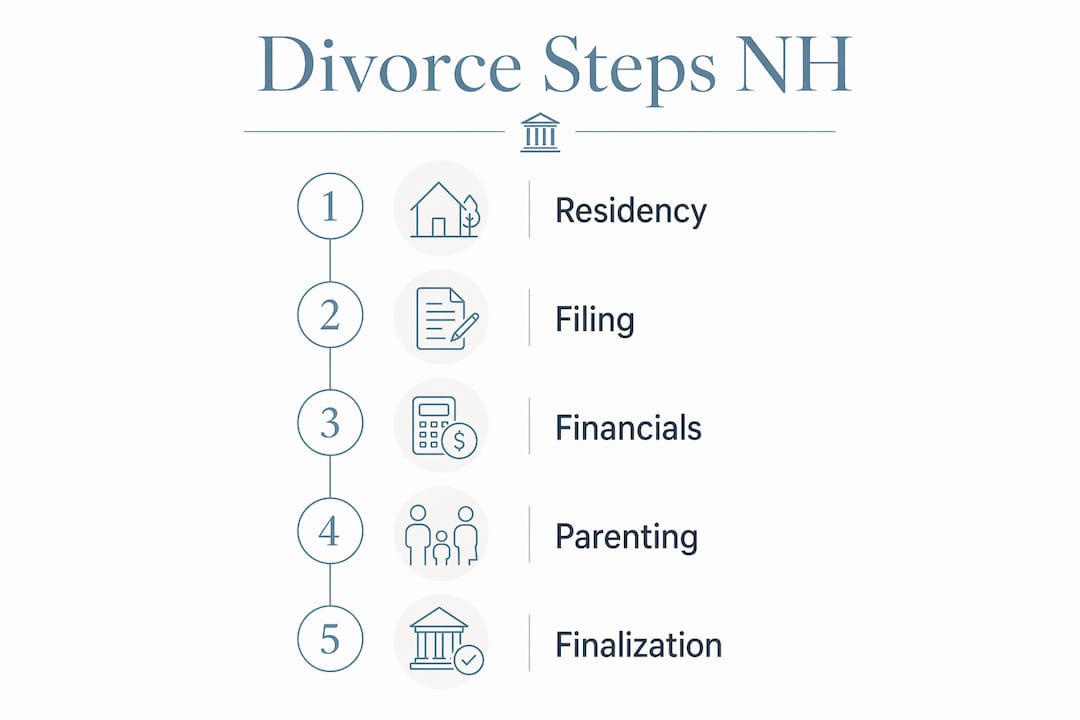
Filing correctly the first time prevents delays and additional court fees. The NH Circuit Court Family Division accepts both joint petitions and individual petitions, and the path you choose affects cost, timing, and service requirements.
Follow these steps to file:
- Choose your petition type. A joint petition means both spouses agree to file together. An individual petition means one spouse files and the other must be formally served.
- Complete required forms. The core documents are the Petition for Divorce and the Personal Data Sheet. Additional forms apply if minor children are involved.
- Serve the other spouse (individual petitions only). Service of process can be completed by a sheriff or an authorized process server. This step adds cost and time.
- Pay the filing fee. Filing fees are $250 without minor children and $282 with minor children as of 2026. A 3% surcharge applies to electronic payments.
- Request a fee waiver if needed. Financial hardship fee waivers are available through the court. You must submit a separate application with supporting financial documentation.
- File electronically or in person. Electronic filing is available and accepted by the court.
Joint petitions save costs by eliminating the service of process requirement entirely. They also signal an amicable resolution, which courts tend to schedule more efficiently.
Pro Tip: Double-check every form for accuracy before submitting. Incomplete or incorrect filings are returned, which delays your first court date by weeks.

What financial preparations and disclosures are required for a New Hampshire divorce?
Financial transparency is not optional in a New Hampshire divorce. Full financial disclosure of income, expenses, assets, and debts is required by court rules, and the accuracy of these disclosures directly shapes property division and support decisions.
Both spouses must complete and exchange Financial Affidavits. These documents cover:
- All sources of income, including wages, self-employment, and investment returns
- Monthly living expenses and recurring debts
- Bank and investment account statements
- Real estate holdings and mortgage balances
- Retirement accounts and pension plans
Financial affidavits must be exchanged within 45 days of service or 10 days before the first hearing, whichever comes first. Missing this deadline can result in court sanctions or rulings that favor the other party.
Incomplete financial disclosures can severely hinder your case. Courts place equal weight on honesty and accuracy. A missing retirement account or underreported income stream does not go unnoticed, and judges have broad authority to sanction parties who file incomplete affidavits.
New Hampshire follows equitable distribution principles, meaning the court divides marital property fairly but not necessarily equally. Accurate disclosures give you the best foundation for a fair outcome. If retirement accounts are part of your marital estate, reviewing how retirement accounts are handled in NH divorces is worth your time before the first hearing.
How does divorce affect parenting responsibilities and what programs must parents complete?
When minor children are involved, New Hampshire divorce law adds specific requirements that both parents must fulfill. These requirements exist to protect children during a difficult transition, and courts enforce them without exception.
Parents with minor children must complete the following:
- Child Impact Program: This is a mandatory four-hour program covering co-parenting skills and child adjustment strategies. The program costs approximately $80 per parent and must be completed within 45 days of service. Completion certificates are required before the court will finalize the divorce.
- Parenting plan submission: Both parents must submit a parenting plan that addresses physical custody, legal custody, and a visitation schedule.
- Child support calculation: New Hampshire uses an income shares model to calculate child support, based on the combined income of both parents. The minimum monthly support order is $50.
The court applies a best interest of the child standard when deciding custody disputes. Factors include each parent’s relationship with the child, the child’s adjustment to home and school, and each parent’s ability to support the child’s relationship with the other parent. Reviewing a child custody negotiation guide before your first hearing gives you a clearer picture of what to expect.
What are the typical timelines for uncontested vs. contested divorces in NH?
Knowing how long your divorce will take helps you plan financially and emotionally. The timeline depends almost entirely on whether both spouses agree on the major issues.
| Divorce Type | Typical Timeline | First Court Appearance |
|---|---|---|
| Uncontested | 2–6 months | 4–8 weeks after filing |
| Contested | 8–14 months | 4–8 weeks after filing |
Uncontested divorces finalize in 2–6 months, while contested cases can stretch to 8–14 months. The first court appearance is typically scheduled 4–8 weeks after filing in both cases.
Mediation is available and strongly encouraged for contested cases. Mediation often leads to faster, less costly resolutions compared to a full trial. Mediators are neutral third parties who help both spouses reach agreement on property, support, and parenting issues outside the courtroom.
After the court approves a final agreement, a nisi period applies before the divorce becomes absolute. This is a short waiting period built into New Hampshire law before the decree takes full legal effect.
Pro Tip: If you and your spouse agree on the core issues, a joint petition is the single fastest way to finalize your divorce. It cuts procedural steps and often results in earlier court scheduling.
Key takeaways
Preparing for divorce in New Hampshire requires meeting domicile requirements, filing accurate forms, completing mandatory financial disclosures, and fulfilling parenting obligations before the court will issue a final decree.
| Point | Details |
|---|---|
| Residency requirement | At least one spouse must be domiciled in New Hampshire with intent to remain permanently. |
| Filing fees | Fees are $250 without children and $282 with children; fee waivers are available for hardship. |
| Financial affidavit deadline | Exchange affidavits within 45 days of service or 10 days before the first hearing. |
| Child Impact Program | Mandatory for parents with minor children; costs approximately $80 per parent and takes four hours. |
| Timeline expectations | Uncontested cases close in 2–6 months; contested cases typically take 8–14 months. |
What I’ve learned about divorce preparation in New Hampshire
After working with clients through New Hampshire divorce cases, the single biggest mistake I see is waiting too long to organize financial records. People assume they have time after filing. They do not. The 45-day financial affidavit deadline arrives fast, and scrambling to locate retirement statements or reconstruct three years of bank records under pressure leads to errors that courts notice.
The second mistake is underestimating the parenting program requirement. The Child Impact Program is not optional, and courts will not schedule a final hearing without the completion certificate. Parents who treat it as an afterthought end up delaying their own case.
My honest recommendation: if there is any chance you and your spouse can agree on the major issues, pursue a joint petition. The time and cost savings are real, and the process is far less adversarial for everyone involved, especially children. Consulting with an experienced New Hampshire family law attorney before you file, not after, gives you the clearest picture of what to expect and what to protect.
— Rich
How Narolaw supports your divorce preparation in New Hampshire
Narolaw is a New Hampshire-based family law practice that guides clients through every stage of the divorce process, from initial case evaluation to final decree. The team helps clients organize financial disclosures, understand their rights under RSA 458, and build parenting plans that hold up in court. Whether your case is straightforward or contested, having experienced legal support from the start reduces errors and protects your interests. Learn more about NH divorce and custody services or schedule a free consultation to discuss your specific situation with a Narolaw attorney.
FAQ
What are the residency requirements to file for divorce in NH?
At least one spouse must be domiciled in New Hampshire, meaning they live there with the intent to remain permanently. If both spouses are NH residents, there is no minimum waiting period before filing.
How much does it cost to file for divorce in New Hampshire?
Filing fees are $250 without minor children and $282 with minor children as of 2026. A 3% surcharge applies to electronic payments, and fee waivers are available for financial hardship.
Is the Child Impact Program required for all divorcing parents in NH?
Yes. Parents with minor children must complete the four-hour Child Impact Program within 45 days of service. The program costs approximately $80 per parent, and the completion certificate is required before the court finalizes the divorce.
How long does a divorce take in New Hampshire?
Uncontested divorces typically finalize in 2–6 months. Contested divorces can take 8–14 months depending on the complexity of the issues and court scheduling.
What happens if I miss the financial affidavit deadline?
Missing the 45-day deadline for exchanging financial affidavits can result in court sanctions or rulings that favor the other party. Courts treat financial disclosure deadlines as strictly enforced obligations.


