

TL;DR:
- Victims of domestic violence, harassment, or stalking in New Hampshire can seek protective orders.
- Preparing a detailed, evidence-backed petition improves chances of approval and swift court action.
- The process includes filing, emergency orders, hearings, and potential modifications or appeals.
Seeking a restraining order in New Hampshire can feel urgent and confusing at the same time. You may be dealing with fear, uncertainty about legal forms, and pressure to act fast. Many people are unsure where to start, what the courts expect, or how long the process takes. This guide walks you through every step of the restraining order workflow in New Hampshire, from understanding your eligibility to standing in court, so you can move forward with clarity and confidence.
Table of Contents
- Understanding restraining orders: Who qualifies and why
- Gathering documentation and preparing your petition
- Filing and serving the restraining order: What to expect
- The hearing and after: Courtroom tips and next steps
- Why detailed evidence can make or break your restraining order case
- Get legal help and guidance for your restraining order
- Frequently asked questions
Key Takeaways
| Point | Details |
|---|---|
| Eligibility clarified | Restraining orders are available under NH law for domestic violence or stalking situations and can cover minors through guardians. |
| Evidence is crucial | A detailed, well-documented affidavit will strengthen your petition and reduce chances of denial. |
| Court process outlined | Filing is free, involves precise paperwork, and leads to a hearing where both sides can present their case. |
| Orders can be modified | Parties can ask the court to change, end, or appeal an order if circumstances evolve. |
Understanding restraining orders: Who qualifies and why
Before filing anything, it helps to understand what kind of protective order fits your situation. New Hampshire law provides two primary paths. The first is under RSA 173-B, which covers domestic violence situations involving family members, household members, or intimate partners. The second is under RSA 633:3-a, which addresses stalking and harassment by someone who may not share a household with you.
Who can file? Victims of family violence, intimate partner abuse, or stalking are all eligible. Minors may file through a parent or guardian. You do not need to be married to the person causing harm. You do not need to have lived with them either, in many stalking cases.
Situations that typically warrant a restraining order include:
- Ongoing physical violence or credible threats
- Repeated harassment or unwanted contact
- Stalking behavior, whether in person or online
- Sexual assault by a known person
Important: The protective order process in New Hampshire begins with filing a petition at your local Circuit Court, and there is no filing fee for protective order petitions.
Respondents, meaning the person the order is filed against, do have rights in this process. They can contest the order at the hearing stage. Orders can also be modified or terminated later if circumstances change.
Gathering documentation and preparing your petition
Once you know you’re eligible, preparation is critical. A weak or vague petition is one of the most common reasons for delays or denials. Courts need specifics, not general descriptions of feeling unsafe.
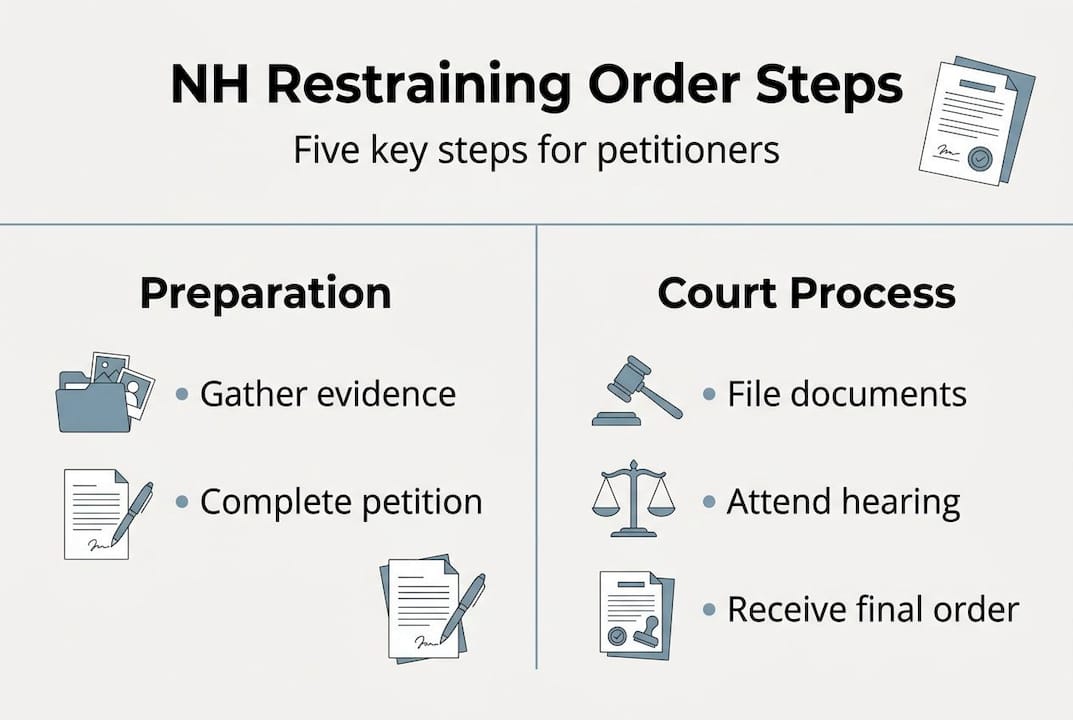
Here is a step-by-step approach to building a strong petition:
- Collect all evidence. Gather text messages, emails, voicemails, photos of injuries, and any police reports related to incidents.
- Write down every incident. Include dates, locations, what was said or done, and any witnesses present.
- Obtain the correct forms. Forms are available at your local courthouse or through the NH Judicial Branch website. As noted in filing your petition, the petition includes a detailed affidavit where you describe each incident clearly.
- Write a detailed affidavit. This is your written account of events. Be factual, specific, and chronological.
- Organize everything before you go to court. Bring copies of all documents.
Pro Tip: Courts in New Hampshire use a preponderance of evidence standard, meaning your account just needs to be more likely true than not. A specific, well-documented affidavit significantly improves your chances of approval without delays.
| Evidence type | Strength level | Notes |
|---|---|---|
| Police reports | High | Official records carry significant weight |
| Text/email records | High | Screenshots with timestamps are ideal |
| Witness statements | Medium | Written statements preferred |
| Personal journal entries | Medium | Useful to establish a pattern |
| Verbal descriptions only | Low | Hard to verify without corroboration |
Understanding the difference between emergency vs. final restraining orders also helps you know what to expect at each stage of the process.
Filing and serving the restraining order: What to expect
Armed with your completed paperwork, here’s what comes next at the courthouse. You will file your petition at the Circuit Court in the county where you live. There is no filing fee for this type of petition, which removes a common barrier for people in difficult financial situations.
After you file, a judge will review your petition, often the same day. If the judge finds sufficient cause, a temporary restraining order (TRO) may be issued immediately. This order is enforceable right away, even before the respondent is notified.
Key things that happen after filing:
- The court arranges service of the order on the respondent, usually through law enforcement
- The respondent is notified of the hearing date
- You receive a copy of the temporary order to keep with you at all times
- A full hearing is scheduled, typically within 30 days
This step matters enormously. About 33.4% of New Hampshire women have experienced intimate partner violence, which reflects just how many people need these protections. Acting promptly after an incident gives the court the clearest picture of the threat you face.
For additional support during this stage, domestic violence resources in New Hampshire can connect you with advocates who understand the court system and can accompany you. Understanding the difference between emergency vs. final orders will also help you prepare for what comes next.
The hearing and after: Courtroom tips and next steps
Once your petition is filed and served, the court will schedule a critical hearing. This is where both sides appear before a judge, and the final protective order decision is made. Being prepared for this moment is essential.
Here is what to expect and how to handle it:
- Bring all your evidence. Printed texts, emails, photos, and police reports should be organized and ready to present.
- Be clear and factual. Stick to specific incidents. Avoid emotional language that may distract from the facts.
- Expect the respondent to appear. They have the right to contest the order and present their own account.
- Listen to the judge’s questions carefully. Answer directly and honestly.
- Know your outcome options. The judge may grant a final order, deny the petition, or continue the hearing.
Remember: Even if an order is granted, staying alert matters. Violations are strictly enforced under New Hampshire law, but respondents do retain defense rights at the hearing stage.
Pro Tip: If you are denied, you are not out of options. You can modify or appeal a restraining order through the court if new evidence emerges or circumstances change significantly.
If the order is granted, keep a certified copy with you at all times. Provide copies to your employer, your children’s school, and anyone else who may need to enforce it.

Why detailed evidence can make or break your restraining order case
Here is something many people don’t realize: not all restraining order petitions are approved. There is a common belief that filing automatically leads to protection. That is not how New Hampshire courts operate.
Judges need credible, well-documented claims. A specific affidavit is often the single most important factor separating a swift approval from a frustrating denial. Vague statements like “he scares me” carry far less weight than a dated account of a specific incident with corroborating evidence.
Over-preparing is not a waste of time. It is the smartest strategy available to you. Courts that see thorough, organized documentation tend to act faster and with more confidence. Understanding NH domestic violence law gives you the context to frame your petition in the language courts respond to most effectively.
Get legal help and guidance for your restraining order
Navigating the restraining order process is manageable, but having experienced legal support makes it significantly less stressful. An attorney can help you prepare a strong petition, advise on what evidence matters most, and represent you at the hearing. At Naro Law, we understand the urgency of these situations and provide compassionate, skilled advocacy for clients across New Hampshire. Whether your situation involves NH family law, legal help for domestic violence, or related matters like child custody legal support, our team is ready to guide you through every step.
Frequently asked questions
What documents do I need for a restraining order in New Hampshire?
You need a completed petition, a detailed affidavit of incidents with dates and descriptions, and supporting evidence such as texts, emails, or police reports. Forms are available at the courthouse or online through the NH Judicial Branch.
How long does it take to get a restraining order in NH?
Temporary orders may be issued the same day you file. Final hearings are typically scheduled within 30 days, though exact timing depends on court scheduling and case complexity.
Can a restraining order be modified or appealed?
Yes. Either party can request to modify, terminate, or appeal an order through the court if circumstances change or new evidence becomes available.
What if the respondent violates a restraining order?
Violations are strictly enforced under New Hampshire law and can result in criminal penalties. Report any violation to law enforcement immediately and keep a record of what occurred.
Is there a fee to file a restraining order in New Hampshire?
No. There is no filing fee for protective order petitions filed at NH Circuit Courts, making the process accessible regardless of your financial situation.


