

TL;DR:
- Refusing a breathalyzer in New Hampshire now leads to longer license suspensions, especially after 2027.
- Most outdated advice on breathalyzer refusal no longer applies due to recent law changes.
- Consulting a qualified DUI defense attorney is crucial for current guidance and legal strategy.
New Hampshire drivers refuse breathalyzer tests at a rate of roughly 70% annually, a figure that is nearly three times the national average of 24% and the second highest in the country. For years, many drivers assumed that refusing the test was a smart move, a way to keep evidence out of court and protect themselves. That assumption is now dangerously outdated. Recent legislative changes have shifted the penalty landscape significantly, and what worked as a strategy five years ago could cost you far more today. This guide walks you through your rights, the real consequences of both choices, and what legal experts say you should know before you decide.
Table of Contents
- Understanding New Hampshire’s implied consent law
- Breathalyzer penalties: What happens if you refuse or take the test?
- Should you refuse a breathalyzer? Perspectives from law enforcement and defense
- Practical steps if you’re stopped for DUI in New Hampshire
- Why most advice about breathalyzer refusal in New Hampshire is outdated
- Connect with New Hampshire DUI defense experts
- Frequently asked questions
Key Takeaways
| Point | Details |
|---|---|
| Penalties are changing | Starting in 2027, refusing a breathalyzer will lead to a longer suspension than failing. |
| Both choices carry risks | Refusing or taking a breathalyzer can result in license loss and affect your DUI case. |
| Expert advice is critical | Laws change often, so consult an experienced NH defense attorney for case-specific guidance. |
| Know your rights | You must be informed of consequences, and you can ask questions and request a lawyer at a DUI stop. |
Understanding New Hampshire’s implied consent law
With so many drivers wondering what’s legal, let’s clarify the foundation: implied consent and your rights during a DUI stop.
Implied consent is a legal doctrine that says by choosing to drive on New Hampshire roads, you have already agreed in advance to submit to chemical testing if a law enforcement officer has probable cause to suspect you of driving under the influence. This is not a choice you make at the time of the stop. It is a condition built into your driving privilege the moment you get behind the wheel.
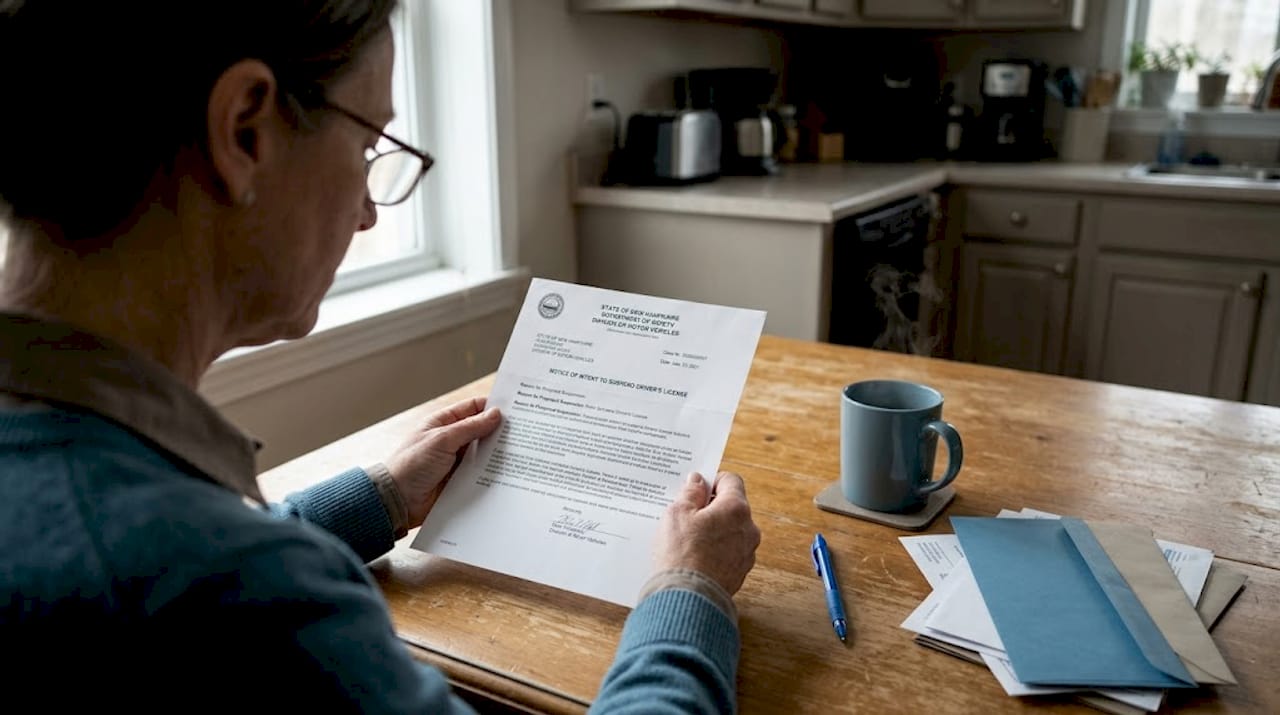
When an officer pulls you over on suspicion of DUI, they are required by law to inform you of the consequences of refusing the test. That notification is not optional, and failing to provide it can sometimes be used in your defense. Understanding your rights at DUI stops is the first step toward making an informed decision under pressure.
Here is a summary of your key rights during a DUI stop in New Hampshire:
- You have the right to ask what test is being requested (breath, blood, or urine) and why.
- You have the right to be informed of the consequences of refusing before you decide.
- You have the right to remain silent beyond providing your license, registration, and insurance.
- You have the right to request an attorney, though the officer is not obligated to wait indefinitely.
- You do not have the right to refuse the test without consequences. Refusal triggers automatic penalties under the implied consent law.
Law enforcement officials have been clear about their position. As Governor Ayotte’s office stated when pushing for legislative reform, refusal hinders prosecution and promotes impunity on the roads, which is why the state moved to make refusal more costly. The goal is to reduce drunk driving fatalities by eliminating the strategic advantage of refusing.
Pro Tip: Before you say anything beyond identifying yourself, ask the officer clearly: “What are the consequences if I refuse this test?” Their answer, and whether they provide it, is legally significant. Once you know the stakes, you can make a more informed choice and report accurately to your attorney.
If you are stopped and charged, learning how to protect your rights if charged with DUI in New Hampshire should be your immediate priority.
Breathalyzer penalties: What happens if you refuse or take the test?
Now that you understand the law, what are the real-world results of your choice to blow or not to blow? Here is how the penalties stack up.
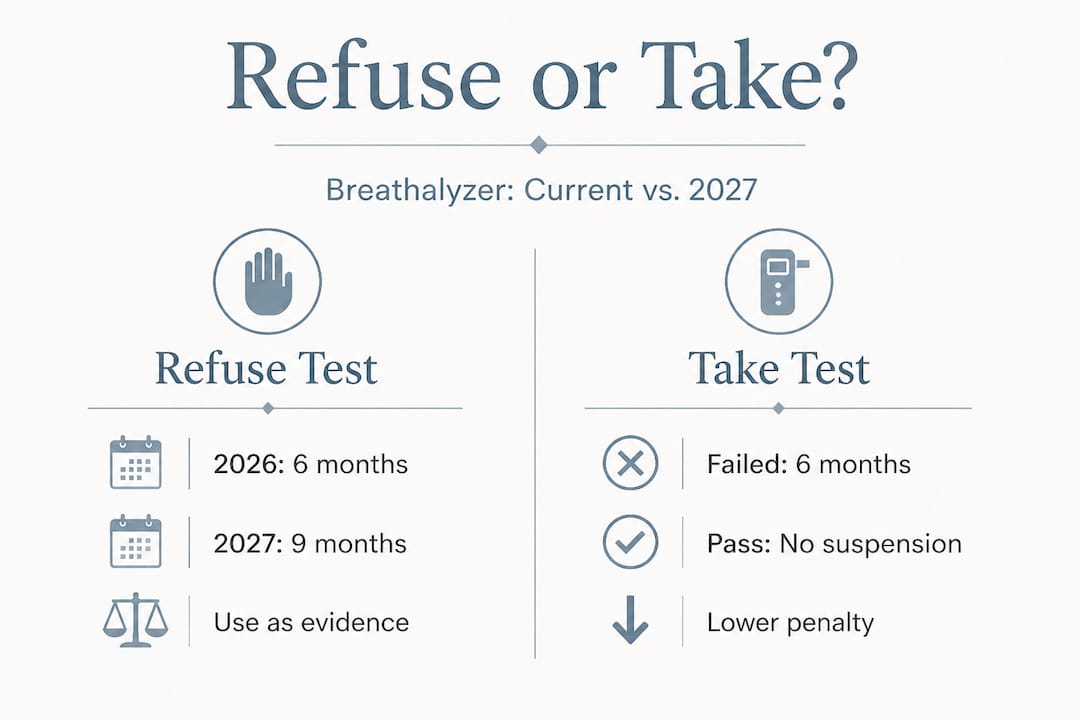
The comparison below reflects current law and the upcoming changes under SB 620, signed in April 2026 and taking effect January 1, 2027.
| Scenario | Current law (2026) | New law (from Jan 2027) |
|---|---|---|
| First refusal: license suspension | 180 days (6 months) | 270 days (9 months) |
| Subsequent refusal: license suspension | 2 years | 3 years |
| First offense DUI (BAC 0.08+): license suspension | 180 days (6 months) | 180 days (6 months, unchanged) |
| Refusal used as evidence in court | Yes | Yes |
| Criminal DUI charges still possible | Yes | Yes |
As the table shows, the new law SB 620 creates a clear imbalance: after January 2027, refusing the test will result in a longer license suspension than simply failing it. For a first offense, refusing will cost you three additional months of driving privileges compared to taking the test and failing.
New Hampshire’s roughly 70% refusal rate is extraordinary in context. The national average hovers around 24%, meaning NH drivers refuse at nearly three times the rate of the average American driver. This pattern developed because, historically, the penalties for refusing and failing were identical, removing the deterrent effect.
Beyond the license suspension, refusing the test carries additional consequences that many drivers do not anticipate:
- Your refusal can be introduced as evidence in a criminal DUI trial, allowing prosecutors to suggest consciousness of guilt.
- Judges and juries may draw negative inferences from your refusal, even without a positive BAC reading.
- You can still be convicted of DUI without a breathalyzer result, based on officer observations, field sobriety tests, and other evidence.
- Insurance companies may treat refusal similarly to a DUI conviction when calculating your premiums.
For a detailed breakdown of all NH DUI penalties and a closer look at the specific consequences of refusal, reviewing current resources before you face a stop is strongly advisable.
Should you refuse a breathalyzer? Perspectives from law enforcement and defense
With penalties evolving, what do authorities and top defense attorneys recommend? Here is what both sides argue.
Law enforcement’s position is straightforward. As officials noted when pushing for SB 620:
“Refusal to submit to a breathalyzer test hinders prosecution of impaired drivers, promotes a sense of impunity, and puts lives at risk on New Hampshire roads. The new law is designed to eliminate the loophole that made refusal an attractive option.”
Defense attorneys, however, offer a more nuanced view. Refusing breath or blood tests is not automatically a bad decision in every circumstance. The calculus depends heavily on the specific facts of your situation, including how much you have had to drink, the reliability of the equipment being used, and whether the officer followed proper procedure.
Here are circumstances where a defense attorney might advise refusal, though always after weighing the full picture:
- You are confident you are significantly over the legal limit. A high BAC reading creates strong evidence against you that is very difficult to challenge at trial.
- You have reason to believe the breathalyzer equipment is faulty or improperly calibrated. Documented equipment issues can sometimes support a defense, but only if the test result is excluded.
- The officer failed to properly inform you of your rights under the implied consent law, which may affect how refusal is treated legally.
- You have prior DUI convictions where a new positive test result would trigger significantly harsher mandatory penalties.
That said, even in these scenarios, the new law’s longer suspension period changes the math considerably. Consulting alcohol testing guidance and understanding how BAC testing works can also help you make a more informed choice.
Pro Tip: No matter what you decide about the breathalyzer, call a criminal defense attorney the moment you are able. The earlier you get counsel involved, the more options you have. Evidence fades, procedural deadlines are strict, and your attorney can sometimes challenge the stop itself before the breathalyzer result even becomes relevant.
Learning 7 ways to protect yourself during a DWI stop is practical preparation that every New Hampshire driver should do before they ever need it.
Practical steps if you’re stopped for DUI in New Hampshire
For those faced with the decision in real time, here is a set of clear steps to protect your rights and minimize risk.
The moments immediately following a traffic stop are high pressure and move quickly. Knowing what to do in advance can prevent costly mistakes.
- Stay calm and be polite. Confrontational behavior gives officers additional grounds for concern and does not help your case.
- Provide your license, registration, and proof of insurance without argument. These are legally required.
- Exercise your right to remain silent beyond the basics. You are not required to answer questions about where you were, what you drank, or where you are going.
- Ask clearly about the consequences of refusal before making your decision. The officer must inform you.
- Make a mental note of everything: the officer’s name, badge number, the time, location, and exactly what was said to you.
- Request an attorney as soon as possible. Even if you cannot reach one immediately, stating your request is legally meaningful.
Remember that failing a test at 0.08+ BAC results in a 6-month administrative license suspension for a first offense, the same as refusal under current law, but less than refusal starting in 2027.
Pro Tip: As soon as you are in a safe location after the stop, write down every detail you can remember. Your attorney will use this information to evaluate whether the stop was lawful, whether proper procedures were followed, and whether any evidence can be challenged. Timing matters because memories fade quickly.
Understanding the DUI process in New Hampshire from stop to potential trial will help you feel less overwhelmed and more prepared to work effectively with your attorney.
Why most advice about breathalyzer refusal in New Hampshire is outdated
Here is an uncomfortable truth: most of the advice circulating in online forums, among friends, and even in older legal guides about refusing a breathalyzer in New Hampshire is based on a legal reality that no longer exists.
For years, New Hampshire’s refusal rate was high because the logic was sound. Refusing and failing carried the same 6-month suspension, so refusing denied prosecutors their strongest piece of evidence at no additional cost. That calculation drove the state’s roughly 70% refusal rate and made NH an outlier nationally.
SB 620, signed in April 2026 and effective January 1, 2027, eliminates that equivalence. Refusal will now carry a 9-month suspension for a first offense versus 6 months for failing. The incentive structure has been deliberately dismantled.
Relying on outdated advice in this environment is genuinely risky. A well-meaning friend who refused a test in 2021 and faced no extra penalty is giving you advice that could cost you three additional months of your license today. Online forums are full of anecdotes that predate the new law. The only source of reliable, current guidance is a licensed New Hampshire criminal defense attorney who is actively practicing in 2026 and beyond.
We strongly encourage anyone facing this situation to review current consequences of refusal information and confirm the applicable law with a qualified attorney before drawing any conclusions about what strategy is best for your specific case.
Connect with New Hampshire DUI defense experts
If you or someone you care about is facing a DUI stop, a breathalyzer decision, or charges already filed, the right time to get legal help is now. The laws in New Hampshire have changed, the stakes are higher, and the decisions you make in the first hours and days after a stop can shape the entire outcome of your case.
The NH criminal defense attorneys at Naro Law understand the current state of New Hampshire DUI law and are equipped to assess your specific situation with clarity and care. Whether you are in Concord or anywhere else in the state, a Concord defense lawyer from our team can help you understand your options, protect your rights, and build a strategy that reflects the facts of your case. Reach out today for a free consultation and take the first step toward informed, confident legal defense.
Frequently asked questions
Will I lose my license for refusing a breathalyzer in NH?
Yes. Under current law, a first refusal results in a 6-month license suspension, and starting January 2027, that increases to 9 months for a first offense under the new SB 620 law.
Can my refusal be used as evidence against me?
Yes. Prosecutors can inform the jury that you refused the test, and courts have consistently allowed this, as refusal can suggest awareness of impairment on the driver’s part.
Is it ever better to refuse the breathalyzer?
In some narrow circumstances, such as when you are confident you are well over the limit or have concerns about equipment reliability, refusal might limit certain evidence, but the new law’s harsher penalties significantly reduce this strategic benefit.
What should I do if I was already stopped and refused the test?
Contact a New Hampshire criminal defense attorney immediately. Time-sensitive procedural steps and appeal rights may be available to you, and an attorney can help you understand your options before any deadlines pass.


