

TL;DR:
- Simple assault in New Hampshire includes causing bodily injury or unprivileged physical contact through purposeful, reckless, or negligent actions. Even attempting to cause harm or instilling fear can lead to charges, with most cases classified as Class A misdemeanors punishable by up to 12 months in jail. Defenses such as self-defense, lack of intent, or mutual consent can significantly impact the case outcome.
Simple assault under New Hampshire law is defined by RSA 631:2-a as purposely, knowingly, recklessly, or negligently causing bodily injury or unprivileged physical contact to another person. This statute covers a wider range of conduct than most people expect. You do not need to throw a punch to face charges. Understanding what the law actually requires, and what consequences follow, is the first step toward protecting yourself or someone you care about.
What is simple assault under New Hampshire law?
RSA 631:2-a identifies three distinct mental states that can trigger simple assault liability. Each one carries a different level of intent, and each matters when prosecutors build a case.
The statute covers the following conduct:
- Purposely or knowingly causing bodily injury. This means you intended to cause harm or knew your actions would cause harm. Punching someone in an argument is the clearest example.
- Purposely or knowingly causing unprivileged physical contact. Unconsented physical contact, even without injury, qualifies. Grabbing someone’s arm without permission can meet this threshold.
- Recklessly causing bodily injury. Recklessness means you consciously ignored a substantial risk. Throwing an object in a crowded room and injuring someone fits this category.
- Negligently causing bodily injury with a deadly weapon. This is the lowest level of fault. It applies when careless handling of a firearm or knife injures another person.
One detail that surprises many people: physical contact is not required for a charge. Attempting to cause harm or placing someone in reasonable fear of imminent injury can also qualify. This is where simple assault and battery diverge. Battery requires completed harmful contact. Assault, under New Hampshire law, can rest on the attempt or the threat alone.
Pro Tip: If you are unsure whether a specific incident meets the legal threshold for simple assault, consult a criminal defense attorney before speaking with law enforcement. Anything you say can be used against you.

What are the penalties for simple assault in New Hampshire?
Simple assault is classified as a Class A misdemeanor in most circumstances. That classification carries real consequences.

| Scenario | Classification | Maximum Jail Time | Maximum Fine |
|---|---|---|---|
| Standard simple assault | Class A misdemeanor | 12 months | $2,000 |
| Fight by mutual consent | Violation | Not applicable | Lesser fine |
| Negligent assault with deadly weapon | Class A misdemeanor | 12 months | $2,000 |
One important nuance: fighting by mutual consent reduces the charge from a misdemeanor to a violation. A violation is not a criminal conviction. This distinction matters because a misdemeanor conviction creates a permanent criminal record, while a violation does not carry the same weight.
The consequences extend well beyond jail time and fines. A criminal record from a simple assault conviction can affect employment background checks, professional licensing, housing applications, and custody proceedings. Courts also routinely impose additional fees, surcharges, and probation conditions on top of the statutory penalties.
Pro Tip: Even if a charge seems minor, treat it seriously. A misdemeanor conviction stays on your record and can surface in background checks for years.
How does simple assault differ from aggravated assault in New Hampshire?
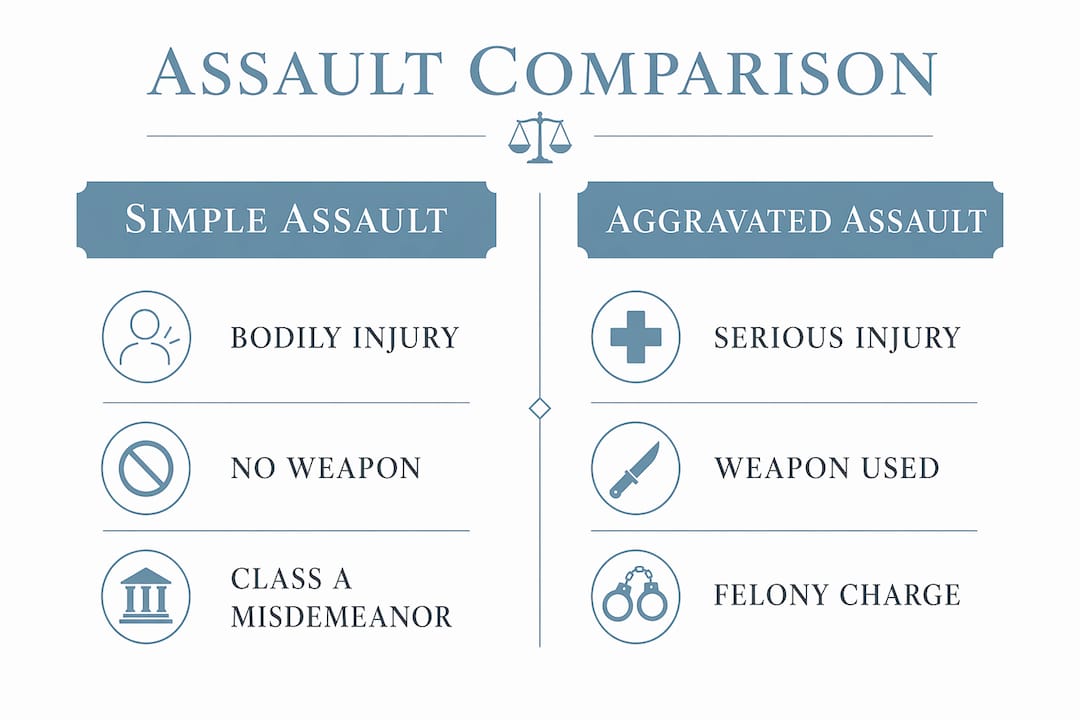
Simple and aggravated assault differ primarily in three areas: the severity of injury caused, whether a weapon was used, and the level of intent involved. Aggravated assault is a felony. That distinction changes everything about how a case is prosecuted and what penalties apply.
| Factor | Simple assault | Aggravated assault |
|---|---|---|
| Injury severity | Bodily injury or unprivileged contact | Serious bodily injury |
| Weapon use | Deadly weapon only in negligent cases | Weapon use elevates the charge |
| Criminal classification | Class A misdemeanor or violation | Felony |
| Potential sentence | Up to 12 months | More than 12 months, state prison |
A practical example clarifies the line. Shoving someone during an argument and causing a bruise is likely simple assault. Striking someone with a bat and breaking bones crosses into aggravated assault territory. The physical outcome and the tool used both determine which charge applies.
Understanding this distinction matters because the legal process differs significantly. Felony charges involve superior court proceedings, higher bail amounts, and longer potential sentences. If you face an assault charge and are unsure of its classification, the type of assault alleged shapes every decision you make from that point forward.
What should you do if you are accused of simple assault in New Hampshire?
Hiring a criminal defense attorney promptly improves defense outcomes significantly. Early legal intervention gives your attorney time to gather evidence, interview witnesses, and evaluate the prosecution’s case before charges are formally filed or arraignment occurs.
Common defenses against simple assault charges in New Hampshire include:
- Self-defense. New Hampshire law permits the use of force to protect yourself from imminent unlawful force. The force used must be proportionate to the threat.
- Defense of others. The same principle applies when you act to protect another person from harm.
- Lack of intent. If the conduct was accidental and did not involve recklessness or negligence with a deadly weapon, the mental state element may not be satisfied.
- Consent. In mutual-consent fight situations, the charge is reduced to a violation rather than a misdemeanor.
- False accusation. Witnesses, surveillance footage, and inconsistencies in the complainant’s account can support a defense against false assault allegations.
The court process for a misdemeanor assault charge typically begins with an arraignment in district court, where you enter a plea. Pre-trial hearings follow, during which your attorney can negotiate with the prosecutor or file motions to suppress evidence. Many cases resolve through plea agreements before trial. Understanding criminal defense strategies in New Hampshire gives you a clearer picture of what to expect at each stage.
Key Takeaways
Simple assault under New Hampshire RSA 631:2-a is a misdemeanor offense that covers far more conduct than physical violence alone, and a conviction carries consequences that extend well beyond the courtroom.
| Point | Details |
|---|---|
| Broad statutory definition | RSA 631:2-a covers purposeful, knowing, reckless, and negligent conduct causing injury or contact. |
| No contact required | Attempting harm or placing someone in reasonable fear of injury can satisfy the charge. |
| Standard penalty | A Class A misdemeanor carries up to 12 months in jail and fines up to $2,000. |
| Mutual consent exception | Fighting by mutual consent reduces the charge to a violation, not a criminal misdemeanor. |
| Long-term record impact | A conviction affects employment, licensing, housing, and custody matters beyond sentencing. |
Why the mental state element is the most underestimated part of these cases
Most people charged with simple assault focus immediately on what happened physically. That instinct is understandable, but it misses the real battleground in these cases. The mental state element, whether you acted purposely, knowingly, recklessly, or negligently, is where most defenses are won or lost.
I have seen cases where the physical facts were not seriously disputed, but the prosecution could not prove the required mental state. Accidental contact, even contact that causes injury, does not automatically satisfy the statute. New Hampshire courts take these distinctions seriously. Prosecutors must prove the defendant’s state of mind, not just the outcome.
The other misconception I encounter regularly is that simple assault is too minor to warrant serious legal attention. That view is costly. A misdemeanor conviction follows you. It shows up in background checks, affects professional licenses, and can surface in family court proceedings. The charge may feel routine to the system. It should never feel routine to you.
Facing an assault charge? Narolaw is ready to help
Narolaw is a New Hampshire criminal defense practice that handles assault and violent crime cases across the state. Whether you are facing a first-time misdemeanor or a more serious charge, the team at Narolaw builds defense strategies tailored to the specific facts of your case. You can learn more about criminal defense representation available through Narolaw, or contact the firm directly to schedule a free consultation. Getting the right legal guidance early makes a measurable difference in how your case unfolds.
— Rich
FAQ
What is the legal definition of simple assault in New Hampshire?
Simple assault under RSA 631:2-a is purposely, knowingly, recklessly, or negligently causing bodily injury or unprivileged physical contact to another person. Negligent assault requires use of a deadly weapon.
Is simple assault a felony in New Hampshire?
Simple assault is a Class A misdemeanor, not a felony, in most cases. It is reduced to a violation when both parties consented to a fight.
Can you be charged with simple assault without touching someone?
Yes. Placing someone in reasonable fear of imminent bodily injury or attempting to cause harm can satisfy the charge even without physical contact.
How long can you go to jail for simple assault in New Hampshire?
A Class A misdemeanor conviction carries a maximum jail sentence of 12 months and fines up to $2,000 under New Hampshire law.
What is the best defense against a simple assault charge in NH?
Self-defense, lack of the required mental state, and consent are the most common defenses. An experienced NH criminal defense attorney can evaluate which defense fits the specific facts of your case.


