

TL;DR:
- A restraining order is a civil court order designed to prevent contact or harassment, but it does not guarantee permanent safety.
- They come in three types—emergency, temporary, and final—each serving different protective durations and purposes.
Many people assume a restraining order works like a force field — that once granted, it guarantees physical safety and resolves the underlying conflict. That misunderstanding can lead to serious mistakes, both for people seeking protection and for those named as respondents. The role of restraining orders is more specific and more legally consequential than most people realize. They are civil court tools with defined functions, real limitations, and significant legal implications that can touch everything from criminal proceedings to child custody. This article breaks down exactly how they work, what they can and cannot do, and what you need to know before filing or responding.
Table of Contents
- Key Takeaways
- The role of restraining orders: definition and purpose
- Types of restraining orders and how they work
- How to obtain a restraining order
- Effects of restraining orders on family and criminal law
- When restraining orders and criminal cases overlap
- My perspective on what most people get wrong
- How Narolaw can help you through this process
- FAQ
Key Takeaways
| Point | Details |
|---|---|
| Restraining orders are civil orders | They are court-issued protections that operate separately from, but intersect with, criminal law. |
| Three tiers exist | Emergency, temporary, and final orders each serve different protective functions and durations. |
| Documentation drives outcomes | Strong evidence, including timelines and police reports, significantly improves petition success. |
| Violations carry serious penalties | A violation can result in arrest, fines, or prison time, including federal charges for interstate violations. |
| Custody and firearms are directly affected | An active order can regulate child visitation and trigger an immediate federal firearm ban. |
The role of restraining orders: definition and purpose
A restraining order, often called a protective order, is a civil court order requiring one person to stop contact, harassment, or physical proximity to another. The purpose of restraining orders is protective, not punitive. The court is not declaring someone guilty of a crime. It is creating a legal boundary to prevent further harm while other processes, whether criminal or civil, proceed.
People seek restraining orders in a range of situations, including:
- Domestic violence between current or former intimate partners
- Stalking or harassment by a neighbor, coworker, or acquaintance
- Sexual assault involving someone known to the victim
- Child abuse situations requiring immediate protective action
Why seek a restraining order rather than wait for criminal charges? Because the criminal process moves slowly, and protective orders can be granted within days. Filing fees are waived in domestic violence cases in every state, removing a financial barrier that might otherwise prevent someone from acting. It is worth understanding, though, that a restraining order does not replace a criminal case. The two can and often do run simultaneously, which creates legal complexity that both parties need to manage carefully.
Types of restraining orders and how they work
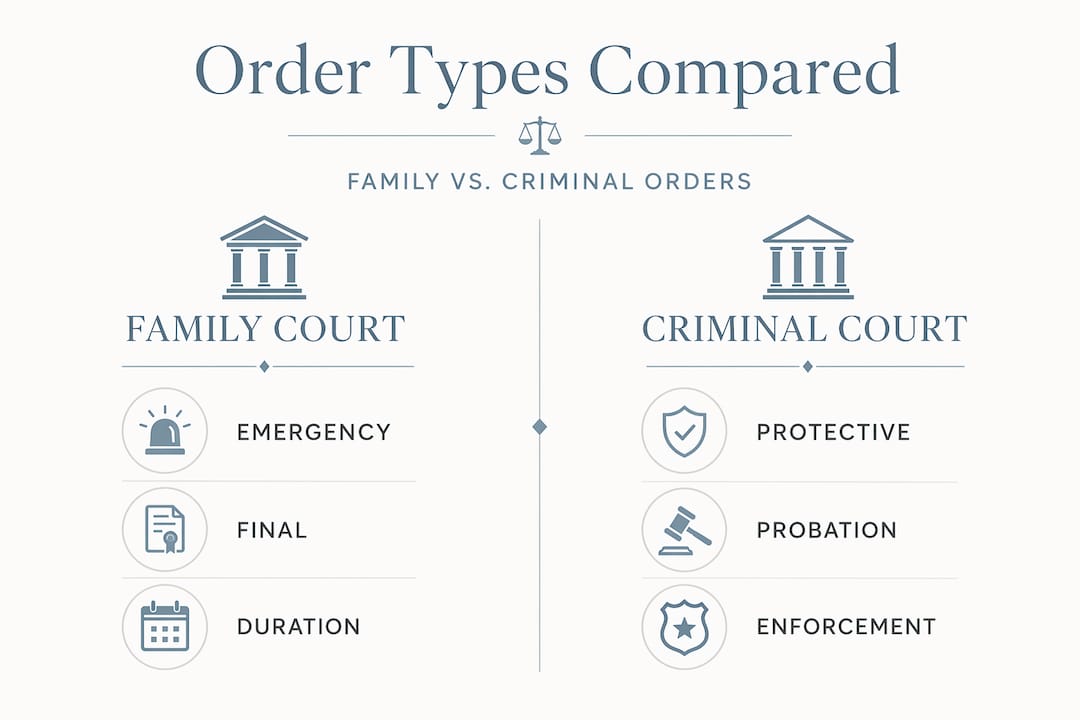
Understanding what is a restraining order requires knowing that not all orders are the same. Courts issue three main types, each designed for a different phase of a situation.
| Order Type | How It Is Granted | Duration | Key Feature |
|---|---|---|---|
| Emergency (Ex Parte) | Judge decides without respondent present | Same day | Fastest protection; temporary until hearing |
| Temporary | Issued after initial petition; hearing scheduled | Until full court hearing | Both parties notified; short-term bridge |
| Final (Permanent) | Granted after full hearing with both parties | 1 to 5 years or permanent | Most comprehensive; renewable depending on jurisdiction |
Criminal protective orders occupy a separate category. These are issued by criminal courts, typically as a bail or probation condition, rather than initiated by the protected person as a civil matter. A criminal protective order carries the full weight of the criminal court’s authority and can exist alongside a civil restraining order, meaning a respondent may be subject to both simultaneously.
For New Hampshire residents, the distinctions between emergency and final restraining orders in your jurisdiction matter because the procedures and timelines differ from other states.
Pro Tip: If you have an emergency order in place, attend the follow-up hearing without fail. Missing it allows the order to lapse, leaving you without protection precisely when the situation may still be volatile.
How to obtain a restraining order
The legal process of filing a petition is more straightforward than many people expect, but the outcome depends heavily on preparation. Here is the general sequence:
- Visit your local courthouse and request the petition forms for a protective order. Court staff can guide you to the right paperwork but cannot give legal advice.
- Complete the petition with specific details about incidents: dates, locations, what was said or done, and any witnesses present.
- Submit your petition to the clerk. A judge will review it, often the same day in emergency situations.
- Attend the temporary order hearing if one is scheduled, where the judge may grant short-term protection.
- Serve the respondent through the sheriff’s office or law enforcement so they receive legal notice.
- Appear at the final hearing prepared with all documentation to pursue a longer-term order.
The New Hampshire filing process follows this general framework with state-specific requirements you should review in advance. What determines whether a judge grants the order is largely the quality of your evidence. Detailed documentation such as dated timelines, screenshots of threatening messages, medical records, and prior police reports materially influences the court’s decision.
Pro Tip: Keep a written log of every incident, including dates, times, what was said or done, and any witnesses. A judge cannot act on your fear alone. A well-documented record gives your petition credibility.
While legal representation is not required to file, successful petitions consistently reflect the kind of organized, detailed evidence that an attorney helps a client compile and present effectively.

Effects of restraining orders on family and criminal law
Once a restraining order is in effect, the legal implications of restraining orders reach further than most people anticipate. The order imposes specific behavioral restrictions on the respondent, and violations carry real consequences.
Common restrictions in a restraining order include:
- No contact provisions covering in-person contact, phone calls, texts, emails, and third-party messages
- Stay-away requirements defining a geographic distance from the petitioner’s home, workplace, or school
- Property restrictions that can grant the protected party exclusive possession of a shared home, even requiring the respondent to vacate
Courts can also assign temporary child custody and visitation terms within the order, which often has lasting influence on family law proceedings that follow.
One consequence that surprises many respondents is the firearm restriction. A federal firearm ban under 18 U.S.C. 922(g)(8) takes effect immediately upon issuance of a qualifying order, making possession of a firearm a federal felony.
Violating an order is not a civil matter. Violation penalties range from arrest and fines to jail time, and federal law treats interstate violations with particular severity, carrying potential prison sentences of up to 20 years.
When restraining orders and criminal cases overlap
The legal stakes rise considerably when a civil restraining order and a criminal case involve the same parties and facts. Domestic violence cases and civil proceedings rarely stay in separate tracks. Evidence introduced in the civil hearing can surface in the criminal case, and vice versa.
The most significant risk for respondents is self-incrimination. Testifying in a civil restraining order hearing to contest the petition can generate statements that prosecutors later use in a criminal trial. Conversely, invoking the Fifth Amendment in a civil hearing can lead a judge to draw an adverse inference. As legal experts emphasize, both proceedings require a coordinated legal strategy, not two separate attorneys working in silos.
When criminal charges and a civil restraining order arise from the same events, a respondent who handles each case independently — without coordinated legal counsel — risks making decisions in one proceeding that seriously damage the other.
For petitioners, the parallel process creates its own challenges. Testimony given in the civil hearing may be scrutinized during a criminal trial and defense attorneys will look for inconsistencies. Preparation and accurate, consistent documentation matter on both sides of the table.
My perspective on what most people get wrong
I’ve worked with clients on both sides of restraining order proceedings, and the pattern I see most often is not dishonesty. It is unpreparedness. People arrive at the courthouse believing the legal system will figure it out for them. It does not work that way.
What I’ve learned is that restraining orders are among the most consequential civil tools a court can issue. They can remove someone from their home, restrict contact with their children, strip their right to own a firearm, and create a public record that follows them into future employment and custody battles. That is not a formality. That is a life-altering legal event.
The clients who navigate this best are the ones who treat it seriously from day one. They document everything, they get counsel early, and they understand that what they say in a civil hearing does not stay in a civil hearing. Whether you are seeking protection or responding to a petition, the choices you make in the first weeks set the trajectory for everything that follows.
— Rich
How Narolaw can help you through this process
If you are facing a restraining order situation in New Hampshire, whether as a petitioner seeking protection or a respondent contesting a petition, Narolaw offers experienced legal support tailored to your circumstances. Narolaw’s practice covers both family law matters including custody and divorce proceedings directly impacted by protective orders, and criminal defense for clients facing charges related to domestic violence or order violations. The firm brings a compassionate, strategic approach to every case, recognizing that the decisions made early in these proceedings shape long-term outcomes. Contact Narolaw to schedule a free consultation and get clear answers about your rights and options before you take your next step.
FAQ
What is a restraining order and what does it do?
A restraining order is a civil court order that legally prohibits a person from contacting, approaching, or harassing another individual. It can also include housing, custody, and firearm restrictions depending on the circumstances.
Who can file a restraining order?
Anyone who has experienced domestic violence, stalking, sexual assault, or harassment from a person with whom they have a qualifying relationship, such as a spouse, partner, household member, or family member, may petition the court for a protective order.
What happens if a restraining order is violated?
Violating a protective order is a criminal offense that can result in arrest, fines, and jail time. Federal law imposes penalties of up to 20 years in prison for violations involving crossing state lines.
How do restraining orders affect child custody?
Courts can include temporary child custody and visitation terms within a protective order. These terms often carry significant weight in subsequent family law proceedings, making early legal guidance especially important.
Do I need a lawyer to get a restraining order?
A lawyer is not legally required to file a petition, but well-documented petitions with organized evidence are far more likely to succeed. Legal counsel helps you build a stronger case and avoid procedural errors that can undermine your petition.


