

TL;DR:
- A restraining order is a powerful legal tool that protects victims of domestic abuse, but it requires proper enforcement to be effective.
- Its impact on custody decisions is increasingly significant, considering both physical and non-physical abuse factors; enforcement involves formal legal steps and timely service.
Many people assume that a restraining order works the moment a judge grants it. That assumption can put someone in real danger. Understanding the role of restraining orders in family law means recognizing both what these orders can do and where their limits begin. They are powerful legal tools that protect victims of domestic abuse, influence custody outcomes, and shape the terms of separation. But they are not automatic shields. They require process, enforcement, and legal strategy to work effectively.
Table of Contents
- Key takeaways
- The role of restraining orders in family law
- How restraining orders affect custody and visitation
- The legal process for obtaining and enforcing orders
- Common challenges and misconceptions
- Co-parenting and safety planning with a restraining order in place
- My perspective on restraining orders in family law
- How Narolaw can help you move forward
- FAQ
Key takeaways
| Point | Details |
|---|---|
| Orders come in three types | Emergency, temporary, and permanent orders each serve a different stage of protection in family law cases. |
| Custody is directly affected | Courts in many states must now screen for domestic violence before making custody decisions. |
| Violations carry criminal penalties | Breaking any term of a restraining order can result in arrest and firearm restrictions immediately. |
| Orders are not self-executing | Protections only become enforceable once an order is physically sealed, served, and registered with law enforcement. |
| Legal representation matters | Having an attorney significantly improves outcomes whether you are seeking a restraining order or responding to one. |
The role of restraining orders in family law
A restraining order, also called a protective order, is a civil court order directing one person to stop certain behaviors toward another. Importantly, it does not require a criminal charge to be filed. This distinction matters because many people wait for police action before seeking protection. You do not have to.
There are three primary types of orders you will encounter in family law cases:
- Emergency (ex parte) orders: Issued without the other party present, often on the same day you file. These last 5 to 30 days depending on the state, and a hearing is scheduled shortly after.
- Temporary restraining orders (TROs): Granted after an initial hearing, typically lasting weeks to months, until a full evidentiary hearing takes place.
- Permanent orders: Issued after both parties present their cases at a formal hearing. Despite the name, these orders often last one to five years and can be renewed.
Common provisions in these orders include no-contact rules, minimum distance requirements from the petitioner’s home or workplace, mandatory surrender of firearms, and limitations on parenting time. The firearm surrender requirement is federally mandated the moment an order is issued, regardless of state law. That is not a minor detail. It has immediate, real-world consequences for the person the order is filed against.
How restraining orders affect custody and visitation
The connection between restraining orders and custody decisions is more direct than most people realize. Courts do not treat a restraining order as a separate matter from a parenting case. They treat it as evidence that shapes the entire custody picture.
Recent legislative trends reflect this clearly. Colorado’s law effective August 2026 mandates abuse screening before any custody allocation decision is made. Texas courts are required to consider any protective order issued within the prior two years when determining parenting arrangements. These are not isolated developments. They reflect a national shift toward treating domestic violence as a direct factor in determining what is in a child’s best interest.
Courts increasingly recognize non-physical abuse as well. Coercive control through economic manipulation, psychological intimidation, and electronic surveillance is now being coded into family law protections in several jurisdictions. A parent who has controlled their partner’s finances or isolated them from family may face custody consequences even without a single physical incident on record.
When a restraining order is in place, the protected orders can also specify custody arrangements directly. A court may grant supervised visitation or deny parenting responsibilities altogether if the risk to the child is clear. If you are involved in a custody dispute where domestic violence is a factor, understanding how these orders intersect is not optional.

Pro Tip: If you are concerned about domestic violence affecting your custody case, document every incident in a private journal, including dates, locations, and witnesses. This record can become a critical piece of evidence at a custody hearing.
The legal process for obtaining and enforcing orders
Getting a restraining order involves real steps, real timelines, and real evidentiary standards. Here is how the process typically unfolds:
| Stage | What happens | Typical timeline |
|---|---|---|
| Emergency filing | Petitioner files with the court; judge reviews ex parte | Same day in most jurisdictions |
| Emergency order issued | Order served on respondent by law enforcement | Within hours to days of filing |
| Temporary hearing | Both parties may appear; TRO extended or modified | 5 to 10 business days after filing |
| Full evidentiary hearing | Both sides present evidence and witnesses | Several weeks after TRO issuance |
| Permanent order decision | Judge issues or denies a long-term order | Same day as hearing |
One enforcement reality that catches people off guard is the gap between a judge’s verbal ruling and the moment a restraining order becomes enforceable. There can be significant administrative delays between a judge’s oral decision and the sealing and service of the written order. During that gap, the order may not be practically enforceable by law enforcement. Knowing this helps you plan for your safety, not just your legal rights.
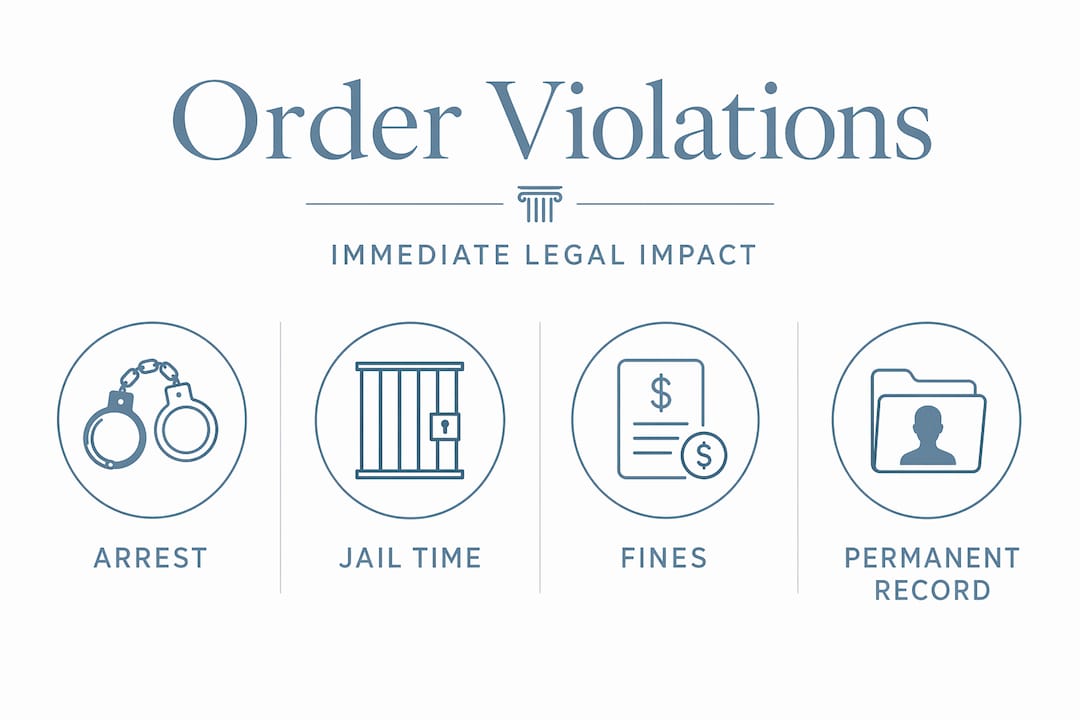
Violating a restraining order is a criminal offense in every state. Consequences can include immediate arrest, jail time, and the permanent loss of the right to possess firearms. If you are the respondent, do not assume any contact is acceptable without speaking to an attorney first.
Common challenges and misconceptions
Several misconceptions about restraining orders create real risks for the people relying on them.
- Orders are not self-executing. The order only becomes enforceable once it is signed, sealed, and served. Until then, law enforcement may not be able to act on it.
- Petitioner contact can backfire. If you filed the order and then reach out to the respondent, even once, you can undermine your own credibility in court and complicate enforcement.
- Mutual orders create complexity. When both parties have orders against each other, violations become difficult to litigate and can confuse the legal record.
- Civil orders still appear on background checks. A granted restraining order can affect employment opportunities, housing applications, and professional licensing, even though it is not a criminal conviction.
If you are the respondent and believe the order was wrongfully issued, do not ignore it. Legal counsel significantly improves outcomes for those contesting orders. Requesting a hearing promptly is critical to protecting your legal rights.
Pro Tip: Whether you are the petitioner or respondent, never communicate directly with the other party about the order or its terms. Use only court-approved channels or attorney-to-attorney communication.
Co-parenting and safety planning with a restraining order in place
Restraining orders and co-parenting create tension by definition. But with the right structure, families can manage this legally and safely.
- Use third-party communication tools. Apps like TalkingParents or OurFamilyWizard create documented, court-admissible records of all communication without requiring direct contact.
- Arrange supervised visitation through the court. If the order permits parenting time, request that exchanges happen at a neutral supervised location or through a designated family member.
- Modify custody orders proactively. If circumstances change, file a motion to modify rather than making informal arrangements. Informal adjustments can violate the order’s terms.
- Document every violation or concern. Keep dated records of any behavior that conflicts with the order’s provisions. This documentation supports your position in future hearings.
- Protect your emotional wellbeing alongside your legal rights. Working with a counselor during this period is not a sign of weakness. It helps you make clearer decisions under pressure, which directly affects your legal outcomes.
Knowing your legal rights in family disputes means knowing how to use the order as a framework, not just a piece of paper.
My perspective on restraining orders in family law
I have watched people walk into the process believing a restraining order would solve everything, and I have watched others dismiss them as bureaucratic formalities. Neither view holds up in practice.
What I have learned is that restraining orders work best as one part of a broader legal strategy. They set boundaries. They create legal records. They signal to the court that safety is a live concern. But they do not replace coordinated legal action in custody cases, financial disputes, or criminal proceedings. Civil and criminal cases involving the same parties rarely stay fully separate, and statements made in civil hearings can surface in criminal defense later.
The clients I have seen navigate this most successfully are the ones who treated the restraining order as a starting point, not an endpoint. They documented thoroughly, communicated through attorneys, and stayed consistent. That consistency is what courts remember. It is what builds credibility over time.
Courts are also finally catching up to the reality that abuse does not always leave visible marks. The recognition of coercive control is a real shift, and it is opening doors for people whose experiences were previously invisible to the legal system. If you have lived under psychological or financial control, your story now has a legal framework to be heard.
— Rich
How Narolaw can help you move forward
When restraining orders intersect with custody, divorce, or domestic violence charges, the legal stakes are serious, and the procedural details matter. Narolaw’s family law practice in New Hampshire provides personalized legal guidance for individuals seeking protection and for those responding to orders that may have been wrongly filed. Whether you need help understanding your family law rights in NH or you are facing a custody dispute complicated by a protective order, the team at Narolaw is ready to walk through your situation with you. For custody-specific concerns, Narolaw’s Manchester custody attorneys bring focused experience to cases where safety and parenting intersect. Schedule a free consultation to discuss your options.
FAQ
What is the role of restraining orders in family law?
Restraining orders in family law serve as civil court orders that protect individuals from abuse, harassment, or contact while also influencing custody arrangements and the terms of separation. They are one of the most direct legal tools available to protect safety during a family dispute.
How do you obtain a restraining order in New Hampshire?
You can file for an emergency restraining order at your local courthouse, often on the same day, by completing a petition and presenting evidence of abuse or threatened harm. A judge reviews the petition and can issue an order immediately if the risk is credible. For step-by-step guidance, see Narolaw’s page on filing a restraining order in New Hampshire.
Can a restraining order affect child custody decisions?
Yes. Courts in many states are now required to consider protective orders when determining custody, and some jurisdictions mandate full domestic violence screening before allocating parental responsibilities. A restraining order can lead to supervised visitation or a complete restriction on parenting time depending on the circumstances.
What happens if someone violates a restraining order?
Violating any term of a restraining order is a criminal offense in every state and can result in immediate arrest, jail time, and loss of firearm rights. Courts treat violations seriously, and each incident becomes part of the legal record in related family law proceedings.
Does a restraining order show up on a background check?
A civil restraining order can appear on background checks and affect employment, housing, and professional licensing even though it is not a criminal conviction. This is one reason why contesting an incorrectly filed order with legal representation matters.


