

TL;DR:
- In New Hampshire, divorce agreements vary based on circumstances, goals, and marriage nature, affecting property and custody rights. Most divorces proceed under no-fault grounds, simplifying negotiations, while complex issues like retirement accounts require specific legal processes like QDROs. Clear, specific language in agreements and full disclosure are essential to avoid future disputes and ensure long-term protection.
Divorce is rarely simple, and one of the biggest misconceptions people carry into the process is assuming there is only one kind of divorce agreement. In New Hampshire, the types of divorce agreements in NH vary significantly depending on your circumstances, goals, and the nature of your marriage. Each type carries distinct legal weight and affects everything from how property is divided to whether you keep decision-making rights over your children. Understanding these differences before you get to the negotiating table is not just helpful. It is the difference between an agreement that protects your future and one that creates problems for years to come.
Table of Contents
- Key takeaways
- Types of divorce in New Hampshire: fault vs. no-fault
- The main types of divorce agreements in NH
- Key legal components in divorce agreements
- Special considerations when negotiating agreements
- Process tips for better agreements
- My perspective on NH divorce agreements
- How Naro Law can help with your divorce agreement
- FAQ
Key takeaways
| Point | Details |
|---|---|
| Multiple agreement types exist | NH divorces involve separation agreements, marital settlement agreements, and parenting plans, each serving a distinct purpose. |
| No-fault is most common | Most NH divorces proceed under no-fault grounds, which simplifies negotiation and reduces legal costs. |
| Property splits follow 15 factors | Courts presume a 50/50 split under RSA 458:16-a but can deviate based on 15 specific statutory factors. |
| Retirement accounts need QDROs | Dividing retirement benefits legally requires a Qualified Domestic Relations Order, not just an agreement clause. |
| Clear language protects you | Vague agreement language around debts and custody can lead to costly disputes. Specificity is non-negotiable. |
Types of divorce in New Hampshire: fault vs. no-fault
Before understanding the different legal agreements for divorce in NH, you need to understand the two foundational categories of divorce itself. These categories shape what you negotiate and how.
No-fault divorce is filed under irreconcilable differences, meaning neither party is required to prove wrongdoing. No-fault divorce under RSA 458:7-a is the most common route in New Hampshire because it is less adversarial, less costly, and far less complicated to prove. For most couples, this path allows them to focus energy on reaching a fair agreement rather than relitigating past conduct.
Fault-based divorce is filed under RSA 458:7 and requires a party to prove specific grounds:
- Adultery
- Extreme cruelty
- Abandonment for at least two years
- Habitual drunkenness or drug use
- Conviction of a crime
Fault-based divorces require evidence and are uncommon precisely because the burden of proof raises costs significantly. That said, understanding fault claims still matters. While fault grounds rarely provide a meaningful strategic advantage, they can influence alimony considerations and, in some cases, property negotiations. An experienced attorney can help you assess whether fault grounds are worth pursuing given your situation.
Pro Tip: If your spouse committed acts that qualify as fault grounds, do not dismiss them without speaking to an attorney first. Even in a no-fault filing, documented misconduct can affect how the court views certain financial claims.
The main types of divorce agreements in NH
Once you understand the grounds for divorce, the next question is: what agreements will formalize the terms? There are three primary types of legal agreements for divorce in NH, and they often work together.
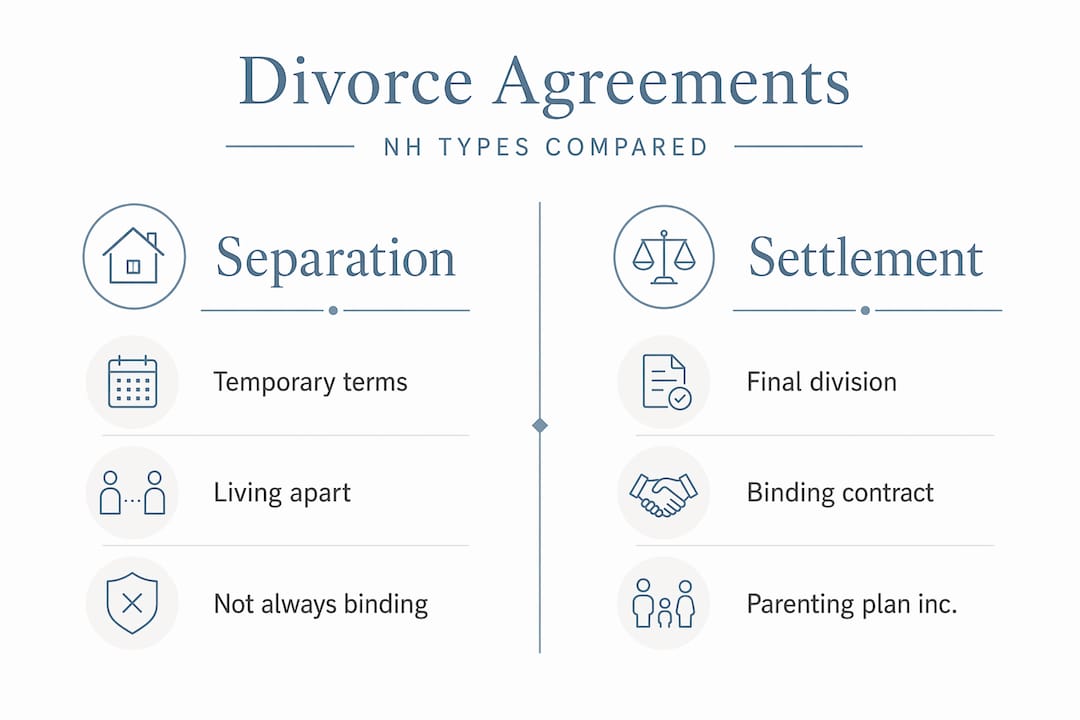
Separation agreements
A separation agreement is a written contract between spouses that outlines terms during a period of living apart before the divorce is final. It can address property use, bill payment responsibilities, and temporary support. While New Hampshire does not require a formal legal separation before divorce, some couples use this period and a written agreement to test whether reconciliation is possible or to protect financial interests in the interim.
For guidance on legal separation vs. divorce, New Hampshire law provides specific distinctions that affect how debts and assets are treated.
Marital settlement agreements
A marital settlement agreement (MSA) is the primary document that resolves all outstanding divorce issues: property division, spousal support, debt allocation, and sometimes custody. Courts in New Hampshire strongly prefer that parties reach their own MSA rather than leaving decisions to a judge. When both spouses agree on the terms, the MSA is submitted to the court for approval and becomes a binding court order.

Parenting plans
Any divorce involving children must include a parenting plan. This document governs physical custody, legal custody, a residential schedule, holiday arrangements, and how parents will make major decisions for the child. NH courts evaluate parenting plans under a best-interest standard.
| Agreement type | Primary purpose | Legally binding? |
|---|---|---|
| Separation agreement | Governs conduct during separation | Yes, when signed |
| Marital settlement agreement | Finalizes all divorce terms | Yes, upon court approval |
| Parenting plan | Establishes custody and visitation | Yes, incorporated into final decree |
Pro Tip: Many couples try to combine all terms into a single MSA and include the parenting plan as an exhibit. This approach keeps all terms in one enforceable document and reduces confusion later.
Key legal components in divorce agreements
Understanding what to include in a divorce agreement is as important as knowing the types. Each of the following areas requires precise language.
Property division in New Hampshire follows an equitable distribution model. RSA 458:16-a governs property division with a presumption of an equal 50/50 split, but courts can deviate based on 15 statutory factors, including the length of the marriage, each spouse’s economic contributions, and the needs of the custodial parent.
One often-overlooked example: the family home. The court considers whether keeping a child in the home outweighs forcing a sale, which can shift the split considerably. For a closer look at family home division, the specific circumstances of your household matter more than any default rule.
Alimony in New Hampshire follows strict guidelines. Term alimony is capped at 23% of the income difference between spouses, with a maximum duration of 50% of the marriage length. Short marriages with minimal income gaps rarely qualify. Your agreement must specify the type, amount, duration, and termination conditions.
Child custody and support are governed by a best-interest standard. The agreement should address:
- Legal custody (who makes medical, educational, religious decisions)
- Physical custody (where the child primarily lives)
- A detailed residential schedule with holiday specifics
- A child support calculation based on NH income shares guidelines
Debt allocation is a section many people handle too casually. Clearly naming which spouse is responsible for each debt, and in what amount, protects both parties. Vague language like “parties will divide debts equally” is an invitation for future disputes.
Special considerations when negotiating agreements
Several issues require more than a passing mention in your agreement.
Retirement accounts are one of the most frequently mishandled assets. Retirement benefits are fully divisible in NH divorces, but a division agreement clause alone is not enough. You must obtain a Qualified Domestic Relations Order (QDRO) to legally transfer a portion of a retirement account. Without a QDRO, a plan administrator can reject the transfer entirely. Notably, a recent NH Supreme Court decision clarified that the entire retirement benefit, including premarital contributions, may be subject to division in certain circumstances.
Debt and creditor risk is another area requiring attention. Even when your agreement assigns a debt to one spouse, creditors can pursue either party if both names appear on the original obligation. Including indemnification clauses in your agreement gives the other spouse a legal remedy if they are pursued for a debt they were not supposed to owe.
Pets may seem like a simple matter, but under NH law as amended in 2019, pets are treated as property with a requirement to consider the animal’s wellbeing in any settlement. If you have pets, address their care and primary residence specifically in your agreement.
Pro Tip: Request QDRO template documents from your retirement plan administrator before finalizing your MSA. Some plans have specific requirements, and discovering them after the divorce is finalized creates expensive complications.
Process tips for better agreements
Getting the process right shapes the quality of your final agreement as much as the content does.
- Disclose fully and early. Full financial transparency reduces the risk of agreements being challenged later. Hiding assets is not just unethical. It can unravel an entire settlement if discovered.
- Consider mediation. The uncontested divorce process in NH can finalize in as little as two to three months with no mandatory waiting period. Mediation helps couples reach that point without handing control to a judge.
- Avoid vague language. Terms like “reasonable visitation” or “fair share of debts” mean nothing in a courtroom. Every provision needs specific numbers, dates, and conditions.
- Account for taxes. Property transfers between spouses are generally tax-free, but retirement distributions and alimony have tax implications. Consider them before signing.
Pro Tip: Use your divorce preparation checklist to gather all financial documents before your first attorney meeting. Incomplete information slows negotiations and increases legal fees.
My perspective on NH divorce agreements
In my experience working alongside clients facing divorce, the single most common mistake I see is treating agreement drafting as a formality rather than a strategy. People often assume that because both parties “agree” on the big picture, the details will work themselves out. They rarely do.
I have seen retirement accounts go undivided for years because nobody filed a QDRO after the divorce was finalized. I have seen parenting plans fall apart because the language left room for interpretation on school holiday schedules. These are not edge cases. They are recurring patterns.
What I have found actually works is approaching your divorce agreement the same way you would approach any significant legal contract: with specificity, with an eye toward future circumstances, and with professional guidance. The goal is not just to get through the divorce. It is to build a document that works when circumstances change, because they will.
— Rich
How Naro Law can help with your divorce agreement
When you are working through the types of divorce agreements available to you, having an attorney who understands the specific requirements of New Hampshire law makes a real difference. Narolaw provides compassionate, practical legal support for divorcing individuals across New Hampshire, from drafting and reviewing marital settlement agreements to preparing parenting plans and navigating custody negotiations.
Whether your situation is straightforward or involves business assets, retirement accounts, or contested custody, Narolaw is prepared to help you build an agreement that protects your interests for the long term. Learn more about NH divorce and family law or contact Narolaw directly to schedule a free consultation.
FAQ
What are the main types of divorce agreements in NH?
The three primary types are separation agreements, marital settlement agreements, and parenting plans. Each addresses different aspects of the divorce, from temporary arrangements to final court-approved terms.
Does fault affect divorce settlement options in NH?
Fault grounds can influence alimony and property division, but fault-based divorces are rare in New Hampshire because they require evidence and carry higher legal costs. Most agreements are reached through no-fault proceedings.
What must a marital settlement agreement include?
A complete marital settlement agreement should address property division, debt allocation, alimony, and, if applicable, child custody and support. Clear, specific language for each term is required to make it enforceable.
Do you need a QDRO to divide a retirement account in NH?
Yes. While the marital settlement agreement may note that a retirement account will be divided, you must obtain a separate Qualified Domestic Relations Order to legally transfer the benefit. Without it, the retirement plan can reject the transfer.
How long does an uncontested divorce take in NH?
New Hampshire has no mandatory waiting period after filing, and an uncontested divorce with a fully agreed-upon settlement can finalize in approximately two to three months, depending on court scheduling.


