

Many people think domestic violence law only covers physical assault, but in New Hampshire, the legal definition extends far beyond that. Victims often hesitate to seek protection because they’re unsure whether their situation qualifies under the law. Understanding what domestic violence legally means in New Hampshire, how protective orders work, and what resources are available can empower you to take action. This guide explains the legal framework governing domestic violence in New Hampshire, walks you through obtaining protective orders, and outlines the support systems designed to protect your safety and rights.
Table of Contents
- Key takeaways
- Overview of New Hampshire domestic violence law
- Understanding protective orders and how to obtain them
- Consequences of violating protective orders and enforcement
- Nuances and additional protections under New Hampshire law
- Get legal help with domestic violence cases in New Hampshire
- Frequently asked questions about domestic violence law in New Hampshire
Key Takeaways
| Point | Details |
|---|---|
| Abuse types under law | New Hampshire defines abuse as physical assault, criminal threats, sexual assault, and harassment by someone with whom you have or had an intimate relationship or household member. |
| Temporary protective orders | Temporary ex parte protective orders can be issued immediately without the abuser present to provide swift protection. |
| Final orders duration | Final protective orders last up to one year and can be extended if ongoing protection is needed. |
| How to obtain orders | The process involves filing a petition at your local circuit court, a judge may grant a temporary order, a hearing is held within 3 to 5 days, and a final order is issued based on the evidence. |
| Penalties and resources | Violating a protective order can result in arrest and criminal penalties, and statewide support services are available to assist victims through the legal process. |
Overview of New Hampshire domestic violence law
Domestic violence in New Hampshire is governed by RSA Chapter 173-B, which defines abuse as specific acts committed by family members, household members, or intimate partners. The statute recognizes several forms of harmful conduct that create credible threats to a victim’s safety. Understanding these legal definitions helps you determine whether your situation qualifies for protective measures under New Hampshire law.
The law categorizes abuse into distinct types:
- Physical assault or attempts to cause bodily injury
- Criminal threatening that places you in fear of imminent serious bodily injury
- Sexual assault or attempts to engage in sexual contact without consent
- Harassment that serves no legitimate purpose and is intended to alarm or seriously annoy you
These acts must be committed by someone with whom you have or had an intimate relationship, share a household, or are related by blood or marriage. The law emphasizes that the conduct must pose a credible threat to your physical or emotional safety. Simply having a disagreement or experiencing general relationship stress does not meet the legal threshold for domestic violence protection.
Pro Tip: Emotional abuse alone typically does not qualify for a protective order unless it includes credible threats or creates reasonable fear of physical harm. Document specific threatening statements or behaviors that make you fear for your safety.
New Hampshire courts evaluate whether the alleged conduct meets these statutory definitions when deciding protective order petitions. The legal framework prioritizes victim safety while requiring specific evidence of abusive behavior. Knowing what constitutes domestic violence in New Hampshire helps you assess your situation accurately and understand your legal options. The domestic violence overview provided by legal professionals can clarify how these definitions apply to different circumstances you may face.
Understanding protective orders and how to obtain them
New Hampshire law provides two types of protective orders designed to safeguard victims at different stages of the legal process. Understanding the distinction between temporary and final orders helps you know what to expect and how to prepare for each step.
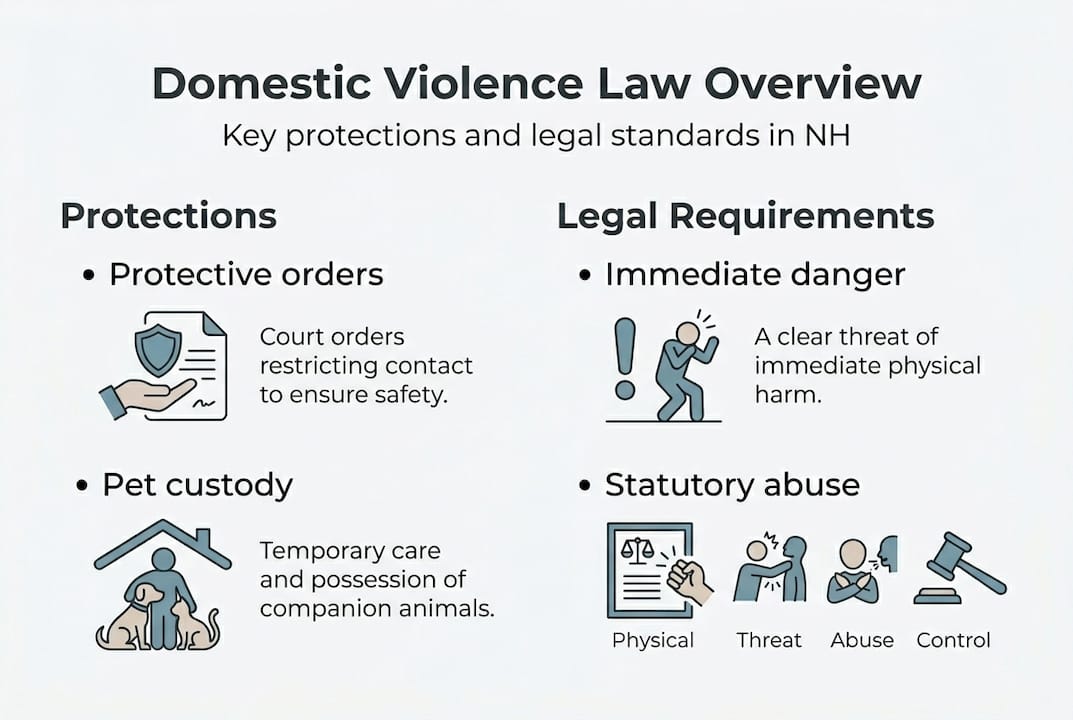
Temporary protective orders can be issued immediately when you demonstrate immediate danger. These ex parte orders, granted without the abuser present, provide swift protection until a full court hearing occurs. You can request a temporary order by phone or facsimile if circumstances prevent you from appearing in person. The order takes effect immediately and remains valid until the next court day when a hearing can be scheduled.
The process for obtaining protective orders follows these steps:
- File a petition at your local circuit court describing the abuse and why you need protection
- A judge reviews your petition and may grant a temporary order if immediate danger exists
- The court schedules a full hearing within 3 to 5 days where both parties can present evidence
- At the hearing, the judge decides whether to issue a final protective order based on the evidence presented
Final protective orders last up to one year and can be extended if ongoing protection is necessary. These orders require a preponderance of evidence showing that abuse occurred and that you need continued protection. The court can include multiple provisions tailored to your specific safety needs.

| Order Provision | What It Means for You |
|---|---|
| No contact | Abuser cannot call, text, email, or communicate through third parties |
| Stay away | Abuser must avoid your home, workplace, school, and other specified locations |
| Firearm surrender | Abuser must relinquish all firearms and ammunition to law enforcement |
| Custody arrangements | Temporary custody of children and visitation schedules if applicable |
| Pet custody | Exclusive care and control of household pets |
| Counseling | Court-ordered treatment programs for the abuser |
Pro Tip: Bring all evidence to your hearing, including photos of injuries, threatening messages, police reports, medical records, and witness statements. The more documentation you provide, the stronger your case for a final protective order.
You can file protective order petitions without paying court fees, removing financial barriers to safety. Many victims work with domestic violence advocates who help with paperwork, safety planning, and court accompaniment. Understanding the differences between emergency vs final restraining orders ensures you know what protections are available at each stage. The process of filing for a restraining order in New Hampshire becomes less overwhelming when you know what to expect and have support resources available. Learning about protective orders in New Hampshire helps you make informed decisions about your safety strategy.
Consequences of violating protective orders and enforcement
New Hampshire takes protective order violations seriously, implementing strong enforcement mechanisms to ensure victim safety. Understanding how violations are prosecuted and what happens when someone disobeys a court order gives you confidence in the legal protections available.
Violating a protective order constitutes a Class A misdemeanor under New Hampshire law. Law enforcement officers can arrest violators without a warrant based on probable cause that a violation occurred. This means police can take immediate action when you report contact or other prohibited behavior, without needing to witness the violation themselves.
The penalties for violations include:
- Class A misdemeanor charges for first violations, carrying up to one year in jail and fines up to $2,000
- Enhanced penalties for subsequent violations, potentially elevating charges to felony level
- Mandatory arrest policies requiring officers to take violators into custody
- Additional criminal charges if the violation involves assault, stalking, or other crimes
Protective orders are entered into statewide and national databases that law enforcement can access instantly. When you call police to report a violation, officers can immediately verify the order’s existence and terms. This system enables rapid response and removes delays that could compromise your safety.
“The law requires arrest without warrant upon probable cause of violation. This immediate enforcement mechanism protects victims by ensuring swift consequences for those who disregard court orders designed to keep them safe.”
You should report every violation immediately, even if it seems minor. Contact attempts that violate no-contact provisions, showing up at restricted locations, or any other breach of order terms deserves police intervention. Each violation creates a documented record that can support enhanced penalties if the abuser continues the behavior. Understanding how domestic violence arrest New Hampshire procedures work helps you know what to expect when you report violations.
Pro Tip: Save all evidence of violations, including screenshots of messages, voicemails, security camera footage, and witness contact information. This documentation strengthens criminal cases against violators and supports your requests for order extensions or modifications.
Nuances and additional protections under New Hampshire law
New Hampshire domestic violence law includes several specific protections and limitations that victims should understand. These nuances affect how courts handle certain situations and what additional safeguards are available beyond basic protective orders.
New Hampshire law prohibits mutual protective orders unless the court makes specific findings of separate abuse by each party. Courts cannot issue protective orders against both parties simply because both claim abuse. Each person must prove independent acts of domestic violence to obtain protection. This prevents abusers from manipulating the system by filing counter-petitions as retaliation. The law also clarifies that reconciliation attempts or time elapsed since the last incident do not bar protective orders if credible threats remain.
Recent legislative changes expanded protections in important ways:
- Pet custody provisions allow courts to grant exclusive care and control of household animals, recognizing that abusers often harm or threaten pets to maintain control
- Animal cruelty is now explicitly recognized as a form of abuse under the statute
- 2025 housing laws enable victims to terminate leases early without financial penalties by providing self-certification of domestic violence status
- New protections help victims relocate safely without being trapped by lease obligations
Emotional abuse cases present unique challenges under New Hampshire law. While the statute recognizes that abuse extends beyond physical violence, emotional abuse alone rarely meets the legal threshold unless it includes credible threats or creates reasonable fear of harm. Courts evaluate whether the conduct serves a legitimate purpose and whether it would cause a reasonable person to feel alarmed or seriously annoyed.
| Protection Type | How It Works | Benefit to Victims |
|---|---|---|
| Pet custody | Court awards temporary care of animals | Prevents abuser from harming pets as control tactic |
| Housing release | Early lease termination with self-certification | Enables safe relocation without financial penalty |
| No mutual orders | Separate abuse findings required | Protects against retaliatory false claims |
| Ongoing threat standard | Past reconciliation does not bar orders | Recognizes cyclical nature of domestic violence |
Some advocates discuss potential 2026 legislative proposals that could affect survivor protections, though no specific bills have passed as of early 2026. Staying informed about domestic violence definitions NH helps you understand how courts interpret these evolving standards. If you face false accusations defense NH situations, understanding the evidence requirements protects your rights.
Pro Tip: If emotional abuse is your primary concern, focus on documenting specific threats, controlling behaviors that limit your freedom, and patterns that create fear. Consider seeking adult therapy for emotional wellness to address trauma while building your legal case.
The complexities of these protections highlight why legal guidance often proves valuable when navigating domestic violence cases. Understanding all available safeguards ensures you can access every protection New Hampshire law provides.
Get legal help with domestic violence cases in New Hampshire
Navigating domestic violence law and protective orders requires understanding complex legal procedures while managing the emotional stress of an abusive situation. Naro Law provides experienced legal representation for domestic violence victims throughout New Hampshire, helping you understand your rights and options at every stage. Our family law attorney Manchester NH team handles protective orders, custody matters, and related legal issues with compassionate advocacy tailored to your circumstances. We guide clients through family law cases in New Hampshire involving domestic violence, ensuring you have the support needed to protect yourself and your children. Explore our legal resource center for additional information and contact us for a consultation to discuss your situation confidentially.
Frequently asked questions about domestic violence law in New Hampshire
What qualifies as domestic violence under New Hampshire law?
Domestic violence in New Hampshire includes physical assault, criminal threatening, sexual assault, and harassment committed by intimate partners, family members, or household members. The conduct must create a credible threat to your safety or wellbeing to qualify for legal protection.
How quickly can I get a protective order in New Hampshire?
You can obtain a temporary protective order immediately upon showing the court that you face immediate danger. The court schedules a full hearing within 3 to 5 days to determine whether to issue a final protective order lasting up to one year.
What happens if someone violates a protective order?
Violating a protective order is a Class A misdemeanor in New Hampshire, allowing police to arrest the violator without a warrant based on probable cause. Repeat violations result in enhanced penalties, potentially including felony charges and longer jail sentences.
Can I get a protective order for emotional abuse?
Emotional abuse alone typically does not meet New Hampshire’s legal standard unless it includes credible threats or creates reasonable fear of physical harm. Courts evaluate whether the conduct serves a legitimate purpose and whether it would alarm a reasonable person.
Do protective orders affect child custody arrangements?
Yes, protective orders can include temporary custody provisions and supervised visitation requirements to protect children from exposure to domestic violence. These arrangements remain in effect until the court modifies them or the protective order expires.


