

TL;DR:
- Divorce in New Hampshire involves complex jurisdiction, parenting, and asset division rules that often cause delays.
- Understanding residency requirements, procedural steps, and dispute factors helps individuals prepare and protect their interests effectively.
Divorce in New Hampshire is rarely as simple as filing a form and waiting for approval. Even couples who agree on most issues discover that jurisdiction requirements, parenting procedures, and asset division rules add layers of complexity they never anticipated. Whether you are just beginning to consider your options or you are already partway through the process, understanding what actually drives difficulty in an NH divorce can help you prepare more effectively, protect your interests, and avoid costly delays.
Table of Contents
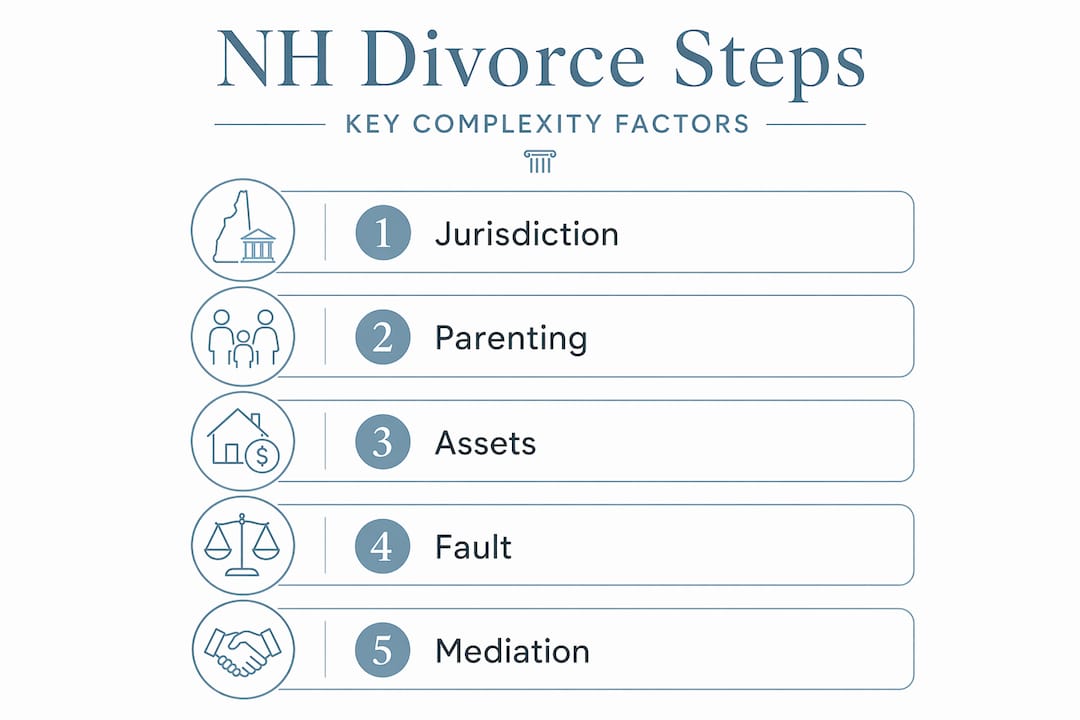
- Jurisdiction and eligibility: The starting complexity
- Parenting rights, responsibilities, and procedural hurdles
- Uncontested vs. contested divorce: Workflow and case complexity
- Complex asset division and fault-based factors
- Mediation, case management, and procedural branching
- Why most people underestimate NH divorce complexity
- Need support navigating your NH divorce?
- Frequently asked questions
Key Takeaways
| Point | Details |
|---|---|
| Jurisdiction determines eligibility | NH divorce filing relies on specific residency, personal service, and domicile rules. |
| Parenting triggers extra steps | If children are involved, parents must complete seminars and navigate new parental responsibilities. |
| Disagreement multiplies complexity | Contested divorces take much longer and cost more than uncontested cases. |
| Asset division is nuanced | Equal split is presumed, but NH laws allow deviation based on detailed statutory factors. |
| Mediation is not always easier | Alternative procedures like mediation can streamline or complicate the process depending on the case. |
Jurisdiction and eligibility: The starting complexity
Before anything else can happen in an NH divorce, the court must have the legal authority to hear your case. This is called jurisdiction, and getting it wrong can result in your case being dismissed before it even begins.
NH divorce jurisdiction is governed by RSA 458:5, and filing eligibility depends on specific domicile pathways that many filers overlook. The statute provides three main routes:
- Both spouses are domiciled in NH at the time of filing.
- Only one spouse is domiciled in NH, but the other is personally served with process within the state.
- One spouse has been domiciled in NH for at least one year prior to filing, regardless of where the other spouse lives.
Each pathway requires different types of evidence. For example, proving domicile typically means showing voter registration, a driver’s license, tax records, or utility bills tied to a New Hampshire address. When a spouse lives out of state, personal service requirements become a real logistical challenge.
| Route to jurisdiction | Key requirement | Common misconception |
|---|---|---|
| Both spouses in NH | Current domicile in NH | Living here temporarily is enough |
| One spouse in NH, served in NH | Personal service within state borders | Mailing papers to an out-of-state spouse counts |
| One spouse with one-year domicile | 12 months continuous NH domicile | Any prior residency qualifies |
Pro Tip: Gather documentation of your NH domicile before you file. Courts take residency questions seriously, and having voter records, bank statements, and a lease or mortgage ready can prevent unnecessary delays.
For a step-by-step breakdown of what the filing process actually looks like, the filing for divorce in NH guide is a useful reference for understanding what to expect after you establish eligibility.
Parenting rights, responsibilities, and procedural hurdles
With eligibility sorted, families with children face an additional layer of complexity that surprises many people. New Hampshire no longer uses the terms “custody” and “visitation” in the traditional sense. Instead, the state has replaced that framework with parental rights and responsibilities, which covers two distinct components: residential responsibility (where the child lives) and decision-making responsibility (who makes major decisions about the child’s education, health, and welfare).

This shift matters because NH replaced custody and visitation with parental rights and responsibilities, meaning the legal standards and terminology that apply to your case are different from what many people expect based on what they have heard from friends or seen in other states. You can review how these recent parenting law changes in NH affect your rights before entering negotiations.
Procedural steps for divorcing parents in NH:
- File the divorce petition and serve the other party.
- Attend the mandatory First Appearance session before a family division master.
- Complete the required four-hour child impact seminar (both parents must attend separately).
- Submit a proposed parenting plan to the court.
- Attempt resolution through mediation or a case manager conference.
- If unresolved, proceed to a contested evidentiary hearing.
| Parenting scenario | Required events | Estimated added timeline |
|---|---|---|
| Both parents agree on parenting plan | First Appearance, child impact seminar | 2 to 4 weeks additional |
| Parents partially agree | Above plus mediation session | 1 to 3 months additional |
| Fully contested parenting dispute | All above plus evidentiary hearing | 6 to 18 months additional |
Pro Tip: Schedule the child impact seminar early. It is required before certain hearings can proceed, and delays in completing it can push your entire case back by weeks.
Uncontested vs. contested divorce: Workflow and case complexity
Beyond parenting, the degree of agreement between spouses is the single biggest driver of how long and how expensive a divorce becomes. Uncontested divorces, where both parties agree on all major issues, can sometimes be resolved in a matter of months. Contested divorces, where even one significant issue remains unresolved, trigger a much more intensive court process.
The most common factors that shift a case from uncontested to contested include:
- Disagreement over the value of major assets such as a home or business.
- One spouse alleging fault grounds such as adultery or extreme cruelty.
- Disputes about the primary residential parent or parenting schedule.
- Hidden or undisclosed financial accounts.
- Significant income disparity between spouses.
“High-conflict or partially agreed cases shift from streamlined resolution to contested litigation, creating significant time and cost variance for the parties involved.”
The timeline difference is stark. A truly uncontested case with no children and minimal assets may resolve in as few as 60 to 90 days. A contested case involving real property, retirement accounts, and parenting disputes can take 18 months or longer. The uncontested divorce NH guide outlines what you need to qualify for the simpler process, while the NH divorce law explained resource covers the broader legal framework. If you are unsure which path applies to your situation, consulting with NH divorce legal professionals can provide the clarity you need.
Complex asset division and fault-based factors
Disputes aren’t just about agreement. They often hinge on financial details that most people underestimate until they are already deep in the process.
New Hampshire applies what is called an “all property” equitable distribution framework, which means the court considers all assets owned by either spouse, not just marital property acquired during the marriage. The starting presumption is equal division (50/50), but the court may deviate from that based on 15 statutory factors listed in RSA 458:16-a.
Complex assets that frequently create disputes include:
- Retirement accounts such as 401(k)s, pensions, and IRAs, which often require a Qualified Domestic Relations Order (QDRO) to divide correctly.
- Business interests, where valuation requires expert appraisal.
- Investment portfolios with unrealized gains and tax implications.
- Real estate, especially when market value is disputed or one spouse wants to remain in the marital home.
- Stock options or deferred compensation plans tied to future vesting.
Fault-based arguments add another layer. In NH, fault allegations like adultery require proof of causation and measurable harm to actually influence property division outcomes. Claiming infidelity happened is not enough. You must demonstrate that it caused the breakdown of the marriage and resulted in quantifiable loss, which is a high legal bar to clear.
Pro Tip: Begin organizing financial documentation early. Bank statements, tax returns, retirement account balances, and business valuations should all be gathered before the first court appearance. Proper documentation can accelerate resolution and strengthen your position. Learn more about how NH retirement accounts in divorce are handled to avoid common QDRO mistakes.
Mediation, case management, and procedural branching
The next key procedural consideration is how NH courts route cases based on their complexity. After the First Appearance, the court does not simply schedule a hearing. Instead, it channels the case into one of several procedural paths based on the nature and extent of the disputes.
Common procedural paths after the First Appearance session:
- Agreement reached: Both parties sign a settlement agreement, and the court issues a final decree.
- Mediation ordered or agreed: A neutral third-party mediator helps both parties reach a settlement without a judge.
- Case manager conference: A court-appointed case manager facilitates negotiation on specific unresolved issues.
- Pre-trial conference: The court sets deadlines for discovery, expert witnesses, and final hearing scheduling.
- Evidentiary hearing: A family division master or judge hears testimony and evidence and issues rulings.
Mediation and case manager conferences play a dual role in NH divorce proceedings: they can either streamline resolution or add a procedural step that extends the timeline, depending entirely on the nature of the dispute. In straightforward financial disagreements, mediation often resolves the matter quickly. In high-conflict parenting cases, it can require multiple sessions without producing agreement.
Why most people underestimate NH divorce complexity
Here is what family law practitioners observe consistently: most people entering a divorce are focused entirely on whether they and their spouse agree. That focus, while understandable, misses the structural complexity that exists regardless of agreement.
You can have a cooperative spouse and still face jurisdiction challenges if your domicile documentation is insufficient. You can agree on parenting and still face months of delay if you miss a required seminar or fail to submit a compliant parenting plan. You can reach a financial settlement and discover later that a retirement account was divided incorrectly because a QDRO was never prepared.
The evidence and documentation requirements in NH divorce are far more demanding than most people expect. Courts do not simply take your word for asset values or residency. They require proof, filed on schedule, in the correct format. That is why a thorough assessment of your specific divorce situation from someone who knows NH family law is worth pursuing early, not after a misstep has already occurred.
The lesson that experienced family law attorneys consistently share is this: preparation prevents complications far more effectively than correction does. Start organized, stay organized, and treat every procedural deadline as non-negotiable.
Need support navigating your NH divorce?
Understanding the complexity of NH divorce is the first step. Taking action with the right guidance is what actually protects your future. At Naro Law, we work with individuals across New Hampshire to navigate divorce proceedings with clarity and confidence, whether your situation is relatively simple or involves significant disputes. Explore our NH family law overview to understand the full scope of services we offer. If you are in the Concord area, our divorce attorneys in Concord are ready to provide focused legal support. Before your first consultation, review our NH divorce preparation checklist to ensure you arrive prepared and informed.
Frequently asked questions
What are the key residency requirements for NH divorce?
Both spouses must be domiciled in NH, or the filing spouse must meet special personal service and domicile rules. Filing eligibility depends on domicile conditions under RSA 458:5, with some cases requiring a full year of NH domicile.
How does New Hampshire handle child custody in divorce?
NH uses “parental rights and responsibilities” instead of traditional custody and visitation. NH mandates First Appearance sessions and a four-hour child impact seminar for all divorcing parents with minor children.
What makes property division complex in NH divorce?
NH applies a presumption of equal division under an “all property” standard, but equitable distribution allows deviations based on 15 statutory factors, making outcomes difficult to predict without legal guidance.
Does adultery affect divorce settlements in NH?
Adultery only influences property division when specific legal thresholds are met. Fault-based arguments require proof of causation and measurable harm, and there is no automatic financial impact without meeting that standard.
Can mediation speed up my NH divorce?
Mediation can streamline certain disputes, particularly financial disagreements. However, in high-conflict cases, its role depends on dispute type and it may not eliminate the need for additional court proceedings.


