

TL;DR:
- An assault arrest in New Hampshire triggers a structured legal process including booking, a court appearance, and bail decisions. Acting quickly and following court orders are crucial for building a strong defense and avoiding additional charges. Early legal consultation, evidence preservation, and disciplined behavior significantly influence case outcomes.
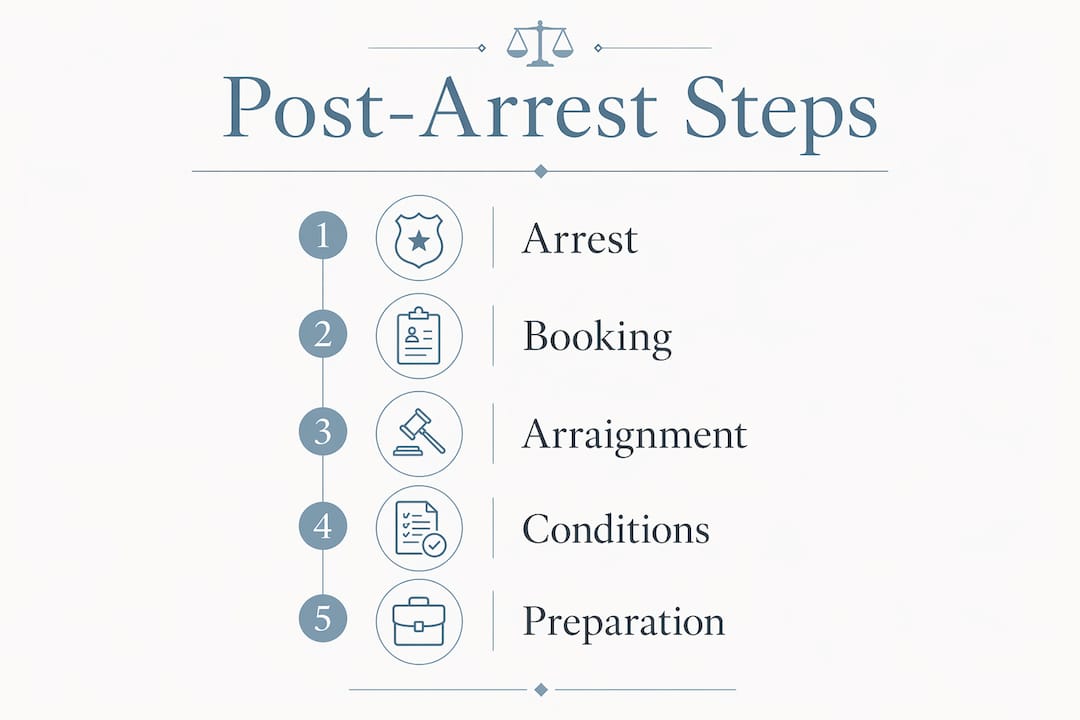
An assault arrest in New Hampshire triggers a structured series of legal steps that begin within hours and can shape your case for months. What happens after an assault arrest in NH follows a clear sequence: booking, a mandatory court appearance within 36 hours, bail determination, and the start of criminal defense proceedings. The New Hampshire Judicial Branch requires this initial appearance to protect defendants’ rights while the prosecution builds its case. Knowing each step, and acting on it quickly, is the difference between a strong defense and a preventable mistake.
What happens at your first court appearance after an assault arrest in NH?
The first court appearance after an assault arrest is called an arraignment or initial bail hearing. Under New Hampshire Judicial Branch guidelines, a judge must hold this hearing no later than 36 hours after arrest, excluding weekends and holidays. That tight window means you could face a judge before you have fully processed what happened.
At this hearing, the judge reads the charges against you and asks for your plea. The court then decides whether to release you and under what conditions. Bail decisions in New Hampshire assault cases depend on factors including the severity of the alleged offense, your criminal history, ties to the community, and the risk you pose to the alleged victim.
The court commonly imposes conditions alongside bail. These often include:
- A no-contact order prohibiting any communication with the alleged victim
- Geographic restrictions, such as staying away from the victim’s home or workplace
- Surrender of firearms
- Regular check-ins with a bail commissioner or pretrial services officer
No-contact orders and protective orders appear immediately after arrest and remain in force throughout the case. Violating them is not a minor issue. Knowingly violating bail conditions can result in bail revocation, additional criminal charges, and contempt of court proceedings. That means you could face new charges on top of the original assault allegation simply by sending a text message to the wrong person.
Pro Tip: Write down every condition the judge states at your arraignment. Misremembering a single restriction can lead to a bail violation, which makes your case significantly harder to defend.
What rights do you have after an assault arrest in NH?
Your rights after an assault arrest are immediate and legally protected. The most critical is the right to remain silent. Statements made immediately after arrest can be used as evidence against you in court, even if they seem harmless or explanatory. Police are trained to ask questions that prompt incriminating responses. The safest answer to any question is a calm, clear statement that you are invoking your right to remain silent and wish to speak with an attorney.

The right to counsel is equally immediate. Early legal consultation helps defendants understand their options and prepares strong defenses, including contesting evidence and negotiating pleas. Do not wait until your arraignment to find a lawyer. Contact a criminal defense attorney as soon as you are able, even from the police station.
Protecting yourself legally in the hours after arrest also means avoiding these common mistakes:
- Posting about the incident on social media, even vaguely
- Contacting the alleged victim directly or through a third party
- Giving written or recorded statements to police without counsel present
- Discussing the case with friends or family in ways that could be overheard or repeated
Pro Tip: Treat everything you say, text, or post as potential evidence. Prosecutors regularly review social media accounts and phone records in assault cases.
Documenting your own account of events is also a protected and smart step. Write down a detailed, private timeline of what happened, where you were, who was present, and what was said. This record helps your attorney build a defense grounded in facts rather than fading memory.
How does evidence gathering and case preparation work after an arrest?
Defense preparation begins the moment you retain an attorney. Your lawyer’s first task is reviewing the police report, arrest affidavit, and any evidence the prosecution has disclosed. This review often reveals procedural errors, inconsistencies in witness statements, or gaps in the prosecution’s case.

Building a defense early involves creating a detailed timeline, gathering witness names, preserving physical evidence, and identifying videos or photos that support your account. Memories fade quickly, and surveillance footage is often overwritten within days. Acting fast on evidence preservation is not optional; it is foundational.
Common types of evidence in New Hampshire assault cases include:
- Surveillance or cell phone video of the incident or surrounding area
- Medical records documenting injuries, or the absence of them
- Text messages and call logs between you and the alleged victim
- Witness statements from people who saw or heard the incident
- Physical evidence such as clothing or objects present at the scene
The burden of proof in a criminal case rests entirely with the prosecution. Your attorney’s job is to create reasonable doubt, not to prove your innocence outright. That distinction shapes every decision in case preparation.
| Evidence type | Why it matters |
|---|---|
| Surveillance video | Provides objective record of events that contradicts or confirms witness accounts |
| Text messages | Establishes context, prior relationship, and who initiated contact |
| Medical records | Confirms or disputes the nature and cause of alleged injuries |
| Witness statements | Corroborates your version of events or challenges the alleged victim’s account |
Your attorney will also evaluate whether a plea negotiation, diversion program, or full trial defense best serves your situation. For defendants with no prior record, New Hampshire courts sometimes offer alternatives to conviction. Understanding those options early gives you more choices later.
What court procedures follow the initial appearance?
After arraignment, the NH criminal defense process moves through several stages before resolution. Cases rarely resolve at the first hearing. Expect a series of scheduled court dates over weeks or months.
The typical sequence after arraignment includes:
- Discovery: The prosecution shares its evidence with your defense attorney, and your attorney may request additional materials.
- Pre-trial motions: Your attorney may file motions to suppress evidence obtained unlawfully, dismiss charges for insufficient evidence, or exclude certain statements.
- Plea negotiations: Many assault cases resolve through negotiated plea agreements that reduce charges or sentencing exposure.
- Trial: If no agreement is reached, the case proceeds to a bench or jury trial.
Throughout this period, bail conditions and protective orders remain active. Violating them at any stage, even months after the initial arrest, carries the same consequences as violating them on day one. Staying disciplined about court orders is not just a legal obligation. It is a direct signal to the judge about your character and reliability.
Key takeaways
An assault arrest in New Hampshire sets a legally structured process in motion immediately, and the decisions you make in the first 36 hours carry the most weight.
| Point | Details |
|---|---|
| 36-hour court appearance | A judge must hold your bail hearing within 36 hours of arrest, excluding weekends and holidays. |
| Bail conditions are binding | Violating no-contact or other bail conditions can result in new charges and bail revocation. |
| Silence protects you | Do not speak to police without an attorney; any statement can be used as evidence against you. |
| Early evidence matters most | Preserve photos, witness contacts, and video immediately, as key proof disappears quickly. |
| Defense options exist | Plea negotiations, diversion programs, and trial are all possible paths depending on your case. |
What I’ve learned about the assault arrest aftermath in NH
Working with defendants through the post-arrest period, one pattern stands out clearly: the clients who fare best are the ones who treat the process with discipline from the very first hour. They call an attorney before they call family. They write down their account of events before the details blur. They follow every bail condition without exception, even the ones that feel arbitrary or frustrating.
The most damaging misconception I see is that the arrest itself is the worst part. It is not. The weeks after the arrest, when defendants are stressed, isolated, and tempted to reach out to the alleged victim or vent on social media, are where cases are truly won or lost. Disclosing all facts to your attorney promptly, including the details that seem unfavorable, is the single most effective thing you can do. Surprises at trial are almost always bad for the defense.
The legal system in New Hampshire is structured, and that structure works in your favor when you understand it. An experienced criminal defense attorney does not just argue in court. They review every procedural step, challenge every piece of evidence, and identify options you would not find on your own. Take the process seriously. Stay disciplined. And start building your defense today, not next week.
— Rich
Narolaw’s criminal defense services for assault charges in NH
Facing assault charges in New Hampshire is serious, and the legal steps after an arrest move quickly. Narolaw’s criminal defense attorneys represent clients across New Hampshire in assault and violent crime cases, from the initial bail hearing through trial or plea resolution. The firm offers confidential case evaluations so you can understand your options before making any decisions. Early consultation gives your attorney the time needed to preserve evidence, review police procedures, and build a defense strategy tailored to your case. If you are facing assault charges, contact Narolaw to schedule your free consultation and get clear answers about what comes next.
FAQ
What happens immediately after an assault arrest in NH?
After an assault arrest in New Hampshire, you are booked, and a judge must hold a bail hearing within 36 hours, excluding weekends and holidays. The court sets bail and may impose conditions such as no-contact orders.
Can I be released on bail after an assault arrest?
Yes, bail is possible in most assault cases, though the amount and conditions depend on the severity of the charge, your criminal history, and the risk to the alleged victim. The judge decides at the initial court appearance.
What should I say to police after an assault arrest?
Invoke your right to remain silent and request an attorney immediately. Statements made after arrest can be used as evidence against you, so do not explain or justify the incident without counsel present.
How long does an assault case take to resolve in NH?
Resolution timelines vary widely. Cases may settle through plea negotiations within a few months or proceed to trial over a year or more, depending on the complexity of the evidence and court scheduling.
What are the possible outcomes of an NH assault charge?
Outcomes range from dismissal and diversion programs to plea agreements and conviction at trial. Your attorney evaluates the strength of the prosecution’s evidence to determine the best path forward.


