

TL;DR:
- In New Hampshire, juvenile cases are handled in the Family Division of the Circuit Court, focusing on rehabilitation rather than punishment.
- Parents should act quickly to secure legal representation for their child and understand juvenile rights during arrest proceedings.
When your child is arrested in New Hampshire, the juvenile justice system treats them very differently from an adult offender. New Hampshire routes most cases involving minors under 18 through the Family Division of the Circuit Court, where the focus is rehabilitation, not punishment. Cases are filed under RSA 169-B for delinquency or RSA 169-D for Children in Need of Services, known as CHINS. Jail is rarely the outcome. Understanding what happens next, and what you can do right now, gives you the best chance of protecting your child’s future.
What happens if my child is arrested in New Hampshire?
The child arrest process in New Hampshire begins the moment law enforcement takes your child into custody. The steps that follow are regulated to protect juveniles at every stage.
- Taken into custody. Police detain your child and begin processing. This is not the same as a formal adult arrest, though it carries serious legal weight.
- Parental notification. Parents have the right to be notified when their child is taken into custody, but this notification may not always be immediate. Call the arresting agency directly if you have not heard within a reasonable time.
- Booking and initial assessment. Officers document the alleged offense and assess whether detention is necessary. Most juveniles are released to a parent or guardian rather than held.
- Detention decision. Juvenile detention facilities are legally distinct from adult jails, and secure detention of juveniles is limited and regulated to protect their welfare. Your child cannot be placed in an adult jail.
- Arraignment. The Family Division schedules an arraignment where the charges are formally presented. You and your child will appear before a judge.
- Preliminary hearing or diversion referral. Depending on the charge, the court may refer your child to a diversion program before any formal adjudication begins.
Pro Tip: Contact a juvenile defense attorney before the arraignment. Statements your child makes during early police contact can affect the entire case, and an attorney can help you limit that exposure from day one.
The criminal defense process for juveniles moves quickly. Delays in securing legal counsel are the most common mistake parents make in the first 48 hours.

Delinquency vs. CHINS: what is the legal difference?
New Hampshire law draws a clear line between two types of juvenile cases. Knowing which category applies to your child shapes everything that follows.
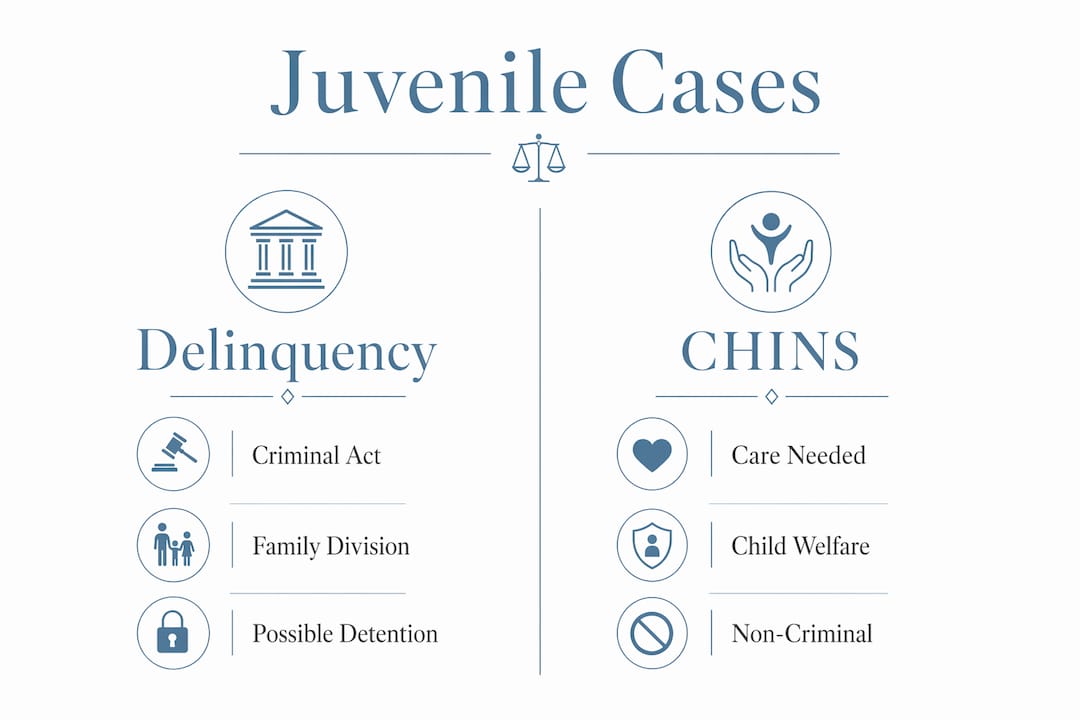
Delinquency involves offenses that would be crimes if committed by adults. CHINS cases address children who need care or services due to behavioral challenges, without a criminal charge attached. A CHINS petition can be filed by a parent, a school, or law enforcement under RSA 169-D.
| Feature | Delinquency (RSA 169-B) | CHINS (RSA 169-D) |
|---|---|---|
| Trigger | Criminal act by a minor | Behavioral or family crisis |
| Filed by | Law enforcement or prosecutor | Parents, schools, or police |
| Court focus | Correction and accountability | Support and services |
| Possible outcomes | Probation, diversion, detention | Counseling, family services |
| Criminal record risk | Yes, if adjudicated | Generally no criminal record |
Child welfare services may become involved in CHINS cases, which can feel alarming. The goal, however, is to connect families with support rather than to punish. Understanding this distinction early can influence legal strategy and outcomes in meaningful ways. An attorney who handles both categories will help you identify which path applies and how to respond.
What rights do parents and juveniles have during this process?
Parents and juveniles both hold specific legal rights throughout the New Hampshire juvenile arrest process. Knowing these rights prevents costly mistakes.
Rights your child holds:
- The right to remain silent. Police questioning without counsel can hurt the juvenile’s defense. Your child should not answer questions without an attorney present.
- The right to an attorney. If you cannot afford private counsel, the court will appoint one.
- Miranda rights apply in juvenile proceedings, though courts evaluate how well a minor understood those rights at the time of questioning.
- Privacy protections. Juvenile records are generally not public, which protects your child at school and in future employment.
Rights you hold as a parent:
- The right to be notified of your child’s custody and to attend hearings.
- The right to participate in court proceedings and speak on your child’s behalf.
- The right to secure private legal representation for your child at any stage.
Pro Tip: Tell your child clearly and calmly: “Do not answer any questions until our attorney is present.” This single instruction, delivered before police questioning begins, can protect your child’s entire case.
Parents should act quickly to secure their child’s welfare and legal representation. Waiting to see how things unfold is the approach most likely to result in a worse outcome.
What are the possible outcomes after a juvenile arrest in New Hampshire?
The range of outcomes in New Hampshire juvenile cases is wider than most parents expect. Formal adjudication and detention are not the default result.
Common outcomes include:
- Pretrial diversion. Many juvenile offenses qualify for diversion programs that avoid formal prosecution entirely. Diversion typically involves counseling, community service, or educational programs. Eligibility depends on the severity of the charge and whether your child has a prior record.
- Probation. The court may place your child on probation with conditions such as curfews, school attendance requirements, or mandatory counseling.
- Mandatory services. The Family Division can order participation in mental health treatment, substance abuse programs, or family therapy.
- Transfer to adult court. Serious or repeat offenses can result in transfer to the adult criminal system. This is the outcome parents most need to avoid, and early legal intervention is the primary way to prevent it.
Juvenile record and expungement:
| Outcome | Record impact | Expungement possible? |
|---|---|---|
| Diversion completed | Minimal or no formal record | Generally yes |
| Probation completed | Adjudication on record | Yes, for eligible offenses |
| Formal adjudication | Juvenile record created | Yes, under certain conditions |
| Transfer to adult court | Adult criminal record | Limited options |
Juvenile records can be sealed or expunged under certain conditions, helping protect your child’s future educational and employment prospects. Expungement most commonly applies to first-time or nonviolent offenses. An attorney can advise you on timing and eligibility. For cases involving driving offenses, the underage DUI laws in New Hampshire carry their own specific consequences worth understanding separately.
Key takeaways
New Hampshire’s juvenile justice system prioritizes rehabilitation over punishment, and early parental action combined with experienced legal counsel produces the best outcomes for children facing arrest.
| Point | Details |
|---|---|
| Juvenile court focus | The Family Division handles cases under RSA 169-B and RSA 169-D with rehabilitation as the primary goal. |
| Parental notification | You have the right to be notified, but delays happen. Contact the arresting agency immediately if you are not called. |
| Right to silence | Your child should not answer police questions without an attorney present, regardless of the circumstances. |
| Diversion is available | Many first-time offenses qualify for diversion, which can prevent a formal juvenile record entirely. |
| Records can be expunged | Juvenile records are not permanent for most offenses. Legal counsel can guide you through the expungement process. |
What I’ve learned about juvenile cases and parental response
Parents who call an attorney within the first few hours consistently see better outcomes than those who wait. That is not a sales pitch. It reflects a pattern that shows up repeatedly in juvenile defense work.
The instinct to handle things quietly, to hope the charge gets dropped, or to let your child explain themselves to police is understandable. It is also the approach most likely to make things worse. Early legal intervention impacts case outcomes in measurable ways. Parents who show up informed, calm, and legally represented send a message to the court that this family takes the situation seriously.
The juvenile system in New Hampshire genuinely is designed to give young people a second chance. That design works best when parents engage with it actively rather than reactively. Your child’s behavior during proceedings, your participation in counseling or court-ordered services, and your attorney’s ability to present a credible rehabilitation plan all carry real weight with judges. This process, as difficult as it is, can be the turning point that redirects a young person’s path. Treat it that way from the start.
— Rich
Narolaw is here to help New Hampshire families
Facing a juvenile arrest is one of the most stressful situations a parent can experience. Narolaw is a New Hampshire-based legal practice with experience in both juvenile criminal defense and family law, and the firm understands how these cases affect entire families, not just the child involved. Narolaw provides defense strategy, court preparation, and guidance through every stage of the juvenile process, from the first hearing to potential expungement. If your child has been arrested or charged, speaking with an attorney early makes a real difference. Contact Narolaw to schedule a free consultation and get clear answers about your family’s options under New Hampshire family law.
FAQ
What age is considered a juvenile in New Hampshire?
In New Hampshire, a person under 18 is generally treated as a juvenile and processed through the Family Division of the Circuit Court rather than the adult criminal system.
Can my child be held in an adult jail after arrest?
No. Juveniles cannot be placed in adult jails in New Hampshire. Secure detention for minors is handled in separate, regulated juvenile facilities with strict guidelines.
Will my child have a permanent criminal record?
Not necessarily. Juvenile records can be sealed or expunged for many first-time or nonviolent offenses, and diversion programs can prevent a formal record from being created at all.
What is a CHINS petition and how does it differ from delinquency?
A CHINS petition addresses children who need services due to behavioral challenges, without a criminal charge. A delinquency case involves an act that would be a crime if committed by an adult.
Should my child speak to police without an attorney?
No. Your child has the right to remain silent, and police questioning without an attorney present can harm the defense. Assert this right immediately and contact legal counsel before any statements are made.


