

TL;DR:
- Parenting plan violations involve a parent’s intentional failure to follow court-ordered custody terms. The court responds with remedies starting from warnings and makeup time, escalating to fines or custody modifications for repeated willful violations. Proper documentation and legal procedures are essential for enforcement and protecting parental rights.
A parenting plan violation is defined as a parent’s willful failure to comply with court-ordered custody or visitation terms, triggering legal enforcement measures designed to protect the child’s well-being. New Hampshire courts treat parenting plans as binding legal obligations, not informal agreements. When a parent violates a parenting plan, the court’s response scales with the severity and frequency of the breach, starting with remedial steps and escalating to fines, custody changes, or in rare cases, jail time.
What legal remedies are available when a parent violates a parenting plan?
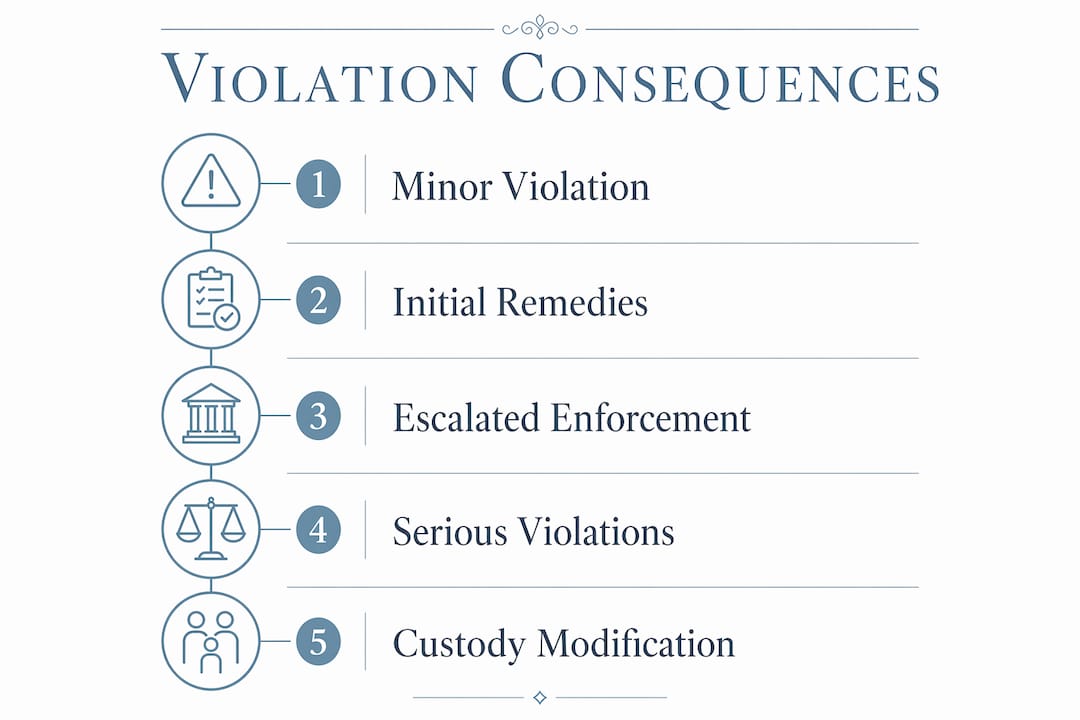
Courts respond to parenting plan violations through a tiered system of remedies. The goal is always the child’s best interests, not punishment for its own sake. Judges prefer remedial actions first, reserving harsher penalties for parents who show a consistent pattern of willful non-compliance.
Initial remedies courts commonly order include:
- Makeup parenting time: The affected parent receives additional scheduled time to compensate for missed visits.
- Mediation or counseling: Courts may require both parents to attend dispute resolution sessions or co-parenting classes.
- Formal warnings: A judge issues a written warning that further violations will result in escalated consequences.
When initial remedies fail to produce compliance, courts move to escalated enforcement. These include monetary fines, an order requiring the violating parent to pay the other parent’s attorney fees, and mandatory parenting education programs. New Hampshire’s parenting plan enforcement statutes have been strengthened in recent years to give courts broader tools at this stage.
Severe or repeated violations can lead to supervised visitation, a formal finding of civil contempt, or a full custody modification. Every remedy the court selects is filtered through the standard of what arrangement best serves the child, not what penalizes the offending parent most harshly.

Pro Tip: Keep a written log of every missed visit, late pickup, or blocked communication. Courts respond to documented patterns, not general complaints.
How does a parent enforce a parenting plan after a violation?
Enforcing a custody agreement requires methodical preparation before you ever set foot in a courtroom. The process follows a clear sequence, and skipping steps weakens your case.
- Document every violation. Record dates, times, locations, and any written communications related to each incident. Screenshots of text messages and emails carry significant weight as evidence.
- Review the court order. Confirm the specific term that was violated. Courts require you to show the order exists, that the other parent knew about it, and that they failed to comply.
- File a Motion to Enforce or Motion for Contempt. This formal filing asks the family court to compel compliance. Filing a Motion to Enforce initiates a hearing where both parents present evidence.
- Attend the court hearing. Bring all documentation, communication records, and any witnesses. The judge will evaluate the evidence and decide on appropriate remedies.
- Understand the costs. Filing fees apply, and attorney fees can add up quickly. A judge may order the violating parent to cover the prevailing parent’s legal costs, which creates a financial incentive for compliance.
The parental rights checklist from Narolaw provides a practical framework for organizing your documentation before filing.
Pro Tip: Do not contact law enforcement for routine scheduling disputes. Police intervene only in clear, immediate violations, such as a refusal to return a child at the scheduled exchange time. Routine disagreements require court remedies, not police calls.
What consequences do parents face for repeated or serious violations?
Repeated or serious violations cross a legal threshold that can permanently alter a custody arrangement. Courts recognize this as a “material change in circumstances,” which is the legal standard required to justify modifying an existing custody order.
| Violation Type | Likely Consequence |
|---|---|
| Single, minor violation | Makeup parenting time, formal warning |
| Repeated scheduling interference | Fines, attorney fee awards, parenting classes |
| Willful denial of visitation | Supervised visitation, reduced parenting time |
| Relocation without court approval | Loss of decision-making authority, custody review |
| Persistent, willful contempt | Civil contempt finding, potential custody transfer |
Patterns of behavior such as recurrent cancellations, unauthorized relocations, and blocking communication weigh heavily when a judge considers enforcement and custody modifications. A single missed pickup rarely triggers a custody change. A six-month pattern of interference is a different matter entirely.
The distinction between civil and criminal contempt matters here. Civil contempt is coercive and ends the moment the parent complies. Criminal contempt punishes past behavior and carries separate legal consequences. Most parenting plan enforcement actions in New Hampshire proceed through civil contempt, which keeps the focus on achieving compliance rather than imposing punishment.
One critical mistake parents make is retaliating through self-help measures. Withholding child support as retaliation for missed visits creates a separate violation and destroys your credibility before the court. Judges treat such retaliation seriously, and it often neutralizes the leverage you had from the original violation.
Pro Tip: If you believe a custody modification is warranted based on repeated violations, consult an attorney before filing. Courts require clear evidence of a material change, and a poorly prepared motion can delay relief.
What practical steps protect your rights when violations occur?
Protecting your legal standing starts long before you file any motion. These practices reduce your exposure and strengthen your position if enforcement becomes necessary.
- Never rely on verbal agreements. Informal modifications carry no legal weight. If both parents agree to a schedule change, formalize it through the court. The parenting plan modification process requires court approval even when both parties consent.
- Use formal channels only. Do not attempt to enforce the order yourself by blocking access or withholding the child. Self-help enforcement escalates conflict and harms your case.
- Consult a family law attorney early. Early legal advice prevents costly mistakes. An attorney can assess whether a violation is significant enough to pursue and advise on the strongest enforcement strategy.
- Document minor infractions too. A single late pickup seems trivial. Ten late pickups over three months establish a pattern the court will take seriously.
- Seek realistic modifications collaboratively. When a parenting plan becomes genuinely unworkable due to changed schedules or circumstances, courts may modify the plan rather than punish violations repeatedly. A cooperative approach to modification often serves everyone better than repeated enforcement motions.
Key Takeaways
When a parent violates a parenting plan, New Hampshire courts apply escalating remedies focused on the child’s best interests, starting with makeup time and advancing to contempt findings or custody modifications for willful, repeated breaches.
| Point | Details |
|---|---|
| Violations trigger scaled responses | Courts start with makeup time and warnings before imposing fines or custody changes. |
| Documentation is the foundation | Record every violation with dates, times, and communications before filing any motion. |
| Verbal agreements are unenforceable | Only court-approved modifications carry legal weight for enforcement purposes. |
| Self-help retaliation backfires | Withholding support or access creates new violations and weakens your court position. |
| Repeated violations justify custody changes | A pattern of interference meets the material change standard for modifying custody orders. |
What I’ve learned about parenting plan enforcement in New Hampshire
After working with New Hampshire families through custody disputes, one pattern stands out clearly. Parents who come in expecting the court to immediately punish the other parent are often surprised by how measured the judicial response is at first. Judges genuinely prioritize getting the parenting relationship back on track over issuing harsh penalties for early violations.
That measured approach is not a weakness in the system. It reflects the reality that punishing a parent too aggressively can harm the child’s relationship with that parent, which is rarely in anyone’s interest. The court’s patience does run out, though. Parents who mistake early leniency for permission to keep violating the order eventually face consequences that are far more serious than what an early intervention would have produced.
The most effective parents I’ve seen in these situations are the ones who document carefully, stay out of retaliatory behavior, and get legal advice before the situation escalates. They also understand that a parenting plan that no longer fits the family’s reality is better modified through the court than ignored informally. Collaborative modification, even when the relationship is strained, almost always produces a better outcome than repeated enforcement motions.
— Rich
Narolaw’s support for New Hampshire custody enforcement
Narolaw works with New Hampshire parents at every stage of parenting plan enforcement, from organizing initial documentation to filing motions and representing clients at hearings. The firm’s family law services cover custody enforcement, contempt proceedings, and plan modifications tailored to each family’s specific circumstances. If you are facing repeated violations or need to understand your legal options before the situation worsens, Narolaw’s Manchester custody attorneys offer free consultations to evaluate your case and outline a clear path forward. Getting legal guidance early protects both your parental rights and your child’s stability.
FAQ
What counts as a parenting plan violation in New Hampshire?
A violation occurs when a parent knowingly fails to follow the terms of a court-ordered parenting plan, including missed exchanges, unauthorized relocations, and blocking communication with the other parent.
Can a parent go to jail for violating a parenting plan?
Jail time is possible but rare. Courts typically pursue civil contempt first, which is coercive and ends upon compliance, reserving incarceration for persistent, willful non-compliance.
How do I start enforcing a custody agreement?
Document the violation thoroughly, then file a Motion to Enforce or Motion for Contempt with the New Hampshire family court. A judge will schedule a hearing where both parents present evidence.
Will a violation automatically change custody?
A single violation rarely changes custody. Repeated interference that establishes a pattern of willful non-compliance can meet the material change standard required for a custody modification.
Can I stop paying child support if the other parent violates the plan?
No. Withholding child support as retaliation creates a separate legal violation and seriously damages your standing before the court, regardless of the other parent’s conduct.
Recommended
- Understanding New Parenting Rights And Responsibilities In New Hampshire: A Guide To Recent Legal Changes
- Do I Need To Modify The Parenting Plan If My Child’s Parent Agrees? – Naro Law
- Enforcement Of Parenting Plans – New Hampshire Strengthens Remedies For Parents Deprived Of Parenting Time
- Why Unmarried New Hampshire Parents Need Parenting Plans – Naro Law


