

Many people believe that a DUI charge automatically leads to conviction, but that’s far from the truth. In New Hampshire, effective defense strategies can significantly alter the outcome of your case, from reduced charges to complete dismissal. Understanding your defense options is crucial when facing DUI allegations. This guide breaks down what DUI defense entails, explores proven strategies used in New Hampshire courts, and explains how legal representation can protect your rights and future throughout the criminal justice process.
Table of Contents
- Key takeaways
- Understanding the basics of DUI defense in New Hampshire
- Challenging evidence and common DUI defenses
- The role of legal negotiation and trial in DUI defense
- Realistic outcomes and tips for DUI defense success in New Hampshire
- How Naro Law helps with DUI defense in New Hampshire
- Frequently asked questions
Key Takeaways
| Point | Details |
|---|---|
| Actual physical control | In New Hampshire DUI can apply when impairment exists even if you are parked and the car is inoperable or you have no intent to drive. |
| Challenging stop legality | Defense investigations focus on whether the traffic stop or checkpoint was lawful and whether probable cause for arrest existed. |
| Field sobriety tests reliability | Field sobriety tests have notable error rates and can be affected by medical conditions footwear and environment, so defenses scrutinize administration and scoring. |
| Breath and blood tests | Defense can challenge calibration procedures and sample handling to reveal potential inaccuracies in breathalyzer and blood test results. |
| Plea bargaining common in NH | Negotiation with prosecutors can lead to reduced charges or dismissals when the evidence is strong or weak. |
Understanding the basics of DUI defense in New Hampshire
DUI defense in New Hampshire starts with understanding what the state considers driving under the influence. The law defines DUI as operating a vehicle while impaired by alcohol or drugs, but the term operating extends beyond actively driving. New Hampshire courts recognize actual physical control as sufficient for DUI charges, meaning you could face prosecution even in a parked car if keys are in the ignition and you’re in the driver’s seat. This legal interpretation creates unique defense opportunities based on intent and vehicle operability.
The arrest process typically begins with a traffic stop or checkpoint encounter. Officers assess impairment through observation, field sobriety tests, and chemical testing. After arrest, you face booking, potential bail hearings, and arraignment where charges are formally presented. During this initial phase, defense attorneys examine every procedural step for violations that could weaken the prosecution’s case. Your lawyer reviews arrest reports, video footage, and testing protocols to identify weaknesses in the state’s evidence.
Defense strategies at this stage often focus on three critical areas:
- Challenging the legality of the initial traffic stop or checkpoint
- Questioning whether officers had probable cause for arrest
- Examining if your rights were properly explained and protected
- Analyzing whether field sobriety tests were administered correctly
The concept of actual physical control deserves special attention because it expands DUI liability beyond traditional driving scenarios. Defense attorneys argue against this charge by demonstrating lack of intent to drive or proving the vehicle was inoperable. For example, if you entered your parked car solely to sleep off intoxication with no intention of driving, this creates reasonable doubt about operating the vehicle. Similarly, if mechanical problems rendered the car undrivable, the prosecution struggles to prove you could have operated it while impaired.
Pro Tip: Document everything immediately after arrest, including weather conditions, your physical state, any medical conditions, and exact locations. These details become crucial evidence when building your defense strategy.
Challenging evidence and common DUI defenses
Field sobriety tests form a cornerstone of DUI prosecutions, yet they carry significant reliability problems. Research shows error rates of 20-25% for these tests, creating substantial opportunities for defense challenges. Officers subjectively score performance on tests like the walk-and-turn, one-leg stand, and horizontal gaze nystagmus. Medical conditions, footwear, road surface quality, weather, and even nervousness can affect results without any alcohol impairment present.
Defense attorneys scrutinize every aspect of field sobriety test administration. Did the officer provide clear instructions? Was the testing surface level and dry? Did environmental factors like temperature, wind, or poor lighting interfere? Many people fail these tests sober due to age, weight, injuries, or neurological conditions. Your lawyer examines your medical history and the testing circumstances to demonstrate that poor performance resulted from factors unrelated to intoxication.
Breathalyzer and blood test challenges represent another powerful defense avenue. These scientific instruments require precise calibration, proper maintenance, and correct administration procedures. Defense strategies target:
- Calibration records showing the device wasn’t properly maintained
- Officer training certifications and testing procedure compliance
- Mouth alcohol contamination from recent use of mouthwash or medications
- Rising blood alcohol concentration suggesting you were under the limit while driving
- Chain of custody issues with blood samples
Procedural violations during arrest and testing can invalidate evidence regardless of actual guilt. If officers failed to observe you for the required period before breath testing, results may be suppressed. If they didn’t read Miranda rights before custodial interrogation, statements you made could be excluded. These technical defenses often prove decisive in DUI cases throughout New Hampshire.

Medical conditions create compelling alternative explanations for apparent impairment signs. Diabetes can produce acetone breath that triggers false positives on breath tests. GERD causes stomach acid to rise into the mouth, potentially contaminating breath samples. Neurological conditions affect balance and coordination independent of alcohol. Eye conditions impact nystagmus test results. Your defense team gathers medical records and expert testimony to establish these alternative explanations for what prosecutors claim is intoxication.
Environmental factors during field sobriety testing deserve careful examination. Cold temperatures affect balance and muscle control. Uneven pavement makes the walk-and-turn test unreliable. Poor lighting prevents accurate observation of pupil reactions. High-heeled shoes or boots compromise balance tests. Officers sometimes administer tests on highway shoulders with traffic passing dangerously close, creating distraction and fear that affect performance.
Pro Tip: Request copies of all calibration records, maintenance logs, and officer training certifications immediately. These documents often reveal gaps that strengthen your defense case substantially.
The role of legal negotiation and trial in DUI defense
Plea bargaining represents the most common resolution path for DUI cases in New Hampshire. When prosecution evidence appears strong, negotiation often proves preferable to trial because it allows some control over outcomes. Prosecutors may reduce DUI charges to reckless driving, lower BAC tier classifications, or recommend reduced penalties in exchange for guilty pleas. These negotiations consider your criminal history, case circumstances, evidence strength, and potential trial risks for both sides.
The plea bargaining process typically unfolds through several stages:
- Your attorney reviews all evidence and identifies prosecution weaknesses
- Initial discussions with prosecutors explore possible resolution terms
- Your lawyer presents mitigating factors like clean record or cooperation
- Prosecutors make formal plea offers with specific charge and penalty terms
- You decide whether to accept the offer or proceed to trial
- If accepted, the court reviews and approves the plea agreement
Trial becomes the strategic choice when prosecution evidence contains significant flaws. Procedural violations, unreliable test results, or weak probable cause for the initial stop make cases worth fighting in court. Your attorney evaluates whether the state can prove guilt beyond reasonable doubt given the available evidence. If critical evidence faces suppression or witnesses lack credibility, trial odds improve substantially.
“The decision between plea bargaining and trial hinges on evidence quality and procedural compliance. Strong cases with solid evidence typically resolve through negotiation, while cases with procedural violations or questionable evidence warrant trial to challenge the prosecution’s ability to meet their burden of proof.”
Trial advantages include the possibility of complete acquittal and avoiding a guilty plea on your record. Prosecutors must prove every element of the DUI charge beyond reasonable doubt. Your defense team cross-examines witnesses, challenges evidence admissibility, and presents alternative explanations for apparent impairment. Juries sometimes sympathize with defendants facing technical violations rather than dangerous behavior. However, trials carry risks including potentially harsher sentences if convicted and higher legal costs.
Negotiation advantages center on certainty and damage control. You know the exact outcome before agreeing, avoiding trial unpredictability. Reduced charges may eliminate license suspension periods or allow work driving privileges. Lower penalties mean less jail time, smaller fines, and shorter probation. Plea agreements often include provisions for record sealing after compliance with terms. For first offenders or cases with strong mitigating circumstances, negotiated resolutions frequently prove most beneficial.
Your attorney’s experience with local prosecutors and judges heavily influences negotiation success. Established criminal defense lawyers understand what concessions specific prosecutors typically offer and which arguments resonate with particular judges. This institutional knowledge helps secure favorable terms that less experienced attorneys might miss. The relationship between your lawyer and court personnel can open doors to creative resolutions that serve everyone’s interests.
Pro Tip: Never accept the first plea offer without thorough evidence review. Prosecutors often start with harsh terms expecting negotiation, and experienced defense counsel can frequently secure significantly better deals through persistent advocacy.
Realistic outcomes and tips for DUI defense success in New Hampshire
DUI case outcomes in New Hampshire vary widely based on evidence quality, prior record, and defense effectiveness. Typical resolutions include charge reduction to lesser offenses, case dismissal due to procedural problems, or conviction with varying penalty levels. First-time offenders with strong mitigating factors often secure reduced charges or alternative sentencing like diversion programs. Repeat offenders face mandatory minimum penalties but may still negotiate within statutory ranges.
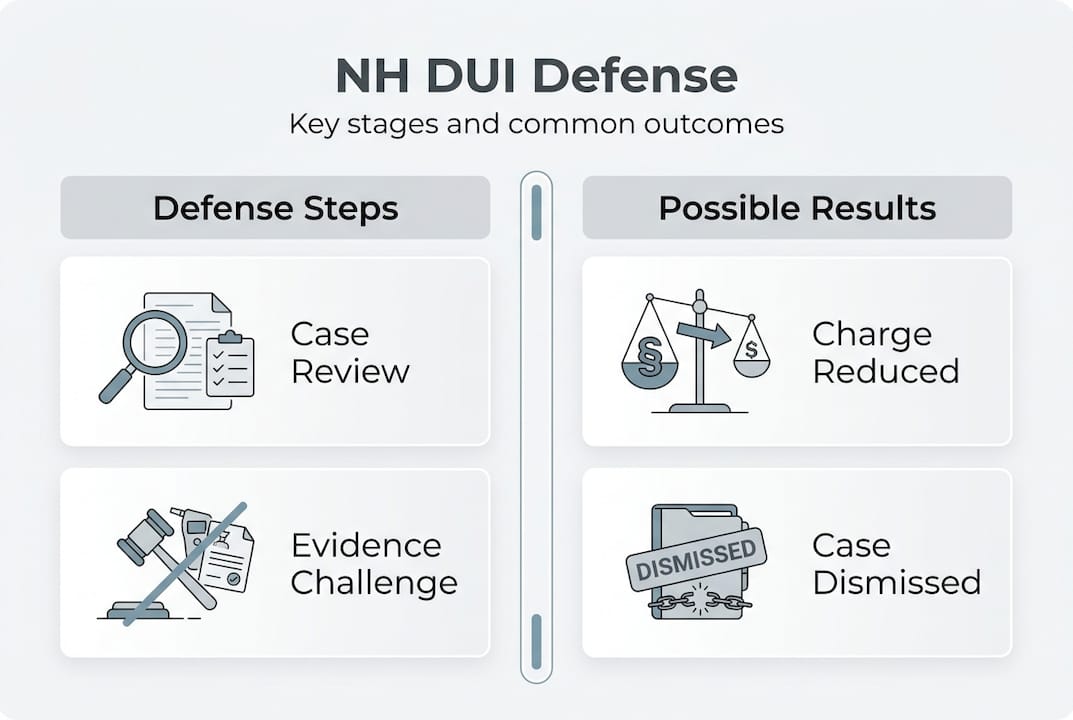
Anecdotal evidence from law firms shows frequent charge reductions and dismissals through skilled negotiation, though New Hampshire doesn’t publish statewide empirical success rates. Defense outcomes depend heavily on case-specific factors including BAC level, accident involvement, cooperation with officers, and available evidence quality. Understanding these variables helps set realistic expectations for your situation.
| Case Resolution | Typical Conditions | Common Scenarios |
|---|---|---|
| Charge Reduction | Reduced to reckless driving or negligent operation | First offense, borderline BAC, no accident, procedural issues |
| Case Dismissal | All charges dropped | Illegal stop, suppressed evidence, rights violations, failed prosecution burden |
| Diversion Program | Complete education/treatment, charges dismissed after compliance | First offense, low BAC, willingness to participate |
| Conviction with Minimum Penalties | Fines, short license suspension, probation | Strong evidence, cooperation, mitigating circumstances |
| Full Conviction | Maximum statutory penalties | High BAC, accident, injuries, prior offenses, aggravating factors |
Several factors significantly influence defense success in New Hampshire courts. Your criminal history plays a major role, with first offenders receiving more lenient treatment than repeat DUI defendants. BAC level matters because higher concentrations reduce negotiation leverage and increase mandatory penalties. Accident involvement, especially with injuries, severely limits defense options and increases potential consequences. Evidence quality determines whether cases settle favorably or require trial to challenge weak prosecution proof.
Maximizing your defense effectiveness requires active participation and strategic choices:
- Hire experienced DUI defense counsel immediately after arrest
- Provide complete, honest information about the incident to your attorney
- Follow all court requirements and conditions precisely
- Document any medical conditions or medications affecting test results
- Avoid discussing your case on social media or with anyone except your lawyer
- Attend all scheduled court appearances and meetings with your attorney
Understanding the complete DUI process helps you navigate each stage effectively. From initial arrest through final resolution, knowing what to expect reduces anxiety and enables better decision making. Your attorney guides you through arraignment, pretrial conferences, motion hearings, and either plea negotiations or trial. Each stage presents opportunities to strengthen your defense or negotiate favorable terms.
Legal representation quality directly correlates with case outcomes. Attorneys familiar with New Hampshire DUI law identify defenses that general practitioners miss. They know which experts to consult for blood test challenges or medical condition defenses. They recognize when prosecutors overreach and when offered deals represent genuine value. This expertise proves invaluable from your first court appearance through final case resolution.
Pro Tip: Start gathering character references, employment records, and community involvement documentation early. These materials demonstrate your value to society and provide leverage during plea negotiations or sentencing hearings.
How Naro Law helps with DUI defense in New Hampshire
Facing DUI charges requires experienced legal counsel who understands New Hampshire’s complex criminal defense landscape. Naro Law brings extensive expertise in DUI and DWI defense across the state, combining aggressive advocacy with personalized attention to each client’s unique situation. Our legal team thoroughly investigates every aspect of your case, from traffic stop legality to testing procedure compliance, identifying weaknesses in prosecution evidence that create defense opportunities.
We provide comprehensive support throughout the entire legal process. Our services include detailed case evaluation, evidence analysis, witness interviews, expert consultation, plea negotiation, and trial representation when necessary. Whether your case requires challenging field sobriety tests, disputing breathalyzer accuracy, or arguing procedural violations, our top DWI lawyers develop strategies tailored to your specific circumstances. Our criminal defense team works tirelessly to protect your rights and secure the best possible outcome. Contact Naro Law today for a consultation and take the first step toward effective DUI defense.
Frequently asked questions
Can you get a DUI in a parked car in New Hampshire?
Yes, New Hampshire law allows DUI charges based on actual physical control rather than active driving. If you’re in the driver’s seat with keys in the ignition while impaired, prosecutors may charge you even if the vehicle never moved. Defense strategies focus on proving lack of intent to drive or demonstrating the vehicle was inoperable, creating reasonable doubt about whether you actually controlled the car.
How reliable are field sobriety tests in New Hampshire DUI cases?
Field sobriety tests carry error rates of 20-25% due to subjective scoring and multiple factors affecting performance. Medical conditions, age, weight, footwear, road surface quality, weather conditions, and officer training all impact results independent of alcohol impairment. Defense attorneys regularly challenge these tests by demonstrating alternative explanations for poor performance, making them less reliable than prosecutors claim.
What determines whether a DUI case goes to trial or results in a plea deal?
Evidence strength primarily determines resolution strategy. Cases with solid prosecution evidence, including high BAC readings and proper procedures, typically resolve through plea bargaining because negotiation offers better outcomes than trial. Conversely, cases with procedural violations, questionable evidence, or weak probable cause often proceed to trial where defense attorneys can challenge the prosecution’s ability to prove guilt beyond reasonable doubt.
What are the most common defenses against DUI charges in New Hampshire?
The most effective defenses challenge evidence reliability and procedural compliance. Attorneys dispute field sobriety test accuracy based on medical conditions or environmental factors, question breathalyzer calibration and maintenance, argue illegal traffic stops lacking probable cause, and identify Miranda rights violations. For parked car cases, lawyers argue lack of intent to operate the vehicle or prove it was mechanically inoperable at the time of arrest.
How does having a prior DUI affect my current case in New Hampshire?
Prior DUI convictions significantly impact current charges by triggering enhanced penalties and reducing negotiation flexibility. Second and subsequent offenses carry mandatory minimum jail time, longer license suspensions, and higher fines that prosecutors cannot negotiate below statutory minimums. However, experienced defense counsel can still challenge evidence quality, argue mitigating circumstances, and work within statutory ranges to minimize consequences even with prior convictions on your record.


