

TL;DR:
- Family law in New Hampshire covers divorce, custody, child support, alimony, and domestic violence protection.
- Most custody cases are resolved through mediation, focusing on the best interests of the child.
- Proper understanding of rules around mediation, modification, and domestic violence is crucial to avoid costly mistakes.
Family law in New Hampshire covers far more ground than most people realize. Many assume it’s simply about ending a marriage, but the reality is that it also governs how parents share time with their children, how financial support is calculated, and how courts protect individuals from domestic violence. Misunderstanding these boundaries can lead to costly mistakes, missed deadlines, and lost rights. This guide walks you through the core areas of NH family law, what to expect at each stage, and how to protect yourself and your family throughout the process.
Table of Contents
- What family law covers in New Hampshire
- Divorce in New Hampshire: Process, grounds, and property division
- Child custody and parental rights: How decisions are made
- Complex issues: Domestic violence, relocation, and modifications
- What most NH families overlook about family law
- Get support from New Hampshire family law experts
- Frequently asked questions
Key Takeaways
| Point | Details |
|---|---|
| Family law scope | It covers divorce, custody, support, and protection from abuse in New Hampshire. |
| No-fault divorce | Most NH divorces proceed on no-fault grounds and resolve faster than contested cases. |
| Custody focuses on child’s needs | Courts use the best interest standard and resolve most cases through mediation, not litigation. |
| Modifications require change | Court orders like custody or support can only be altered with a substantial, unanticipated change. |
| Expert advice helps | Family law is complex and compassionate, experienced legal counsel can help you navigate your options. |
What family law covers in New Hampshire
Now that you know family law covers more than divorce, let’s clarify what falls under its umbrella in New Hampshire. Family law in NH is the branch of law governing family relationships, including divorce, child custody (termed parental rights and responsibilities), child support, alimony, and domestic violence protective orders. Each area has its own rules, timelines, and court procedures.
Family law cases rarely exist in isolation. A divorce, for example, almost always triggers questions about child custody, property division, and spousal support at the same time. Understanding how these areas connect helps you anticipate what’s ahead.
Here are the primary areas covered under NH family law:
- Divorce: Legal dissolution of a marriage, including property and debt division
- Parental rights and responsibilities: NH’s term for child custody and visitation, covering both legal and physical arrangements. Learn more about parental rights explained
- Child support: Financial contributions from each parent toward a child’s living expenses
- Alimony (spousal support): Payments made by one spouse to support the other after separation
- Domestic violence protective orders: Court orders that restrict contact and protect victims from harm
| Family law area | Common questions and issues |
|---|---|
| Divorce | How is property split? How long does it take? |
| Parental rights | Who decides where the child lives? What about school decisions? |
| Child support | How is the amount calculated? Can it be changed? |
| Alimony | Who qualifies? For how long? |
| Domestic violence | How do I get a protective order? Does it affect custody? |
Divorce in New Hampshire: Process, grounds, and property division
Once you see what family law can cover, it’s clear that divorce is often the starting point for many who seek help. Here’s what the process involves.
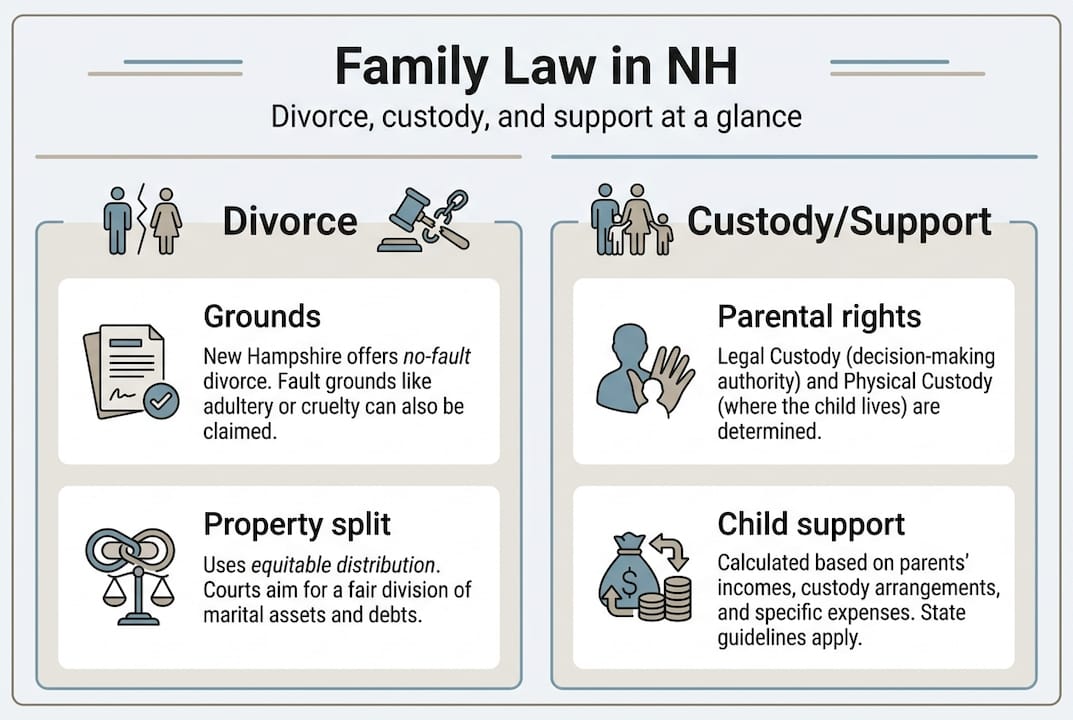
NH recognizes two types of divorce. A no-fault divorce is filed on the grounds of irreconcilable differences under RSA 458:7-a, meaning neither spouse has to prove wrongdoing. A fault-based divorce requires proving specific grounds such as adultery or cruelty. Most couples choose the no-fault route because it’s faster and less adversarial.
The NH divorce process follows equitable distribution rules under RSA 458:16-a, which presumes an equal but fair split of marital property based on factors like marriage length, each spouse’s contributions, and financial circumstances. “Equitable” does not always mean 50-50. It means what is fair given the full picture.
Here’s a basic walkthrough of the process:
- File a petition for divorce with the NH Superior or Circuit Court
- Serve your spouse with legal notice
- Attend mediation if required
- Negotiate or litigate issues like property, support, and custody
- Receive the final divorce decree from a judge
| Divorce type | Grounds | Typical timeline |
|---|---|---|
| No-fault | Irreconcilable differences | 2 to 3 months (uncontested) |
| Fault-based | Adultery, cruelty, abandonment | 8 to 18 months (contested) |
Residency requirements apply: at least one spouse must have lived in NH for one year, or both must be domiciled in the state at the time of filing.
Pro Tip: If you and your spouse agree on all major issues, an uncontested divorce is significantly faster and less expensive. Consider filing for divorce in NH with legal guidance to avoid procedural errors that could delay your case.
Child custody and parental rights: How decisions are made
Divorce and separation often raise critical questions about your children. Let’s explore how the law handles custody and parental rights.

New Hampshire does not use the word “custody” in the traditional sense. Instead, the state refers to parental rights and responsibilities, which covers both decision-making authority (legal responsibility) and where the child primarily lives (residential responsibility). Importantly, NH law is gender-neutral. There is no preference for mothers over fathers.
Most custody cases never reach a courtroom. 75% of custody cases in NH are resolved through mediation, where parents work with a neutral third party to reach an agreement. This is usually faster, less costly, and less stressful for children.
“75% of custody cases in New Hampshire are resolved via mediation, not courtroom battles.”
When courts do decide, they focus on the best interests of the child. Factors include:
- The child’s relationship with each parent
- Each parent’s ability to meet the child’s physical and emotional needs
- The child’s adjustment to home, school, and community
- Any history of domestic violence or abuse
- The child’s own preferences, depending on age and maturity
Changing a custody order after it’s been issued is not easy. Courts require a substantial, unanticipated change in circumstances before they will revisit an arrangement. Understanding the parental rights workflow from the start helps you avoid decisions that could hurt you later. If modification becomes necessary, learn what’s involved in how to modify custody before filing.
Pro Tip: Document your involvement in your child’s daily life from the beginning. School pickups, medical appointments, and extracurricular activities all matter when courts assess parenting roles.
Complex issues: Domestic violence, relocation, and modifications
Even after a family law order is issued, life sometimes throws curveballs. Here’s what happens with complex or high-conflict situations.
When domestic violence is present, the standard family law process changes significantly. Under NH custody nuances, domestic violence allegations screen out mediation and can prevent joint custody arrangements entirely. Courts take these allegations seriously, and a protective order can directly affect parenting time and residential arrangements.
If you need to relocate with your child after a custody order is in place, NH law requires 60 days’ written notice to the other parent under RSA 461-A:12. Failing to provide this notice can result in serious legal consequences, including contempt of court.
Modifying any existing family law order requires meeting a high legal threshold. Here’s what the process generally involves:
- Identify a substantial and unanticipated change in circumstances (required under RSA 461-A:11)
- File a motion to modify with the court that issued the original order
- Serve the other party and allow time for a response
- Attend a hearing where both sides present evidence
Common reasons courts may consider a modification:
- A significant change in a parent’s work schedule or living situation
- A child’s changing needs due to age, health, or education
- Evidence of a new safety concern
- Violation of an existing parenting plan
For support-related changes, the same principle applies. Review your options for modifying custody and support carefully before filing.
What most NH families overlook about family law
After unpacking the core topics, there’s one insight worth emphasizing that rarely appears in court documents: the biggest risks in NH family law often come not from the obvious legal battles, but from underestimating the rules around mediation, modification, and domestic violence protection.
Mediation isn’t just a formality. It decides most outcomes. If you enter it unprepared or without legal guidance, you may agree to terms that are difficult to change later. Many parents also assume they can revisit custody arrangements whenever circumstances shift, but courts set a high bar for what counts as “substantial” change.
Reviewing the parental rights checklist before any proceeding can help you avoid these common and costly oversights.
Get support from New Hampshire family law experts
If you’re facing a family law challenge, you don’t have to go it alone. At Naro Law, we work with NH families navigating divorce, custody disputes, support modifications, and domestic violence matters every day. Our approach is straightforward: we listen, we explain your options clearly, and we advocate for outcomes that protect you and your children. Whether you need to speak with a family law attorney or want to start by reviewing family law terms explained, we’re here to help. You can also explore real NH case examples to see how cases like yours have been handled.
Frequently asked questions
What is the difference between family law and divorce law in New Hampshire?
Family law covers all legal aspects of family relationships, including divorce, custody, support, and protective orders, while divorce law specifically addresses ending a marriage. Divorce is one part of a much broader legal framework.
How long does a typical divorce take in NH?
An uncontested divorce usually takes 2 to 3 months, while a contested case can take 8 to 18 months depending on the complexity of the issues involved.
What does ‘equitable distribution’ mean for property division?
Equitable distribution means property is divided fairly, not always 50-50, based on factors like marriage length, each spouse’s financial contributions, and overall circumstances.
When can a custody order be changed in NH?
Custody can only be changed if there’s a substantial, unanticipated change in circumstances, as required under RSA 461-A:11. Minor or expected changes generally do not meet this standard.
Does NH family law favor mothers over fathers in custody cases?
No. NH law is gender-neutral and does not give preference to mothers. Courts focus solely on the best interests of the child when making custody decisions.


