

TL;DR:
- Legal custody grants parents the authority to make major decisions regarding a child’s education, health, and religion, distinct from where the child physically resides. Courts prioritize the child’s best interest by evaluating parental involvement, stability, cooperation, and relationships when determining custody arrangements, emphasizing formal court orders over informal agreements. Effective communication, documentation, and early planning are crucial for navigating legal custody challenges and ensuring the child’s welfare.
When parents separate or divorce, one of the first questions that comes up is: what is legal custody, and how is it different from where my child lives? Many parents assume custody is simply about which home a child sleeps in. That assumption can lead to costly misunderstandings. Legal custody is about decision-making power, not physical presence. This guide explains what legal custody covers, the types courts recognize, how judges make their determinations, and what your rights look like in practice.
Table of Contents
- Key takeaways
- What is legal custody and how it differs from physical custody
- Types of legal custody and what each means for parents
- How courts determine legal custody
- Managing legal custody in real life
- My perspective on legal custody arrangements
- How Naro Law can help with your custody case
- FAQ
Key takeaways
| Point | Details |
|---|---|
| Legal custody means decision-making | It governs who has the right to make major choices about a child’s education, health, and religion. |
| It differs from physical custody | Physical custody determines where a child lives; legal custody is entirely about authority over decisions. |
| Two main types exist | Joint legal custody requires cooperation; sole legal custody gives one parent full decision-making authority. |
| Courts follow the best interest standard | Judges look at parental involvement, stability, and co-parenting ability rather than parental preference. |
| Court orders are required | Without a formal order, both parents retain equal rights to make decisions for the child. |
What is legal custody and how it differs from physical custody
Legal custody is the legal authority to make significant decisions in a child’s life. These decisions span four core areas: education, healthcare, religion, and general welfare. Think about choosing a school, consenting to a surgical procedure, deciding whether a child participates in a particular religious tradition, or approving enrollment in competitive sports. All of those fall under legal custody.
Physical custody, by contrast, determines where the child primarily lives and which parent manages day-to-day routines. The two types of custody are separate legal concepts, and they can be divided differently between parents. A court can grant one parent sole physical custody while both parents share legal custody. Equally, a court might grant sole legal custody alongside joint physical custody when parents can share parenting time but cannot cooperate on major decisions.
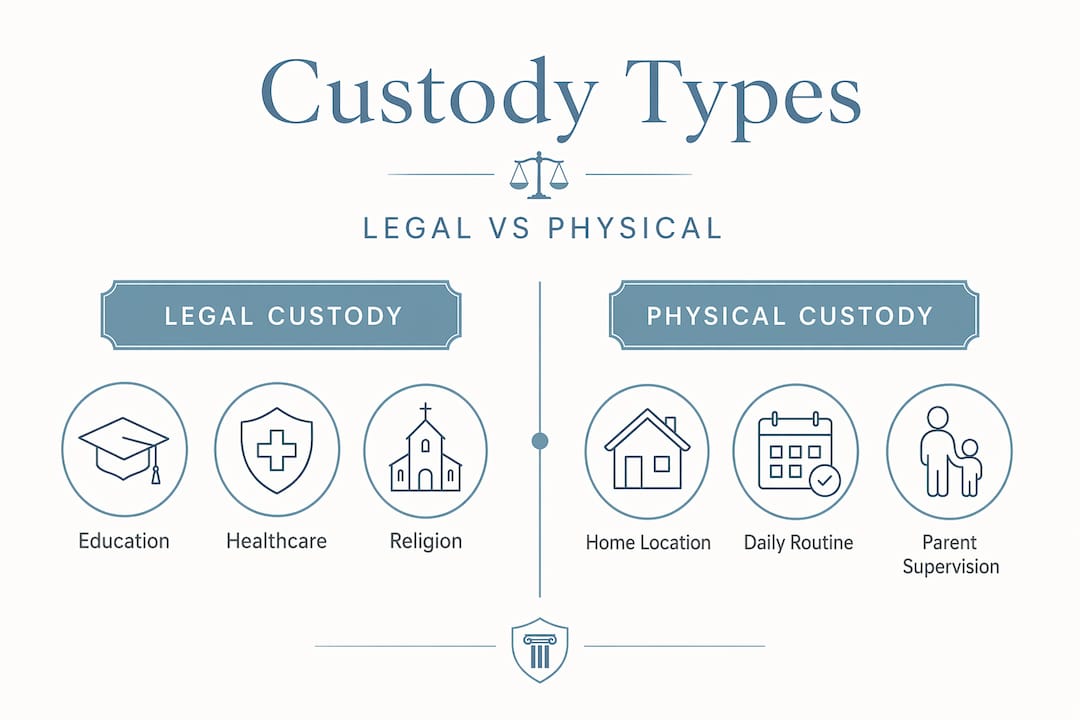
Here is a side-by-side comparison to make the distinction clear:
| Aspect | Legal custody | Physical custody |
|---|---|---|
| Core focus | Decision-making authority | Where the child resides |
| Examples | School choice, medical consent, religion | Daily schedule, meals, homework supervision |
| Can be shared? | Yes, through joint legal custody | Yes, through joint physical custody |
| Can be held separately? | Yes, one parent can hold each type | Yes, different arrangements are possible |
| Governed by | Formal court order | Formal court order |
Key decisions covered under legal custody include:
- Selecting a school or educational program
- Authorizing medical or dental procedures
- Determining religious participation and upbringing
- Approving participation in extracurricular activities
- Making mental health care decisions
Types of legal custody and what each means for parents
Joint legal custody
Joint legal custody means both parents share the authority to make major decisions for the child. This is the most common arrangement courts award today because it keeps both parents actively involved in the child’s life. However, it carries a real requirement: both parents must communicate and collaborate, even when their relationship is strained.

Joint legal custody works best when parents share similar values around parenting and can set aside personal conflict for the child’s benefit. When disagreements arise about a major decision, such as which school a child should attend, both parents are expected to work toward an agreement.
Joint legal custody does come with a clear legal boundary. Making unilateral decisions under a joint legal custody order can expose a parent to contempt of court. For example, if one parent enrolls a child in a new school without the other’s consent, a judge can hold that parent legally accountable.
Sole legal custody
Sole legal custody grants one parent the exclusive authority to make major decisions for the child without requiring input from the other parent. Courts typically award this when:
- There is a documented history of severe conflict between the parents
- One parent has been absent or minimally involved
- Domestic violence or abuse has been established
- Communication between the parents has completely broken down
When courts award sole legal custody, the reasoning is usually to avoid decision-making gridlock that would harm the child’s stability and welfare. The non-custodial parent may still have visitation or parenting time, but they do not hold the authority to make major decisions independently.
Pro Tip: If you hold joint legal custody, document major decisions in writing and communicate through a co-parenting app or email. This creates a paper trail that protects both parents and keeps discussions focused on the child.
How courts determine legal custody
Courts do not award custody based on which parent asks for it most assertively. Instead, judges follow the best interest of the child standard, which is the governing principle in custody law across all U.S. states. State statutes govern custody arrangements and require formal court proceedings to assign legal custody rights. An informal agreement between parents carries no legal weight without a judge’s approval.
When evaluating what arrangement serves the child’s best interest, courts typically examine the following factors:
- Each parent’s history of involvement. Which parent has been the primary caregiver? Who attends medical appointments, school events, and parent-teacher conferences?
- Stability each parent can provide. Judges look at housing, employment, and the consistency of the child’s current routine.
- Co-parenting ability. Courts assess whether both parents can communicate and cooperate. Parental ability to cooperate weighs heavily in joint custody determinations.
- The child’s established relationships. Siblings, extended family, and close friendships factor into maintaining the child’s sense of continuity.
- Each parent’s willingness to support the other’s relationship with the child. A parent who actively interferes with the other’s access is viewed unfavorably.
If you are heading into a custody proceeding, understanding NH child custody laws early gives you a significant advantage in preparing your case. Documentation, consistency, and demonstrated involvement all signal to the court that you are a capable and committed parent.
Managing legal custody in real life
Even with a clear court order in place, legal custody arrangements generate practical challenges that parents often do not anticipate.
When both parents hold joint legal custody, minor day-to-day decisions like what a child eats or what time they go to bed do not require mutual agreement. The scope of legal custody is reserved for major decisions. That distinction matters because it prevents one parent from weaponizing the custody arrangement over routine parenting choices.
Here is where things can get complicated:
- Disagreements about healthcare. If one parent wants a child to receive a particular medical treatment and the other does not agree, neither parent can act alone under joint legal custody. Mediation or a return to court may be necessary.
- School changes mid-year. A parent who relocates and wants to enroll the child in a new school must get the other parent’s consent or seek a court modification.
- Religious differences. Courts rarely override a parent’s right to expose a child to their own faith, but forcing a child to abandon the other parent’s religious traditions without consent can become a legal issue.
Pro Tip: When you and your co-parent reach an agreement on a major decision, put it in writing and retain a copy. If disputes arise later, that documentation can support your position in court.
Legal recourse exists when one parent violates the custody order. You can file a motion for contempt, seek modification of the custody arrangement, or in serious cases, request a change in primary custody. Understanding the custody workflow in New Hampshire can help you take the right procedural steps without delay.
My perspective on legal custody arrangements
I’ve worked with families at some of the most stressful points in their lives, and what I’ve seen consistently surprises people: most custody disputes are not really about the law. They are about communication that broke down long before anyone filed paperwork.
What I’ve learned is that parents who underestimate legal custody tend to treat it as a formality. They focus almost entirely on the parenting schedule, on who gets the holidays and how many overnights each month, while glossing over the decision-making framework entirely. Then a medical situation arises, or a school transfer is needed, and suddenly neither parent is sure who has the authority to act. That uncertainty is avoidable.
The parents who navigate joint legal custody successfully are not the ones who agree on everything. They are the ones who agreed on a process: how they will communicate, how quickly they will respond, and what happens when they cannot reach agreement. Building that structure early, ideally before the divorce is finalized, makes every future decision easier.
My honest advice is to treat legal custody as the foundation of your post-divorce parenting relationship, not an afterthought. Get clarity now. It costs far less in time, money, and stress than resolving a legal dispute over a school enrollment form two years from now.
— Rich
How Naro Law can help with your custody case
Legal custody questions rarely have simple answers, especially when parents are in conflict or navigating New Hampshire’s specific statutes. Narolaw’s family law attorneys in Manchester provide the kind of personalized, experience-backed guidance that general online resources cannot replicate. Whether you are working toward a joint custody agreement, seeking sole legal custody due to ongoing conflict, or trying to modify an existing order, Narolaw’s team approaches each case with focus on the child’s welfare and your rights as a parent. You can also explore NH divorce and custody topics to build a stronger foundation before your first consultation. Reach out to Narolaw today to schedule a free consultation and get real clarity on your custody situation.
FAQ
What does legal custody actually cover?
Legal custody covers the right to make major decisions about a child’s education, healthcare, religion, and welfare. It does not govern day-to-day parenting decisions like meals or bedtime routines.
What is the difference between legal and physical custody?
Legal custody addresses decision-making authority, while physical custody determines where the child lives. Both can be held independently, meaning one parent can have sole legal custody while physical custody is shared.
Can both parents have legal custody after a divorce?
Yes. Joint legal custody is common after divorce and requires both parents to agree on major decisions. Courts award it when parents demonstrate they can communicate and cooperate in the child’s interest.
What happens if one parent violates a legal custody order?
A parent who makes major decisions without the other’s consent under a joint legal custody order can be held in contempt by the court. Consequences can include fines, custody modifications, or other legal penalties.
How does a court decide who gets legal custody?
Courts apply the best interest of the child standard, evaluating parental involvement, stability, and cooperation ability. A parent’s history of involvement and willingness to support the other’s relationship with the child are significant factors.


