

TL;DR:
- Legal separation in New Hampshire involves a court-ordered arrangement that keeps the marriage intact while formalizing custody, support, and property agreements. It differs from divorce in that it preserves marital status, allows continued health insurance coverage, and prevents remarriage until a final divorce is granted. Many misconceptions exist, such as believing informal agreements or simply moving out constitute legal separation, which can lead to legal vulnerabilities without court enforcement.
Legal separation is a court-approved process where a married couple lives apart and formalizes arrangements for custody, support, and property while remaining legally married. Unlike divorce, it does not end the marriage. For New Hampshire residents weighing their options, this distinction carries real consequences for finances, health insurance, parenting rights, and the possibility of reconciliation. Understanding the legal separation definition clearly is the first step toward making a decision that fits your situation, your family, and your future.
What is legal separation and how does it work in New Hampshire?
New Hampshire courts treat legal separation similarly to divorce in terms of the orders they issue, but with one critical difference: the marriage itself remains intact. A court can address custody, parenting, and support through a separation order, and it can divide property and assign financial responsibilities, all without dissolving the marital bond.
The process of legal separation in New Hampshire typically follows these steps:
- File a petition with the court. One or both spouses submit a formal petition requesting a separation order. This initiates the court’s jurisdiction over the matter.
- Serve the other spouse. The non-filing spouse must be formally notified and given the opportunity to respond.
- Negotiate or litigate key issues. The court addresses custody arrangements, child support, spousal support, and property division, just as it would in a divorce proceeding.
- Receive a court order. The judge issues a legally binding separation order that governs the couple’s rights and obligations while they remain married.
One point that surprises many people: court orders are required for these arrangements to be legally enforceable. A private agreement between spouses, even a written one, does not carry the same legal weight as a court order.
Pro Tip: If you and your spouse have reached informal agreements about finances or parenting, do not assume those agreements are enforceable. Only a court-issued order provides the legal protection you need if circumstances change.

How does legal separation compare to divorce in New Hampshire?
The differences between separation and divorce go beyond the obvious. Yes, divorce ends the marriage and separation does not. But the practical implications reach further than most people initially realize.
| Issue | Legal separation | Divorce |
|---|---|---|
| Marital status | Remains married | Marriage legally ended |
| Remarriage | Not permitted | Permitted after finalization |
| Health insurance | Often retained through spouse’s plan | Typically lost upon divorce |
| Reconciliation | Separation order can be canceled | Requires a new marriage license |
| Property division | Court divides assets and debts | Court divides assets and debts |
| Tax filing | May still file jointly | Must file separately or as single |
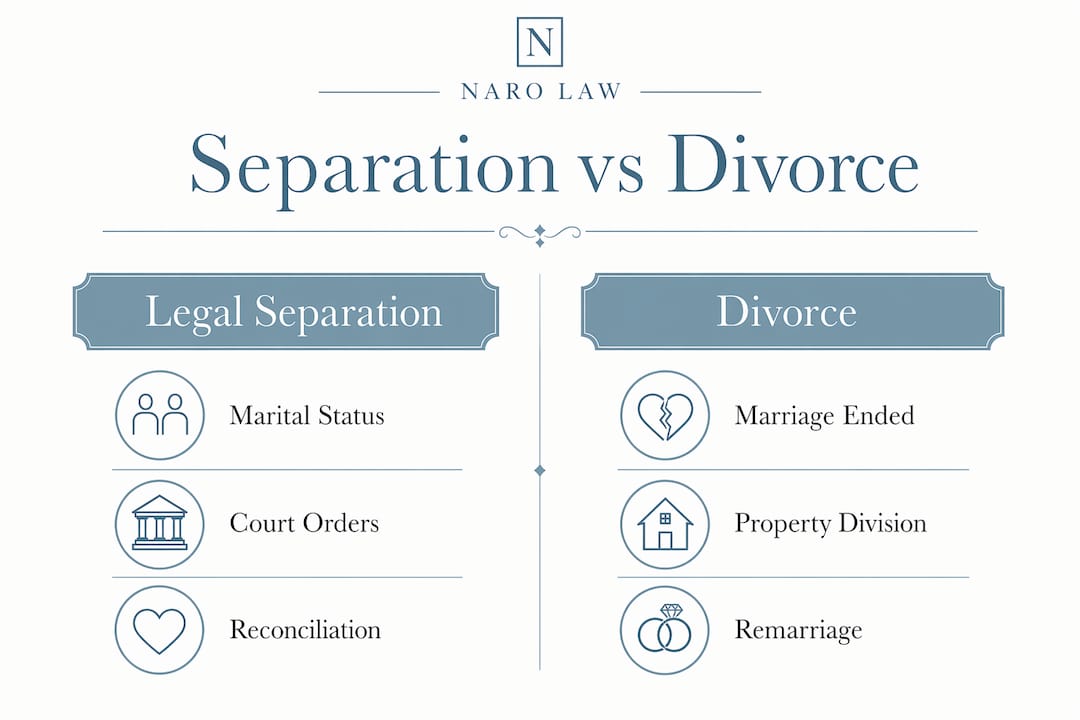
Because marriage is not legally ended during separation, spouses retain certain rights they would lose in divorce. The most significant of these is health insurance coverage. Many employer-sponsored health plans allow a legally married spouse to remain on the other’s policy, while a divorce typically triggers immediate loss of that coverage.
Reconciliation also works differently under each status. After legal separation, reconciliation occurs by canceling the court’s judgment of separation, which is a relatively straightforward legal step. After divorce, the couple would need to obtain a new marriage license and remarry entirely. For couples who are uncertain about the permanence of their decision, this distinction matters.
The inability to remarry is the most significant limitation of legal separation. If either spouse meets someone new and wants to marry, they cannot do so without first obtaining a divorce. This is a factor worth weighing carefully before choosing separation over divorce.
What are the practical implications of choosing legal separation?
Legal separation legally divides finances and property but does not dissolve the marriage. That combination creates a specific set of benefits and limitations that are worth examining honestly.
Benefits of legal separation include:
- Retaining health insurance and other marital benefits through your spouse’s employer plan
- Remaining next of kin for medical decision-making purposes
- Preserving Social Security benefits tied to the length of the marriage
- Allowing time to assess whether divorce is truly the right path
- Accommodating religious beliefs that prohibit divorce
Limitations to understand before proceeding:
- You cannot remarry while legally separated
- You may still be financially connected to your spouse’s debts in certain circumstances
- The legal process involves court costs and attorney fees similar to divorce
- Separation does not automatically convert to divorce; you must file separately for that
Legal separation can be a transitional step that allows couples to maintain benefits and test reconciliation before committing to divorce. For some families, this breathing room is exactly what they need. For others, it simply delays an inevitable outcome and adds legal costs along the way.
Tax implications also deserve attention. Separated spouses who remain legally married may still have the option to file jointly, which can carry significant financial advantages. However, joint filing also means shared responsibility for any tax liability. If your spouse has tax issues, you could be affected. Consulting a tax professional alongside your family law attorney is worth the time. Resources like innocent spouse relief exist for situations where one spouse is held liable for the other’s tax obligations, and understanding your exposure before finalizing any legal arrangement is prudent.
Pro Tip: Ask your family law attorney to walk through the specific financial benefits you currently receive as a married couple. Knowing exactly what you stand to lose or retain under a separation order versus a divorce will sharpen your decision considerably.
How to decide if legal separation is right for you
Choosing between legal separation and divorce is not a one-size-fits-all decision. The right path depends on your specific circumstances, your goals, and your family’s needs. Work through these questions before deciding:
- Do you have religious or moral objections to divorce? Legal separation allows you to live apart and formalize arrangements without violating those beliefs.
- Do you rely on your spouse’s health insurance? If losing coverage would create a serious financial or medical hardship, separation may protect you while you explore alternatives.
- Are you uncertain about the permanence of the split? Separation preserves the option to reconcile without the legal complexity of remarriage.
- Do you have children? Both separation and divorce address custody and support through court orders, but the emotional context differs. Some parents prefer to avoid the finality of divorce while children are young.
- Are you close to a milestone that benefits from marital status? Social Security eligibility, pension benefits, and certain tax advantages can depend on the length of a marriage.
Legal separation is a strategic choice for couples with religious objections to divorce or financial reasons to remain married. That said, if reconciliation is genuinely off the table and neither spouse has a compelling reason to remain legally married, divorce may be the more direct and cost-effective path. Reviewing your options with a New Hampshire family law attorney who understands the local court system will give you the clearest picture of what each choice means for your specific situation.
Key takeaways
Legal separation in New Hampshire is a court-ordered status that formalizes parenting, financial, and property arrangements while keeping the marriage legally intact, making it a meaningful alternative to divorce for couples who are not ready to permanently end their marriage.
| Point | Details |
|---|---|
| Legal separation defined | A court order formalizes custody, support, and property while the marriage remains intact. |
| New Hampshire process | Filing a petition triggers court orders covering parenting, support, and property division. |
| Key difference from divorce | Separation preserves marital status; divorce ends it and permits remarriage. |
| Retained benefits | Health insurance, next-of-kin rights, and Social Security eligibility may be preserved. |
| Reconciliation advantage | Canceling a separation order is simpler than obtaining a new marriage license after divorce. |
What I’ve seen that most articles get wrong about legal separation
Rich here. After working with New Hampshire families through separation and divorce proceedings, the single most common misunderstanding I encounter is this: people believe that moving out and reaching a private agreement with their spouse constitutes legal separation. It does not.
A handshake deal, or even a signed document between spouses, carries no court-enforced weight. If your spouse stops paying support or violates a custody arrangement you agreed to privately, you have no immediate legal remedy without going back to court to establish an order in the first place. That delay can cost you time, money, and stability at the worst possible moment.
The second thing I see consistently is that people choose separation as a way to avoid making a hard decision, rather than as a deliberate legal strategy. Separation has real costs, both financial and emotional. It works well when there is a clear reason to preserve the marriage legally. It works poorly as an indefinite holding pattern. If you are considering this path, go in with a clear purpose and a realistic timeline. Talking with an attorney early, before you file anything, will save you from decisions that are difficult to undo.
How Naro Law can help with your separation
Naro Law works with New Hampshire residents facing exactly these decisions every day. Whether you are weighing legal separation and divorce options or need representation through a court proceeding, the firm’s family law practice covers custody, support, property division, and the full range of separation-related matters. Understanding family law in New Hampshire is the foundation for making informed choices about your marriage and your family’s future. Naro Law offers free consultations so you can get clear answers before committing to any course of action. Reach out to schedule yours.
FAQ
What is the legal separation definition?
Legal separation is a court-approved status where a married couple lives apart and has formal orders governing custody, support, and property, while remaining legally married. It does not end the marriage the way divorce does.
Can you get legally separated in New Hampshire?
New Hampshire courts issue separation orders that address custody, support, and property division, similar to divorce proceedings, but the marriage remains legally intact. You cannot remarry while under a separation order.
What are the main differences between separation and divorce?
Divorce ends the marriage and permits remarriage; legal separation does not. Separated spouses may retain health insurance coverage and next-of-kin rights that are typically lost upon divorce.
How does reconciliation work after legal separation?
After legal separation, reconciliation occurs by canceling the court’s separation judgment, which is simpler than remarrying after a divorce, which requires a new marriage license.
Is a private separation agreement the same as legal separation?
No. Private agreements differ from court-ordered separations in enforceability. Only a court-issued order gives you legal recourse if your spouse fails to meet agreed obligations.


