

Many people assume that handling a divorce without legal help is the smart, cost-saving choice. That assumption can be costly. Self-representation risks errors in paperwork, missed deadlines, and unfair settlements, especially when children, significant assets, or shared debts are involved. New Hampshire divorce law is detailed, procedurally demanding, and easy to misread without formal training. This guide walks you through the specific legal requirements, the real risks of going it alone, and the concrete ways a qualified divorce attorney protects your rights, your finances, and your future.
Table of Contents
- Understanding New Hampshire divorce laws and requirements
- The real risks of representing yourself (pro se)
- When does hiring a divorce lawyer make the biggest difference?
- How a lawyer protects your rights, assets, and future
- Cost-effective strategies for hiring a divorce lawyer in New Hampshire
- Get experienced divorce help in New Hampshire
- Frequently asked questions
Key Takeaways
| Point | Details |
|---|---|
| New Hampshire divorce is complex | Required forms, disclosures, and rules make expert guidance extremely valuable. |
| DIY mistakes are costly | Self-representation can lead to errors that hurt finances, custody, and legal standing. |
| Lawyer helps protect your rights | A divorce attorney advocates for fair settlement, proper asset division, and your parental rights. |
| Affordable options exist | Limited-scope or mediation services offer legal support without breaking your budget. |
Understanding New Hampshire divorce laws and requirements
Once you realize what’s at stake, it’s essential to understand the specific rules New Hampshire sets for every divorce. The state’s divorce process is not simply a matter of filling out a few forms and submitting them to a courthouse. It involves a structured set of legal requirements that vary depending on whether children are involved, how assets are held, and whether both parties agree on the terms.
New Hampshire requires specific forms including financial affidavits, parenting plans, and compliance with procedural rules such as Rule 1.25-A for mandatory disclosures. These documents must be accurate, complete, and filed correctly. A single error can delay your case or result in an unfavorable ruling.
Here is a breakdown of the core requirements and who they apply to:
| Requirement | Who it applies to |
|---|---|
| Financial affidavit | All divorcing parties |
| Parenting plan | Couples with minor children |
| Rule 1.25-A disclosures | All parties in contested cases |
| Child Impact Program | Parents with minor children |
| Petition for divorce | All divorcing parties |
Key documents and steps involved in the filing for divorce process include:
- Financial affidavit: A sworn statement of your income, expenses, assets, and debts
- Parenting plan: A written agreement covering custody, visitation, and decision-making for children
- Rule 1.25-A disclosures: Mandatory exchange of financial and property information between both parties
- Child Impact Program: A required educational program for divorcing parents in New Hampshire
- Petition for divorce: The formal legal document that initiates the divorce proceeding
Each of these carries legal weight. Missing or incorrectly completing any one of them can set your case back significantly.
The real risks of representing yourself (pro se)
With these requirements established, the next concern is what can happen if you try to manage all this alone. Representing yourself in a divorce, known legally as going “pro se,” is allowed in New Hampshire. But allowed does not mean advisable.
Self-representation risks errors in paperwork, missed deadlines, and unfair settlements, particularly when assets, debts, or children are involved. The most common mistakes made by self-represented individuals include:
- Filing incomplete or inaccurate financial affidavits
- Missing court deadlines that result in default judgments
- Agreeing to property divisions that are legally unenforceable
- Failing to account for retirement accounts, pensions, or business interests
- Overlooking tax consequences of asset transfers
- Submitting parenting plans that courts reject as insufficient
These errors are not just inconvenient. They can cost you thousands of dollars to correct, or in some cases, they cannot be corrected at all once a judge signs the final decree.

Pro Tip: If your divorce is genuinely simple, meaning no children, minimal shared assets, and full agreement on all terms, a limited-scope attorney or mediation may give you professional oversight at a fraction of the full representation cost. Reviewing common divorce mistakes before you file can also help you avoid the most frequent pitfalls.
For those considering the uncontested divorce process, even an uncontested case benefits from at least a one-time legal review to confirm that all documents are properly prepared.
When does hiring a divorce lawyer make the biggest difference?
Understanding the pitfalls, let’s clarify the specific circumstances where hiring a lawyer is proven to matter most. Not every divorce is the same, and the complexity of your situation should guide how much legal support you seek.
| Divorce type | Complexity level | Lawyer recommended? |
|---|---|---|
| Uncontested, no children, few assets | Low | Optional but helpful |
| Uncontested with children or shared property | Moderate | Strongly recommended |
| Contested on any issue | High | Essential |
| High-asset or business ownership involved | Very high | Essential |
| Domestic violence or power imbalance | Critical | Essential |
Situations where hiring a lawyer makes the clearest difference include:
- Child custody disputes: Courts prioritize the child’s best interest, and legal strategy matters enormously here
- Significant shared assets: Real estate, retirement accounts, and investments require careful legal handling
- Business ownership: Valuing and dividing a business is legally and financially complex
- Contested alimony: Spousal support calculations involve multiple legal factors
- Fault-based claims: When misconduct is alleged, legal representation shapes the outcome
90% of New Hampshire divorces are filed as no-fault, but fault can still influence alimony and property division. Equitable distribution in New Hampshire considers factors like the length of the marriage, each spouse’s contributions, and economic circumstances, meaning outcomes are rarely automatic or predictable.
Working with an experienced divorce lawyer ensures that these factors are presented accurately and persuasively to the court. For a broader view of your options, exploring family law support resources can help you understand the full scope of what legal representation covers.
How a lawyer protects your rights, assets, and future
Now that you’ve seen when a lawyer is most important, it’s vital to understand what you gain by hiring one. Legal representation is not just about having someone speak for you in court. It’s about having a trained professional manage every detail of a process that has lasting financial and personal consequences.
Here is what a qualified divorce attorney does differently:
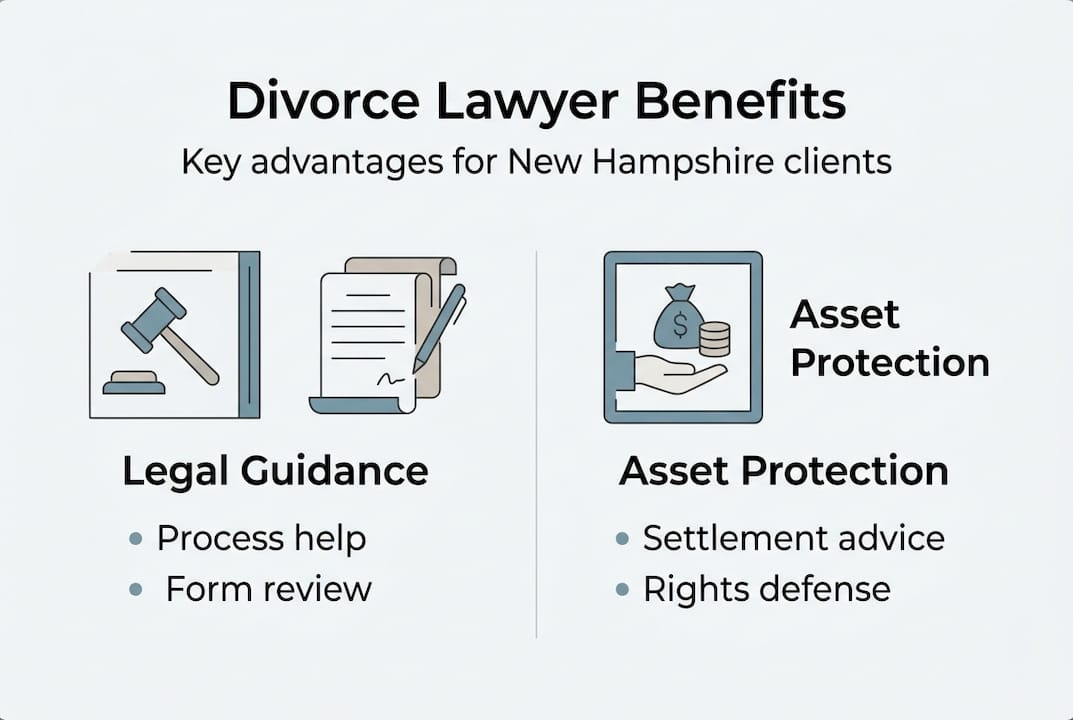
- Strategic negotiation: Lawyers understand leverage, legal precedent, and how to structure settlements that hold up over time
- Accurate court filings: Every document is prepared correctly, submitted on time, and compliant with New Hampshire procedural rules
- Asset identification and valuation: Attorneys work with financial experts to ensure all marital property is properly identified and fairly valued
- Parental rights protection: In custody matters, lawyers build a case that reflects your role as a parent and your child’s needs
- Preventing costly errors: A missed deadline or an improperly worded agreement can require expensive litigation to fix later
Consider a practical example. If you undervalue a retirement account during property division, you may walk away with tens of thousands of dollars less than you are legally entitled to. Equitable distribution considers marriage length, contributions, and fault, and without legal guidance, you may not know what you are entitled to claim.
Pro Tip: Seeking legal advice early, even before filing, is one of the most cost-effective steps you can take. Early guidance helps you avoid decisions that are expensive to unwind later, particularly around asset disclosure and temporary support arrangements.
For those navigating property and support issues, understanding the process of negotiating settlements can give you a clearer picture of what to expect and how to prepare.
Cost-effective strategies for hiring a divorce lawyer in New Hampshire
After seeing the benefits, it’s natural to wonder how to afford legal support. The good news is that full-scope representation is not your only option. Several approaches can give you professional legal oversight while keeping costs manageable.
A DIY uncontested divorce may cost as little as $300 to $500 in filing fees, but errors can lead to far higher long-term expenses. Contested divorces with full attorney representation average between $12,000 and $44,000 in New Hampshire. Limited-scope representation and mediation sit between these extremes and are worth serious consideration.
Your main options include:
- Full-scope representation: Your attorney handles everything from filing to final decree. Best for contested or complex cases.
- Limited-scope representation: You hire a lawyer for specific tasks only, such as reviewing documents or preparing for a hearing. Reduces cost while adding professional oversight.
- Flat-fee arrangements: Some attorneys offer fixed pricing for straightforward uncontested divorces. Predictable and budget-friendly.
- Mediation: A neutral third party helps both spouses reach agreement outside of court. Often faster and less expensive than litigation.
- Consultation-only services: A single meeting with an attorney to review your situation and documents can prevent major errors at minimal cost.
Choosing the right level of family law representation depends on the complexity of your case, the level of conflict between you and your spouse, and the assets or custody arrangements involved. Even a modest investment in legal guidance can prevent outcomes that cost far more to correct.
Get experienced divorce help in New Hampshire
Navigating a divorce in New Hampshire involves more than paperwork. It involves protecting your financial future, your parental rights, and your peace of mind during one of the most difficult transitions you may face. Working with experienced legal counsel means you have someone in your corner who understands the law, knows the local courts, and is focused entirely on your outcome.
The Naro Law team serves clients across New Hampshire with personalized, compassionate family law representation. Whether you are facing a contested divorce, a custody dispute, or simply need guidance on where to start, we are here to help. You can also explore family law case examples to better understand how cases like yours are handled, or connect directly with a Manchester family law attorney to schedule a free consultation. Taking that first step costs nothing and can make all the difference.
Frequently asked questions
Is hiring a divorce lawyer required in New Hampshire?
No, you are not legally required to hire a lawyer, but self-representation risks costly errors in paperwork, missed deadlines, and unfair settlements that are difficult to reverse.
What forms are mandatory for a New Hampshire divorce?
You must file a petition for divorce, a financial affidavit, a parenting plan if children are involved, and comply with Rule 1.25-A disclosures as required by New Hampshire courts.
How much does a divorce lawyer cost in New Hampshire?
Contested divorces with full representation average $12,000 to $44,000, while a DIY uncontested divorce may cost $300 to $500 in filing fees but carries significant legal risk.
How does fault affect divorce settlements in New Hampshire?
Although 90% of NH divorces are filed as no-fault, proven fault can still influence alimony awards and how marital property is distributed by the court.
Can I hire a lawyer just for part of my divorce case?
Yes. Limited-scope representation allows you to hire an attorney for specific tasks only, which reduces overall cost while still providing professional legal oversight where it matters most.


