

People seek legal separation primarily to remain legally married while gaining court-enforceable protections for finances, child custody, and support. The most common reasons include:
- Preserving health insurance under a spouse’s employer plan, which divorce typically ends
- Protecting Social Security spousal benefits, which require at least 10 years of marriage to qualify
- Avoiding divorce residency requirements in states like California, where separation has no waiting period but divorce requires six months
- Maintaining a trial period for reconciliation, since revoking a legal separation is far simpler than remarrying after divorce
- Honoring religious or moral beliefs that prohibit divorce while still establishing formal legal boundaries
- Protecting against joint debt incurred after the separation date, which many states treat as the non-responsible spouse’s liability
Legal separation is not an informal arrangement. It is a formal court process that produces binding orders nearly identical in enforceability to a divorce decree.
Why do couples choose legal separation over divorce?
The reasons for choosing legal separation over divorce are often practical, financial, and deeply personal. Understanding each one helps clarify whether this path fits your situation.

Health insurance and pension benefits. Divorce typically ends a spouse’s eligibility under the other’s employer health plan. Legal separation, because the marriage remains intact, often allows continued coverage. Pension survivor benefits work similarly: many plans terminate upon divorce but continue through separation. For a spouse who cannot obtain affordable independent coverage, this distinction can be significant.
Social Security and long-term marriages. Social Security spousal benefits require a marriage of at least 10 years. Couples approaching that threshold sometimes choose separation rather than divorce to preserve eligibility. Years spent legally separated count as years married for this purpose.
Military families face a specific version of this calculation. The 20/20/20 rule for VA benefits requires at least 20 years of marriage overlapping with 20 years of military service. Legal separation preserves that overlap; divorce forfeits lifetime VA healthcare and benefits permanently.
Residency requirements and timing. Some states impose waiting periods before a divorce can be filed. California requires a residency waiting period before divorce before a divorce petition, but legal separation has no such requirement. A spouse who needs immediate court orders for support or custody can file for separation first, then convert the petition to divorce once residency is met.
A structured trial period. Legal separation gives couples the space to live apart under clear legal rules while leaving the door open to reconciliation. Reversing a separation decree is procedurally straightforward. Reversing a divorce requires remarriage, a far more involved process.
Religious and moral convictions. For many people, divorce conflicts with deeply held beliefs. Legal separation offers a path that respects those convictions while still establishing enforceable rules about money, property, and parenting.
Financial protection from new debt. Many states treat debt incurred after the legal separation date as the sole responsibility of the spouse who took it on. A court-enforceable separation order can freeze joint accounts, clarify bill responsibilities, and shield one spouse from the other’s financial decisions going forward.
Children’s adjustment. A slower transition can ease the emotional impact on children. Legal separation allows parents to establish and test a parenting plan, covering school nights, holidays, and medical decisions, before committing to a final divorce arrangement.
How does legal separation differ from divorce legally?
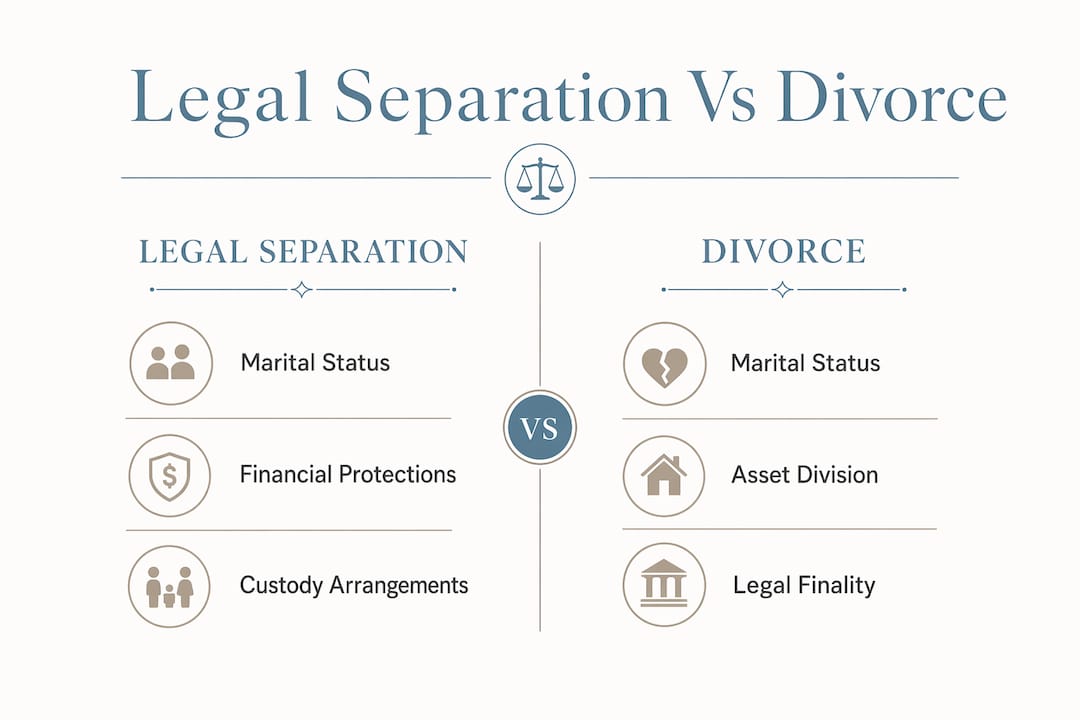
The core distinction is marital status. Legal separation leaves the marriage legally intact; divorce ends it. Both processes involve court orders on property, support, and custody, but the legal consequences diverge in several important ways.
| Feature | Legal separation | Divorce |
|---|---|---|
| Marital status | Remains married | Marriage legally ended |
| Ability to remarry | No | Yes |
| Health insurance eligibility | Often retained | Typically lost |
| Next-of-kin status | Retained | Lost |
| Social Security spousal benefits | Preserved | May be lost if under 10 years |
| Court enforceability | Yes, binding orders | Yes, binding orders |
| Reversibility | Revocable by agreement | Requires remarriage |
| State availability | Not available in all states | Available in all states |
Next-of-kin status deserves particular attention. A legally separated spouse retains the authority to make medical and financial decisions in an emergency. After divorce, that authority is gone. For couples who still trust each other despite living apart, this can matter enormously in a crisis.
State availability is also uneven. Delaware, Florida, Georgia, Mississippi, Pennsylvania, and Texas do not formally recognize legal separation. Residents of those states who want structured arrangements must pursue temporary court orders or separate maintenance actions instead. If you live in New Hampshire, the legal separation vs. divorce framework differs from states that do not recognize separation at all, so understanding your state’s specific rules is the necessary first step.
Separation agreements carry the same weight as divorce decrees once a court approves them. Violating a separation order can result in contempt of court, the same consequence as violating a divorce order.
What are the financial and custody implications of legal separation?
Financial and custody arrangements under legal separation closely mirror what a divorce court would order, with a few meaningful differences.
Health insurance. Legally separated couples often retain shared health coverage because the marriage continues. Every employer plan sets its own rules, so verifying the specific plan terms is necessary. Divorce almost always triggers a qualifying life event that removes the non-employee spouse from coverage.
Tax filing status. Legally separated spouses are still married in the eyes of the IRS, which affects filing options. Depending on income levels and deductions, filing jointly or separately as a married couple may produce different results than filing as a divorced individual. The U.S. Department of Labor notes that reviewing both retirement and health plan implications during separation is critical to protecting long-term financial stability.

Debt liability. Many states treat debt accumulated after the legal separation date as the sole obligation of the spouse who incurred it. This protection is not automatic everywhere, and long-term separation carries real risks: a less careful spouse can still damage joint credit scores, and estate complications arise if one spouse dies before a divorce is finalized.
Child custody and support. Separation agreements address custody, parenting time, and child support with the same specificity as divorce orders. Courts evaluate these arrangements using the best interests of the child standard, and a judge can modify any custody term if circumstances change. One practical advantage: parents can test a parenting plan during separation and adjust it before it becomes part of a final divorce decree.
Retirement accounts. Separation does not automatically divide retirement assets. A Qualified Domestic Relations Order (QDRO) is still required to divide most employer-sponsored plans, whether the couple separates or divorces. Understanding how retirement accounts are handled before signing any separation agreement prevents costly surprises later.
Pro Tip: If your marriage is approaching the 10-year mark, consult a family law attorney before filing for divorce. Waiting to cross that threshold could preserve Social Security and pension benefits under certain conditions.
Personal and social reasons that lead people to choose legal separation
Not every reason for choosing legal separation appears on a financial spreadsheet. Personal, social, and emotional factors often carry equal or greater weight.
Religious conviction is among the most common. For members of faith traditions that prohibit divorce, legal separation offers a way to establish independent living arrangements and legal protections without formally dissolving the marriage. The couple remains married under civil law and, in many traditions, under religious law as well.
Social considerations also play a role. Some people prefer to avoid the social weight that divorce carries within their family, community, or professional circle. Legal separation provides breathing room without requiring a public declaration that the marriage has ended. This can ease tension with extended family and give both spouses time to process the situation privately.
Emotional readiness matters too. Separation creates space for reflection, counseling, and honest assessment of whether divorce is truly the right outcome. The court-enforceable structure reduces daily conflict by setting clear rules on money and parenting, which stabilizes the household environment for children and adults alike.
Children benefit from the slower pace of transition that separation allows. Parents can establish routines, observe how children adjust, and refine parenting arrangements before those arrangements become permanent. That flexibility is harder to achieve once a divorce is finalized.
One caution applies across all these considerations: legal separation is not appropriate in situations involving domestic abuse. Because the marriage remains legally intact, an abusive spouse retains certain legal access and rights that a divorce would sever. Anyone in an unsafe relationship should explore protective legal options designed specifically for that situation rather than relying on separation alone.
What family law attorneys say about legal separation
Family law attorneys consistently emphasize one point that surprises many people: legal separation is not a softer or simpler version of divorce. It is a formal legal proceeding that produces binding court orders with the same enforceability as a divorce decree.
Legal separation is often misunderstood as an informal middle ground, but it carries the same legal weight as divorce in terms of court orders on finances, property, and custody. A well-drafted separation agreement can serve as a strategic foundation for an eventual divorce, potentially simplifying and improving the outcome of those proceedings. Attorneys also caution that separation agreements require both spouses to negotiate in good faith. A fairly negotiated agreement can pre-resolve the most contested issues before divorce proceedings begin, reducing both cost and conflict.
Attorneys also flag the risks of letting separation drag on indefinitely. Joint debt liability, shifting asset values, and estate complications all grow more complex the longer a separation extends without resolution. If one spouse’s financial situation improves significantly during a long separation, alimony calculations at eventual divorce may shift in ways neither party anticipated.
The strategic value of legal separation is real, but it depends on the specific facts of each marriage. State law, the length of the marriage, the presence of children, the nature of shared assets, and the relationship between the spouses all shape whether separation or immediate divorce better serves a person’s interests. An experienced family law attorney can assess those factors and help structure an agreement that protects both short-term needs and long-term goals. For anyone in New Hampshire weighing these options, Narolaw’s family law services provide the kind of personalized guidance this decision requires.
Key Takeaways
Legal separation preserves marital status and court-enforceable protections for finances, custody, and benefits without ending the marriage, making it a deliberate legal choice rather than a temporary workaround.
| Point | Details |
|---|---|
| Benefits preservation | Social Security spousal benefits require at least 10 years of marriage; separation keeps that clock running. |
| Court enforceability | Separation orders carry the same legal weight as divorce decrees for debt, custody, and support. |
| State availability | Delaware, Florida, Georgia, Mississippi, Pennsylvania, and Texas do not formally recognize legal separation. |
| Reversibility advantage | Revoking a legal separation is procedurally simpler than remarrying after divorce. |
| Domestic abuse exception | Legal separation is not appropriate in abusive relationships because marital ties preserve the abuser’s legal access. |


